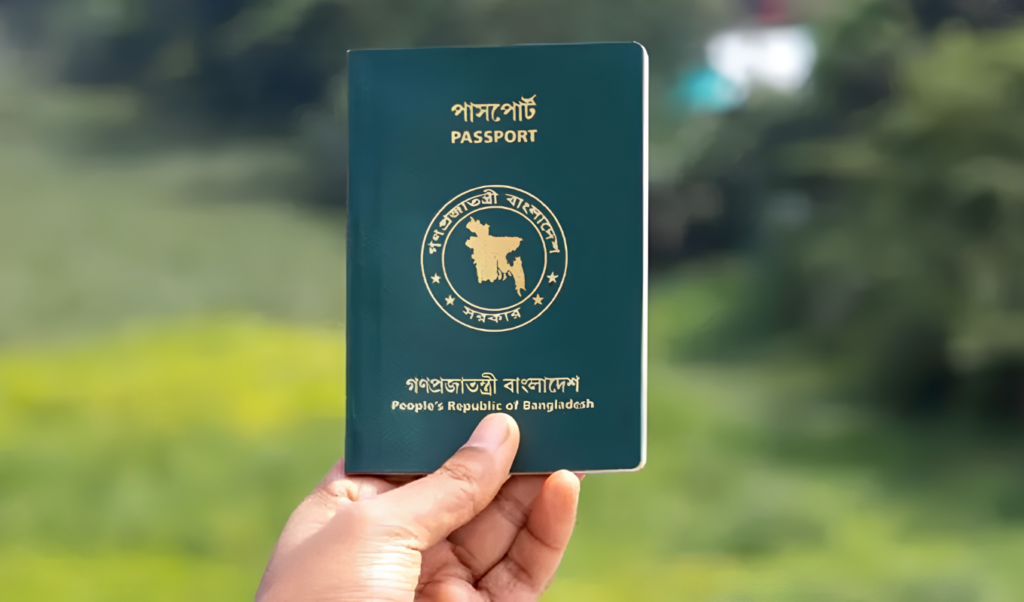
An investigation has uncovered a deeply entrenched institutional bribery syndicate operating within passport offices across Bangladesh. Driven by specialised personnel known as ‘channel masters’, this illicit system orchestrates the collection, accounting, and distribution of bribes. The network implicates individuals at every level—from office heads to low-ranking clerks—with allegations that monthly proceeds worth millions of BDT reach influential high-level circles, corrupt law enforcement members, and local political figures.
During a recent interrogation by the Anti-Corruption Commission (ACC), a Department of Immigration and Passports (DIP) official disclosed the inner workings of this internal corruption network. The official stated to investigators that halting this bribery system is exceptionally difficult because high-ranking department executives are directly involved. Furthermore, portions of the illicit funds are regularly distributed to certain corrupt officials within the Ministry of Home Affairs, rogue field-level intelligence operatives, and local leaders of the ruling political party.
The Role of the ‘Channel Master’ and Bribe Structures
The scale of bribery is directly determined by the volume of passport applications handled by a specific office; locations with higher application volumes generate significantly larger sums. According to investigative sources, at least 80% of all submissions are processed through these illicit channels, managed by brokers (dalals). For these specific applications, an additional ‘channel fee’ ranging from 1,500 BDT to 3,000 BDT is systematically extorted from applicants on top of the government-mandated fees.
To manage this workflow, almost every regional office designates a specific employee to count marked applications, collect the cash, and distribute the proceeds. This individual is referred to internally as the ‘channel master’. Typically, this role is assigned to staff holding the rank of accountant or Deputy Assistant Director (DAD).
Office Categorisation and Illicit Revenue Streams
The Department of Immigration and Passports operates approximately 69 regional offices nationwide. Based on the volume of daily applications received, these offices are officially divided into ‘A’, ‘B’, and ‘C’ categories. However, sources reveal that these classifications primarily serve as a blueprint for lucrative posting rackets, where officials pay significant bribes to secure transfers to high-revenue stations.
| Office Category | Total Offices | Daily Applications | Minimum Bribe per Application (BDT) | Estimated Monthly Illicit Income (BDT) |
| Category A (Highly Corrupt) | 33 | 200 – 250 (up to 1,500) | 1,500 – 3,000 | Up to 15 million (1.5 Crore) |
| Category B | 24 | 100 – 199 | 1,500 | 1.6 million – 3 million |
| Category C | 12 | Fewer than 100 | 1,500 | Minimum 2 million (20 Lakh) |
The financial logistics of the syndicate follow a simple mathematical model. In a standard ‘C’ category office receiving 100 applications daily, 80% arrive via brokers. At a minimum bribe of 1,500 BDT per application, this yields 120,000 BDT daily, amounting to 600,000 BDT over a five-day working week, and roughly 2 million BDT per month.
In contrast, premium ‘A’ category stations receiving between 1,000 and 1,500 applications daily generate immense revenues. Weekly collections in these offices frequently exceed 4 million BDT, culminating in monthly totals of approximately 15 million BDT (1.5 Crore). Beyond basic processing, the syndicate capitalises on ten distinct sectors, including data correction fees—where charges scale with the complexity of the error—and expedited delivery timelines.
Cash Delivery to Headquarters and Institutional Silence
The bribery network operates as an open secret within the passport department. Field officials regularly travel to the central passport headquarters in Agargaon, Dhaka, under the pretext of official meetings, to hand-deliver cash-filled packets directly to powerful directors and deputy directors. To ensure strict discretion, these envelopes are sometimes delivered directly to the officials’ private residences. Local political figures, rogue law enforcement personnel, and brokers posing as journalists from obscure publications also receive designated shares. Daily our representative reportedly holds audio recordings confirming these distribution methods.
When approached for comment regarding these systemic irregularities, institutional leaders maintained complete silence. Major General Nurul Anwar, Director General of the department, did not answer multiple telephone calls or respond to text messages seeking an official statement.
An anonymous official at the headquarters stated to our representative that while strict confidentiality is currently maintained in regional offices like Narsingdi, Sunamganj, Barishal, Patuakhali, Moulvibazar, Lakshmipur, Tangail, Chandpur, Jashore, and Satkhira, systemic corruption remains embedded. Observers note that administrative crackdowns on field-level bribes have failed to improve service quality; instead, they have severely increased public harassment. Experts argue that suppressing field bribes without eliminating the underlying lucrative transfer racket is ineffective, describing it as “cutting the roots of a tree while watering the branches.”
Intelligence Crackdowns and the Fate of the Syndicate
In 2019, the Directorate General of Forces Intelligence (DGFI) launched an operation to curb this rampant extortion. Several high-ranking passport officials were summoned to intelligence headquarters for rigorous interrogation. The resulting evidence, including video and audio confessions, was delivered via a special courier to the then-ACC Chairman, Iqbal Mahmood. The intelligence report officially blacklisted 25 top passport officials.
ACC investigation sources revealed that while formal charges were initially filed against several individuals on the list, political pressure stalled broader prosecution efforts. Consequently, multiple accused officials utilized influential connections to secure clean chits and liability exemptions from the ACC. Many have since returned to their previous roles.
A prominent example cited by a department official involves Deputy Director Bipul Kumar Goswami, who ranked fourth on the DGFI’s list of corrupt officials. Extremely influential during the Awami League administration, Goswami served in the administration wing for an extended period. Following an intervention by the former Home Minister, Asadduman Khan Kamal, he secured an exemption from the ACC. On 12 May, Goswami received a premium posting, being transferred to the Chandgaon regional office in Chattogram—historically recognised as one of the primary hubs for passport bribery.