In the global market, gold serves as far more than mere jewellery or a medium for private investment; this precious metal has evolved into a vital indicator of national economic security and geopolitical leverage. Driven by global economic uncertainties, the consistent expansion of central bank reserves, and a rising demand for safe-haven assets, the significance of gold continues to intensify daily. This trend was underscored in 2025 when global gold prices surged by over 70 per cent.
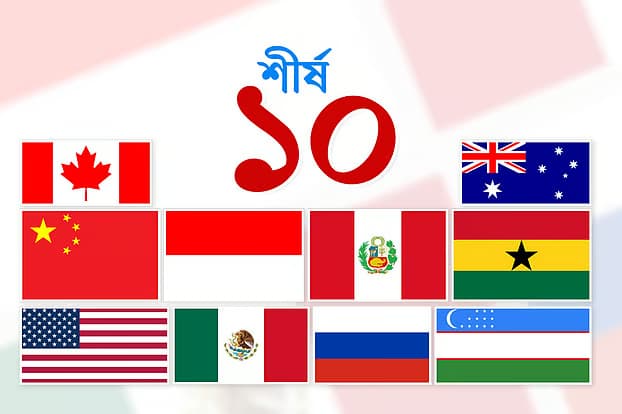
According to an analysis by Visual Capitalist, utilizing comprehensive data from the World Gold Council, global gold production remains heavily consolidated among a small group of influential nations. The ranking, compiled based on verified output data from 2024, reveals that China continues to dominate the global sector, followed closely by Russia, Australia, Canada, and the United States. Concurrently, several African nations—including Ghana, Mali, and South Africa—are rapidly solidifying their presence, contributing substantially to the total global output.
Global Gold Production Standings (2024 Data)
The table below outlines the precise production outputs and primary extraction zones of the world’s top 10 gold-producing nations:
| Rank | Country | Continent | 2024 Output (Tonnes) | Key Production Regions & Characteristics |
| 1 | China | Asia | 380.2 | Expansive refining capacity and state-backed operations |
| 2 | Russia | Europe/Asia | 330.0 | Siberia and the Far East regions |
| 3 | Australia | Oceania | 284.0 | Kalgoorlie and Western Australian mining hubs |
| 4 | Canada | North America | 202.1 | Ontario, Quebec, and British Columbia |
| 5 | United States | North America | 158.0 | Nevada, Alaska, and Colorado |
| 6 | Ghana | Africa | 140.6 | Leading producer in Africa; high foreign investment |
| 7 | Mexico | North America | 140.3 | Northern and Central mining corridors |
| 8 | Indonesia | Asia | 140.1 | Home to the massive Grasberg mine |
| 9 | Peru | South America | 136.9 | Andean mountain ranges |
| 10 | Uzbekistan | Asia | 129.1 | Muruntau mine; major foreign exchange generator |
Detailed Market Profiles of Leading Producers
1. China (380.2 Tonnes)
Maintaining its undisputed position at the pinnacle of global production for well over a decade, China produced 380.2 tonnes of gold in 2024. Supported by an extensive domestic mining infrastructure, substantial state support, and sophisticated refining capabilities, Beijing retains immense influence over the international sector. Beyond its status as the leading producer, China is also one of the world’s largest consumers, driven by domestic jewellery manufacturing, aggressive central bank accumulations, and investment demand.
2. Russia (330.0 Tonnes)
Despite enduring stringent Western economic sanctions and heightened geopolitical tensions, Russia has successfully sustained its operational capacity, securing the second position globally with an output of 330 tonnes. Its primary extraction networks are situated across the vast expanses of Siberia and the Far East. In recent years, Moscow has prioritised gold as a strategic reserve asset, turning the metal into a cornerstone of its economic security framework to withstand pressures within the international financial architecture.
3. Australia (284.0 Tonnes)
Ranking third globally, Australia’s extraction sector is heavily anchored in Western Australia, particularly around the prominent Kalgoorlie region. Mineral commodities remain the bedrock of the Australian economy. Backed by extensive natural reserves, technologically advanced management systems, and a highly stable regulatory framework, Australia commands a premium position in the global industry, exporting significant volumes to major Asian markets, including China.
4. Canada (202.1 Tonnes)
Canada occupies the fourth spot, with its primary operations concentrated across Ontario, Quebec, and British Columbia. Over the past decade, Canadian gold production has expanded notably. This growth is directly attributed to the deployment of advanced technologies, adherence to stringent environmental standards, and the maintenance of an investor-friendly economic environment, making it a dominant force in North American mining.
5. United States (158.0 Tonnes)
The United States holds the fifth position globally, drawing its primary supply from operations in Nevada, Alaska, and Colorado. Although the nation remains a formidable player in the international arena, its domestic production has faced downward pressure in recent years. This decline is largely due to escalating environmental regulations, rising operational and extraction costs, and the closure of several mature, large-scale mining facilities.
6. Ghana (140.6 Tonnes)
As Africa’s leading gold producer, Ghana ranks sixth on the global stage. Gold exports serve as the primary source of foreign exchange for the nation. Over the last ten years, substantial capital injections from international mining conglomerates have rapidly accelerated Ghana’s national output. However, the country faces ongoing challenges regarding the regulation of illicit mining activities and the mitigation of associated environmental degradation.
7. Mexico (140.3 Tonnes)
With a mining heritage stretching back centuries, Mexico ranks seventh globally. The nation is a major producer of both silver and gold, with its primary extraction operations situated across northern and central territories. While abundant mineral wealth and steady foreign direct investment have fortified the industry, security challenges and the presence of organized crime groups present persistent operational risks in certain mining regions.
8. Indonesia (140.1 Tonnes)
Indonesia is Asia’s second-largest gold producer after China. The massive Grasberg mine functions as the country’s primary operational asset, yielding vast quantities of both copper and gold. While Indonesia’s prominence as a Southeast Asian mining hub is growing, the sector faces scrutiny regarding environmental degradation, deforestation, and unresolved disputes surrounding the rights of local indigenous communities.
9. Peru (136.9 Tonnes)
Peru remains one of Latin America’s most vital mineral-driven economies, with its major operations nestled within the Andean mountain ranges. While gold exports act as a critical engine for national economic growth, the industry is frequently subjected to operational strain caused by domestic political instability, social unrest among local populations, and environmental disputes.
10. Uzbekistan (129.1 Tonnes)
Completing the global top ten, Uzbekistan relies heavily on its famed Muruntau facility, which is globally recognized as one of the largest open-pit gold mines in existence. Gold exports generate a vast share of foreign currency revenue for Tashkent. In recent years, the government has actively modernized its extraction frameworks and revised policies to attract foreign investment, steadily elevating Uzbekistan’s strategic importance in the international gold market.