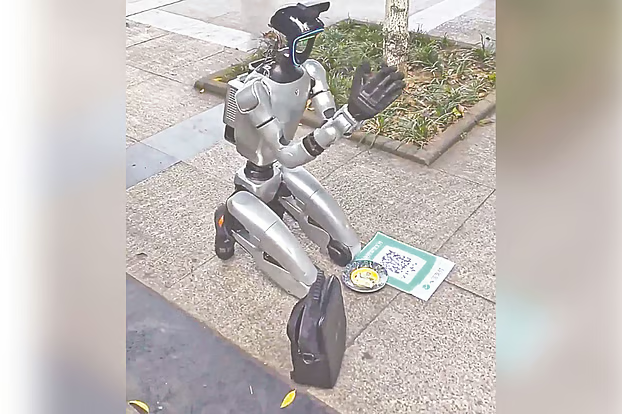
A striking scene from China’s Sichuan Province has sparked widespread discussion across social media platforms, where a humanoid robot was seen apparently begging for money on a public pavement. The unusual spectacle has drawn amusement, curiosity and debate, with many users questioning whether the incident was a genuine plea for assistance or a creative publicity stunt.
According to videos circulating online, the humanoid robot was positioned on one knee beside a busy walkway, repeatedly bowing its head and joining its hands in a gesture resembling a request for help. In front of the machine sat a small dish containing several coins, while a QR code was displayed nearby, allowing passers-by to make digital donations.
Adding to the surreal nature of the scene, the robot’s LED display and loudspeaker continuously broadcast a message asking for financial support. The announcement reportedly stated that the robot lacked funds for recharging and needed assistance to pay its electricity bill.
Several media reports have identified the machine as the Unitree G1, a humanoid robot developed by the Chinese robotics company Unitree. The model has previously attracted international attention for demonstrating advanced mobility and balance capabilities. Earlier this year, a Unitree G1 robot made headlines after successfully climbing Ecuador’s Chimborazo Volcano, showcasing the growing sophistication of modern humanoid robotics.
The latest footage, however, has presented the technology in a far more light-hearted context. Social media users have responded with a mixture of humour and scepticism. Some joked that robots are already replacing people in various jobs and may now be competing with human beggars as well. Others sarcastically remarked that rather than taking over the world, artificial intelligence appears to be struggling to afford its own electricity costs.
Not everyone is convinced that the robot was genuinely collecting money. Many observers believe the performance may have been part of a marketing campaign, an artistic street exhibition, or a promotional event designed to attract attention and encourage public interaction with emerging technologies.
Reports suggest that this is not an isolated incident. Information published by Hong Kong-based media outlet HK01 indicates that similar “begging robots” have recently been spotted in several Chinese cities, including Beijing, Chengdu and Fuzhou. These appearances have fuelled speculation that the phenomenon may be part of a broader trend rather than a spontaneous event.
As digital payments become increasingly common and robots become more visible in everyday life, scenes such as this blur the line between technology, entertainment and social commentary. Whether viewed as clever marketing, public art or a glimpse into the future, the image of a humanoid robot seeking donations through a QR code offers a memorable snapshot of a rapidly evolving technological age.