Rajshahi University, the historic vanguard of higher education and democratic activism in northern Bangladesh, has celebrated its 72nd founding anniversary, marking its official transition into its 73rd year. The milestone has prompted widespread reflection from academics, current students, and its global alumni network, who view the institution as a foundational pillar of the nation’s intellectual and political identity.
For the university’s expansive community, the milestone transcends a standard institutional anniversary. Prominent alumni—including ABM Zakirul Haque Titon, the editor and publisher of Khaborwala and G-Live, who formerly served as the elected magazine editor of the Rajshahi University Central Students’ Union (RAKSU)—have expressed profound gratitude for the campus’s role in fostering leadership, political consciousness, and social responsibility.
The Historic Quest for Northern Education
The genesis of Rajshahi University lies in a protracted public movement aimed at addressing the severe educational disparity in the northern region of Bengal. Although postgraduate and legal studies had been introduced at Rajshahi College as early as 1873, these vital programmes were subsequently abolished. Following the 1947 partition of the subcontinent, the demand for an independent, fully-fledged university in East Bengal’s northern territory became a crucial socio-political objective.
On 15 November 1950, a dedicated 64-member struggle committee consisting of pioneering educationists, statesmen, and local dignitaries was formed to lobby for the cause. The movement reached a critical crescendo during the Language Movement of 1952. Student demonstrations at Rajshahi College on 6 February 1952, followed by massive public rallies on 10 and 13 February, successfully galvanised public sentiment into an unstoppable civic campaign.
Despite the targeted imprisonment of 15 prominent student leaders by the state authorities, the government eventually capitulated to public demand. The Rajshahi University Act was formally passed on 31 March 1953. The institution officially commenced its academic operations on 6 July 1953, under the stewardship of its inaugural Vice-Chancellor, the distinguished scholar Professor Itrat Husain Zuberi.
Architectural Legacy of the Motihar Campus
Initially, the university’s academic and administrative functions were scattered across temporary urban sites, including Rajshahi College, Bara Kuthi, Lal Kuthi, and Fuller Hostel.
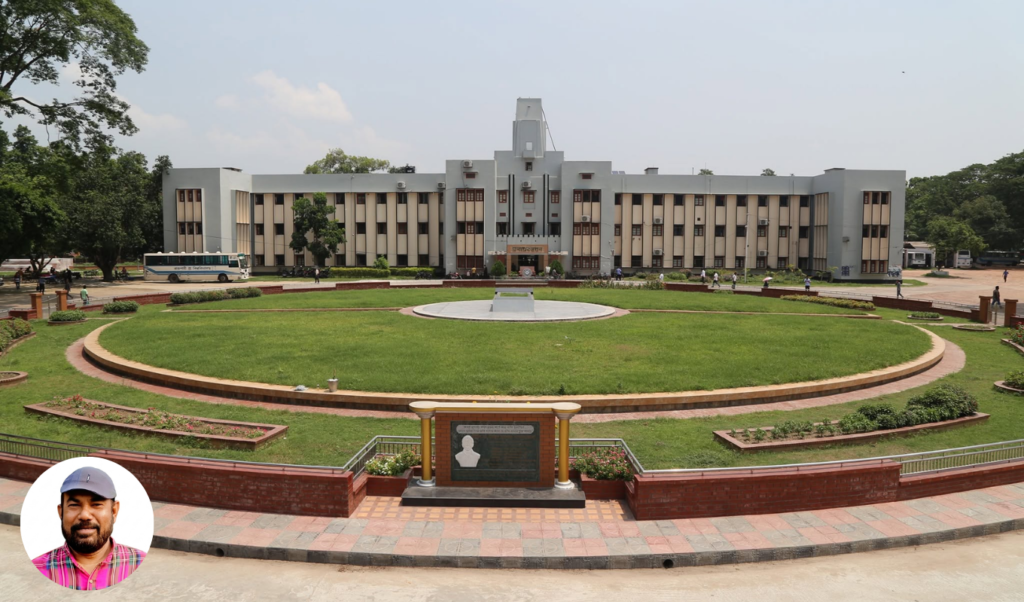
This fragmented arrangement changed with the acquisition of the scenic Motihar estate near the banks of the Padma River. Designed by the celebrated Australian architect Dr Swaney Thomas, the campus was meticulously planned during the mid-1960s to integrate modernist architecture with the region’s natural landscape. Today, the Motihar campus is nationally renowned for its expansive green canopies, aesthetic symmetry, and an atmosphere uniquely suited to independent thought and scientific inquiry.
A Citadel of Democratic Sacrifice
The legacy of Rajshahi University is uniquely defined by its historic role in national resistance, democratic movements, and the struggle for Bangladeshi independence.
During the 1969 Mass Uprising against autocratic Pakistani rule, the university’s Proctor, Dr Mohammad Shamsuzzoha, sacrificed his life to protect protesting students from military gunfire. Dr Zoha’s martyrdom stands as a monumental event in global academic history, representing the first instance of a university professor dying in defense of his students. His death injected critical momentum into the pre-independence movement.
The institution paid an even heavier price during the 1971 Liberation War, when occupation forces systematically targeted and executed numerous intellectuals, staff, and students. Prominent among the martyrs were Professor Habibur Rahman, Sukhranjan Samaddar, and Mir Abdul Kayyum.
In the post-independence era, the campus remained an active front against autocracy and extremism. On 22 December 1984, during anti-authoritarian protests, student leader Shajahan Siraj and a local civilian, Abdul Aziz, were fatally shot, while future political leader and former RAKSU Vice-President Ruhul Kabir Rizvi sustained critical injuries. The campus similarly resisted religious fundamentalism in subsequent decades, witnessing the loss of student activists such as Yassir Ahmed Pitu.
Charting the Path Forward
As Rajshahi University enters its 73rd year, its collective leadership and alumni emphasise the need to translate this rich historical legacy into future academic excellence. Stakeholders argue that the institution must transcend contemporary challenges—including partisan polarization, administrative corruption, and campus instability—to firmly establish itself as a modern, world-class centre for research, ethical governance, and progressive humanitarian values.
Author:
ABM Zakirul Haque Titon
Editor and Publisher, Khoborwala, G-Live
Former Newspaper Editor, RAKSU.