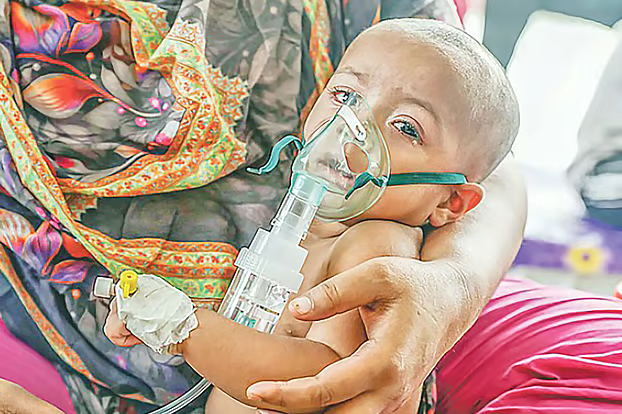
A mother wanted nothing more than to take her five-month-old son home in her arms. She did return home, but carrying his lifeless body instead.
“I wanted to hold my baby and take him home,” cried Amena Begum after losing her son, Mohammad Takrim. “I never brought him here like this. How can I take him back like this? My son will never come back to me. Why didn’t Allah show mercy? Why did my child leave before me? Forgive me, my son, for all the pain you suffered.”
Takrim died on 6 May at a private hospital in Dhaka after battling measles and related complications for more than a month. His parents had sought treatment at Bhola Sadar Hospital, a private clinic in their hometown, and later at Shaheed Suhrawardy Medical College Hospital in the capital. As his condition deteriorated, doctors recommended admission to a Paediatric Intensive Care Unit (PICU). With no PICU bed available at the government hospital, he was transferred to another medical facility, where he eventually died.
Takrim’s story is not an isolated tragedy. It represents a much larger public health crisis unfolding across Bangladesh.
Between 15 March and 10 July, more than 750 children died from measles and its complications within just 117 days. The disease, once considered largely under control through routine immunisation, has returned with devastating consequences. Public health specialists argue that such a death toll is extraordinary, particularly more than two months after a nationwide measles-rubella vaccination campaign. They believe significant shortcomings in vaccine coverage left millions of children vulnerable.
The figures suggest that approximately four million eligible children were not vaccinated during the recent campaign, leaving a substantial immunity gap.
These deaths raise uncomfortable but unavoidable questions. If administrative action can be taken when a handful of preventable deaths occur in a single hospital, should hundreds of preventable child deaths linked to broader policy failures not warrant an equally rigorous national investigation?
Bangladesh’s success in immunisation was once regarded as a model for many developing nations. Through its Expanded Programme on Immunisation (EPI), the country achieved remarkable progress in reducing vaccine-preventable diseases.
According to the World Health Organization, Bangladesh’s national measles vaccination campaign in 2006 successfully vaccinated its target population of 34.2 million children aged between nine months and ten years, achieving 100 per cent coverage. A follow-up campaign in 2010 reached its entire target of 18.1 million children aged between nine months and five years. In 2014, the nationwide measles-rubella campaign exceeded its original target by vaccinating more than 52.7 million children aged between nine months and fifteen years.
For years afterwards, official vaccination coverage remained close to or above 100 per cent.
That record changed dramatically in 2025.
Official data showed routine measles vaccination coverage collapsing to just 59 per cent, accompanied by vaccine shortages reported across different parts of the country. Health experts believe this sharp decline laid the foundation for the current outbreak.
Representatives from UNICEF had repeatedly warned government authorities that proposed changes to vaccine procurement procedures could delay vaccine supplies and increase the risk of disease outbreaks. Officials reportedly expressed these concerns through multiple meetings and formal letters, cautioning that interruptions in vaccine availability could result in preventable illness and child deaths.
Those warnings, analysts argue, were not adequately acted upon.
The resurgence of measles did not emerge without warning. Early cases appeared at the beginning of the year, but surveillance, outbreak response and emergency vaccination efforts failed to keep pace with the rapidly increasing transmission.
Although the current government later introduced a nationwide measles-rubella immunisation campaign, coverage remained incomplete. Approximately 18.48 million children aged between six and 59 months received the vaccine. Yet more than 22.3 million children participated in the national Vitamin A Plus Campaign conducted on 28 June, suggesting that around four million eligible children were still missed during measles vaccination.
This disparity indicates that a large number of children remain susceptible to infection.
Even more concerning is that, despite the emergency vaccination campaign, around a thousand new infections continue to be identified each day, while child deaths have not been completely eliminated. Public health experts warn that vaccination campaigns require consistently high coverage to establish herd immunity. When substantial numbers of children remain unvaccinated, outbreaks can continue to spread rapidly.
Bangladesh has never previously experienced a measles outbreak on this scale in recent decades. During the past 25 years, annual infections had never exceeded 50,000. The previous highest recorded number of confirmed cases occurred in 2005, when 25,934 infections were documented. Thereafter, cases declined sharply. Only 132 cases were recorded in 2025, while annual totals between 2020 and 2024 remained relatively low. Importantly, no measles-related deaths were reported during those years.
Against that background, the current mortality figures represent an unprecedented reversal of Bangladesh’s earlier public health achievements.
The tragedy has also revived a broader debate about governmental responsibility. The nineteenth-century thinker Friedrich Engels described the concept of “social murder” to explain circumstances in which preventable deaths occur because authorities fail to take measures they know could save lives. Applied to modern public health, the concept raises a difficult ethical question: when safe, effective vaccines exist, warnings have been issued, and preventable deaths still occur because of failures in policy or implementation, should those deaths be regarded merely as unfortunate medical outcomes?
Many health experts argue that these questions deserve careful and independent examination rather than political blame.
The public also deserves clear answers. Why did routine vaccination coverage collapse? Why were vaccine supplies delayed? Why were repeated warnings not acted upon more decisively? Why were millions of children left outside the immunisation programme?
Equally significant are concerns over transparency. Following criticism of declining vaccination rates during the previous administration, reports indicate that some official vaccination data were later removed from government websites, raising further questions about public accountability.
More than 750 children have already lost their lives. Each represented a family shattered, a future erased and a preventable tragedy. Beyond the statistics lies a national responsibility to establish what went wrong, ensure accountability where failures occurred and restore confidence in one of Bangladesh’s most celebrated public health successes before more children pay the ultimate price.