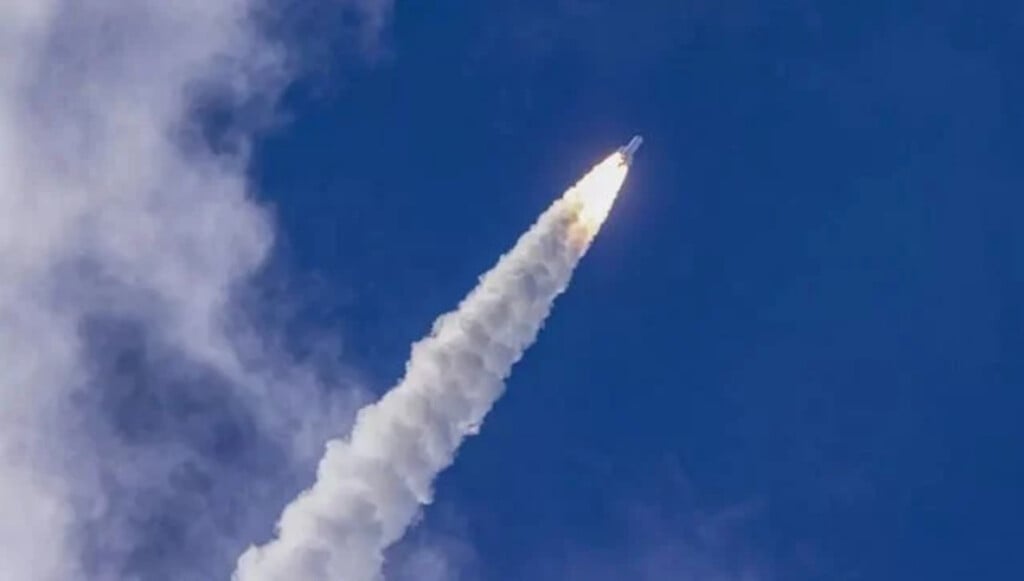
KOUROU, March 3, 2025 (BSS/AFP) – Europe’s new heavy-lift rocket, Ariane 6, is set to carry out its first commercial mission today, as European nations aim to secure independent access to space amid a surprising thaw in relations between Moscow and Washington.
This high-profile launch comes at a time when French President Emmanuel Macron is advocating for Europe to reduce its security dependence on the United States, while the European space industry faces growing competition from Elon Musk’s SpaceX.
After several delays, the Ariane 6 rocket is now scheduled to lift off from the Kourou spaceport in French Guiana at 13:24 local time (16:24 GMT). The mission will see the launch of a French military satellite, which will be positioned in orbit at an altitude of approximately 800 kilometres (500 miles).
The CSO-3 satellite is expected to enhance France’s military autonomy and bolster its intelligence capabilities.
Europe lost access to Russia’s Soyuz rocket for satellite launches following the Russian invasion of Ukraine in 2022, and the Ariane 5 was retired in 2023.
David Cavailloles, CEO of French aerospace company Arianespace, remarked in February: “The whole world is watching us.”
‘Sovereign Manner’
Originally slated for December, the mission has been delayed twice, first to February 26 and now to March 3, due to logistical issues involving the satellite’s transport to the launchpad in Kourou, according to Arianespace.
This will be the second launch for the Ariane 6 rocket, following its inaugural flight last July.
The CSO-3 satellite will complete a network of three French military imaging satellites, with the first two having been launched in 2018 and 2020 aboard Soyuz rockets.
General Philippe Steininger, a consultant for the French Space Agency (CNES), told AFP: “It’s always better to have your own launcher and to fire it from home.”
Given the military nature of the satellite, tight security measures are in place at the spaceport on the northern coast of South America, with three Rafale fighter jets patrolling the skies above.
“The satellite has to be protected,” said Carine Leveau, CNES Director of Space Transport. “It has special instruments that must not be seen by just anybody.”
The CSO-3 satellite will provide the French military with high-resolution images, enabling them to produce accurate military maps through 3D imaging. Steininger emphasised, “It is very important for the armed forces to conduct their operations and for our political authorities to make decisions in a completely sovereign manner, with first-hand information that does not depend on anyone else.”
‘Autonomous Access to Space’
Europe’s other launcher, Vega-C, resumed flights only in December 2024 after a two-year hiatus following an accident that resulted in the loss of two satellites. This setback left Europe without spacecraft for satellite launches for an entire year, further exacerbated by the delays to the Ariane 6 rocket and a breakdown in cooperation with Russia.
Lionel Suchet, acting head of CNES, told AFP: “It was very important for France and for Europe to regain this autonomous access to space because we cannot have a space policy today without having the means to send our satellites into space independently.”
He added, “What counts in these cases is to be sure that everything is secure. Like all launches, it is a risky launch.”
Some of the images taken by the CSO-3 satellite will be shared with Germany, Belgium, and Sweden, strengthening the collaborative space efforts across Europe.
Context:
The Ariane 6 launch reflects Europe’s broader effort to strengthen its space capabilities and reduce reliance on external powers for crucial technology. With growing geopolitical tensions, especially in the context of the war in Ukraine, having autonomous access to space has become a priority. The European Space Agency, along with national space agencies like CNES, continues to focus on developing reliable space infrastructure to maintain its competitive edge and safeguard its strategic interests.