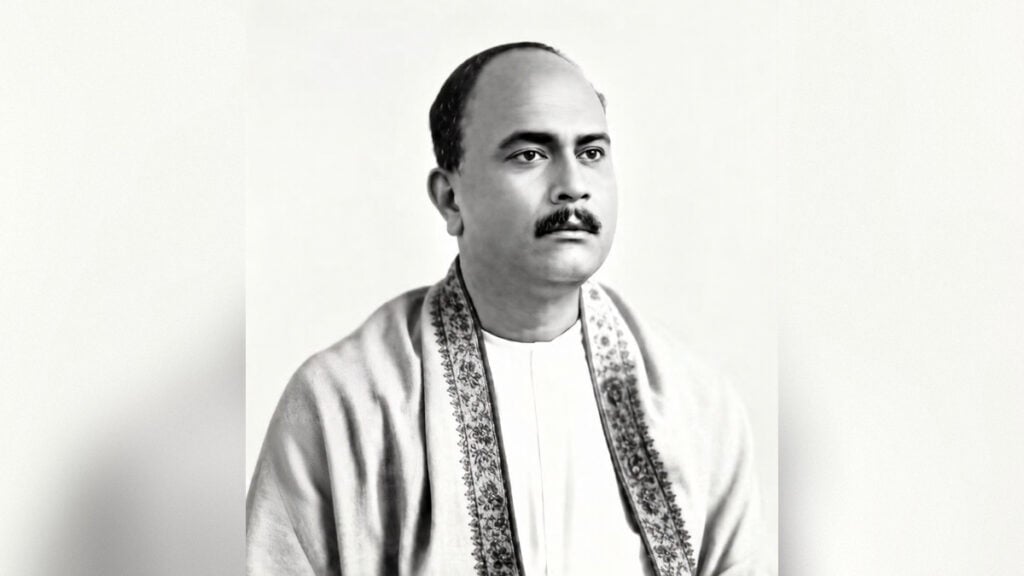
“Our pride, our hope—ah, how I love the Bengali language.” These immortal words capture the deep affection that poet, lyricist, composer and singer Atul Prasad Sen held for his mother tongue. Decades after his death, his songs continue to occupy a distinctive place in Bengali cultural life, carrying themes of patriotism, devotion, love, longing and emotional introspection.
For generations of Bengalis, his celebrated song Moder Gorob, Moder Asha has been closely associated with the love of language and cultural identity. Its enduring appeal lies not simply in its melody, but in the sense of dignity and belonging expressed through its words. The song evokes the emotional bond between a people and the language through which they express their history, memories and aspirations.
Atul Prasad Sen was born on 20 October 1871 at his maternal grandparents’ home in Dhaka. His ancestral paternal home was in Magar village of Naria in present-day Shariatpur. He lost his father at a very young age and was subsequently brought up under the care and guidance of his maternal grandfather, Kali Narayan Gupta. It was during these formative years that he received his early exposure to music and devotional songs.
After passing the Entrance Examination in 1890, Atul Prasad studied for a time at Presidency College in Calcutta. He later travelled to London to study law. Although his professional life was closely associated with legal practice, literature and music remained central to his intellectual and emotional world.
Atul Prasad is regarded as one of the five major architects of modern Bengali song. His contribution was particularly significant in introducing the influence of the thumri tradition into Bengali music and in developing Bengali ghazal. At a time when Rabindranath Tagore’s immense musical and literary influence dominated Bengali cultural life, Atul Prasad succeeded in developing a musical identity of his own.
His compositions are generally grouped into three broad categories: patriotic songs, devotional songs and songs of love. Yet these divisions do not fully capture the emotional range of his work. Personal sorrow, loneliness and longing frequently run beneath his compositions, giving many of them a distinctly poignant quality.
His songs often convey melancholy, but that melancholy assumes different forms. At times it reflects romantic separation; elsewhere it emerges through spiritual devotion or an intense attachment to the motherland and mother tongue. This emotional depth helped distinguish his compositions from many other works of his era.
In terms of quantity, Atul Prasad’s musical output was relatively modest. He composed around 206 songs, of which roughly 50 to 60 achieved particular popularity and became established as widely performed pieces. Yet the lasting importance of his music cannot be measured by numbers alone. The combination of lyrical sensitivity, melodic beauty and individuality gave his compositions a permanent place in Bengali musical heritage.
His contribution extended beyond music. Atul Prasad was one of the principal figures involved in establishing the Prabasi Banga-Sahitya Sammelan, an important platform for Bengali literary and cultural activity outside Bengal. He also served as one of the editors of its journal, Uttara. He presided over the Sammelan’s sessions in Kanpur and Gorakhpur, reflecting his wider engagement with Bengali literature and cultural affairs.
His public life also reflected a strong sense of social responsibility. Although he was not a full-time political activist, he supported the Congress in his early years and later moved towards liberal political thinking. His more enduring legacy, however, was shaped by his commitment to culture, education and public welfare.
Atul Prasad devoted a considerable portion of his earnings to charitable and community causes. He reportedly donated his residence and the rights to his literary works to institutions engaged in public welfare. Such decisions reflected an outlook in which personal wealth was regarded less as an end in itself than as a means of serving society.
Atul Prasad Sen died on 26 August 1934. He was later laid to rest beside the Brahma Temple at Kaoraid in the present-day Sreepur area of Gazipur. His death marked the passing of a major figure whose work had already become deeply woven into Bengali cultural consciousness.
His legacy, however, did not end with his death. His songs continued to be performed and remembered because they speak to emotions that remain familiar across generations. The affection for one’s mother tongue, the pain of separation, the search for spiritual solace and the love of one’s homeland are themes that transcend the circumstances in which a song was originally written.
Atul Prasad’s particular achievement was to bring these emotions together in a musical language that was recognisably his own. His compositions demonstrated that Bengali music could absorb influences from other traditions while retaining its linguistic and cultural character.
On the anniversary of his death, Atul Prasad Sen is therefore remembered not merely as a singer or composer, but as one of the cultural figures who helped broaden the expressive possibilities of Bengali music. His work connected language, melody and emotion in ways that continue to resonate with listeners.
His famous declaration of love for Bengali remains especially powerful:
“Our pride, our hope—
Ah, how I love the Bengali language;
In your embrace, in your words,
How much peace and love we find.”
Atul Prasad Sen is no longer here, but his songs remain. His melodies continue to carry the tenderness, sorrow and pride that defined his artistic world. As long as Bengalis cherish their language and cultural heritage, his music is likely to remain an enduring part of that collective memory.
On his death anniversary, the contribution of this remarkable artist deserves to be remembered with respect—not only for the songs he created, but also for the cultural identity and emotional richness he helped give to Bengali music.