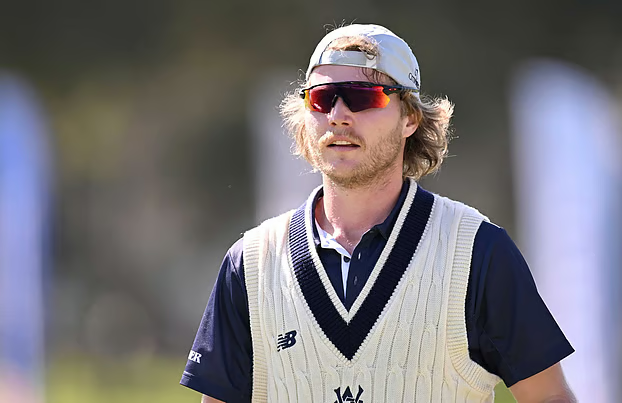
Will Pucovski, whose promising cricket career was cut short by repeated head injuries, has taken legal action against his former school a decade after a pivotal incident that he claims derailed his life.
The twenty-six-year-old former Test batsman has filed a lawsuit against Brighton Grammar School, an independent establishment located in a Melbourne suburb where he was a student. The legal proceedings stem from a severe concussion he suffered during a school football training session in 2014, when a teammate’s knee accidentally struck him in the head, causing him to lose consciousness. Pucovski alleges that the institution failed to implement appropriate medical protocols following the trauma, instead allowing him to resume training prematurely.
Reflecting on the episode at a Lords Taverners event earlier this year, Pucovski recounted how he was initially led to the sideline before being asked by a coach if he wished to continue. Agreeing to do so, he spent the remainder of the day participating in practice. He later described that juncture as a profound turning point, noting that he never felt the same afterwards, transitioning from an energetic youth to someone who spent long periods confined to a sofa.
That initial trauma set off a cascade of similar injuries. Over the course of his athletic journey, Pucovski accumulated a total of thirteen diagnosed concussions. Following his schooling, he pursued a professional cricket career, culminating in a Test debut for Australia against India in 2021. However, his progress was repeatedly interrupted by health setbacks, including a leave of absence for mental health reasons in 2018.
The situation came to a head in March 2024 during a Sheffield Shield fixture, when a delivery from Tasmanian fast bowler Riley Meredith struck him on the helmet. Following that incident, an independent medical panel strongly advised him to step away from the sport. He officially announced his retirement later that year at the age of twenty-six, describing a harrowing recovery period where even basic household navigation proved arduous and fatigue dominated his daily life.
This legal challenge highlights the evolving conversation surrounding head trauma in youth sport. Medical authorities, including the International Concussion Society, have long emphasised that adolescent brains are still developing, making prompt identification and conservative management critical to avoiding long-term cognitive damage.
While sporting governing bodies have introduced robust safeguards in recent years—such as the International Cricket Council introducing concussion substitutes in 2019 following incidents like Steve Smith being struck during the Ashes—Pucovski’s case serves as a stark reminder of the enduring legacy left by past institutional oversight.