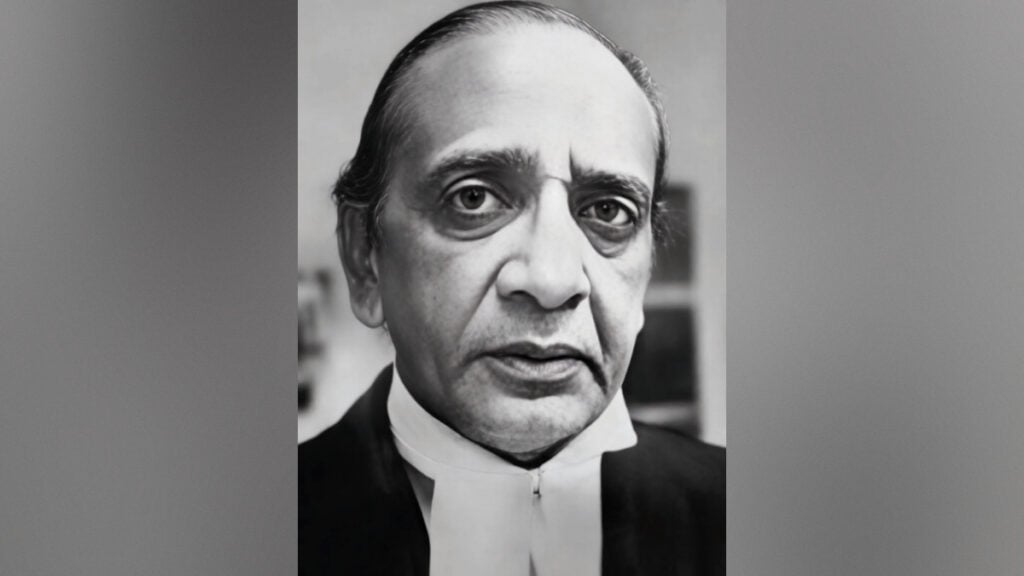
History is rarely a simple account of heroes and victories. Political history, in particular, contains figures whose careers remain deeply contested, shaped by decisions that continue to provoke debate long after their deaths. Shah Azizur Rahman was one such figure in Bangladesh.
A skilled parliamentarian, accomplished orator and linguist, Shah Azizur Rahman occupied some of the highest positions in the politics of independent Bangladesh. Yet his political legacy remains inseparable from his stance during the Liberation War of 1971, when he supported the unity of Pakistan and opposed Bangladesh’s independence movement.
His career therefore presents one of the more striking contradictions in Bangladesh’s political history: a man who opposed the country’s emergence as an independent state later became its prime minister.
Early life and political career
Shah Azizur Rahman was born on 23 November 1925 in Kushtia. He became involved in politics during his student years, taking part in the anti-British movement and subsequently becoming active in the Muslim League’s campaign for the creation of Pakistan.
He also served as general secretary of the All-Bengal Muslim Students League, establishing himself as a prominent young political organiser.
Following the creation of Pakistan in 1947, Shah Aziz continued his political career in East Pakistan. He remained committed to the Pakistani state structure and opposed the political position of Sheikh Mujibur Rahman on the question of greater autonomy for East Pakistan.
His political trajectory was consequently closely linked to the political developments that eventually culminated in the Liberation War.
His role during the Liberation War
The most controversial chapter of Shah Azizur Rahman’s career came in 1971.
As the independence movement gathered momentum and armed conflict broke out between the Pakistani military and Bengali forces, Shah Azizur Rahman took a position in favour of Pakistan’s territorial integrity. He opposed the establishment of an independent Bangladesh.
In November 1971, he led Pakistan’s delegation to the United Nations. There, he presented the Bangladesh independence struggle as an internal matter of Pakistan and rejected allegations concerning atrocities committed by Pakistani forces. He also appealed to Muslim-majority countries not to recognise Bangladesh.
His position placed him firmly on the opposite side of the independence movement at a defining moment in the country’s history.
For Bangladesh, where millions of people were engaged in the struggle for independence, his actions during the war became a central element of the controversy surrounding his political legacy.
Arrest after independence
Following Pakistan’s defeat and the emergence of Bangladesh as an independent country in December 1971, Shah Azizur Rahman was arrested and detained under legislation concerning collaborators.
He was later released in 1973 under the general amnesty announced by the government of Sheikh Mujibur Rahman.
The political circumstances of Bangladesh changed dramatically in the years that followed. The assassination of Sheikh Mujibur Rahman on 15 August 1975 brought a major transformation in the country’s political order, creating new opportunities for several politicians who had been marginalised after independence.
Shah Azizur Rahman gradually returned to active politics. In 1976, he assumed an important role in the revived Muslim League and subsequently entered the political sphere associated with President Ziaur Rahman.
Rise within the BNP
When the Bangladesh Nationalist Party, or BNP, was established under Ziaur Rahman in 1978, Shah Azizur Rahman became one of its senior figures.
He served as the party’s senior vice-president and held ministerial responsibilities in Ziaur Rahman’s government, including the portfolios of labour and industry.
In the 1979 general election, he was elected to parliament from the Kushtia-3 constituency as a BNP candidate.
His political career reached its highest point shortly afterwards.
Becoming prime minister
On 15 April 1979, Shah Azizur Rahman became Prime Minister of Bangladesh under President Ziaur Rahman. He also served as leader of the parliamentary government.
His appointment carried particular historical significance because of his position during the Liberation War only eight years earlier. A politician who had opposed Bangladesh’s independence had risen to the office of prime minister in the very state whose creation he had rejected.
The development reflected the profound political changes that took place in Bangladesh during the second half of the 1970s.
When Ziaur Rahman was assassinated in 1981, Justice Abdus Sattar assumed the presidency, while Shah Azizur Rahman remained prime minister.
That government, however, was short-lived.
The 1982 military takeover
On 24 March 1982, Army Chief Hussain Muhammad Ershad seized power in a military coup, overthrowing President Abdus Sattar’s government. The takeover also brought Shah Azizur Rahman’s tenure as prime minister to an end.
His political career did not end there.
Following a split within the BNP in 1985, Shah Azizur Rahman led one faction of the party and, for a period, became associated with Ershad’s political initiatives. He later moved away from that position and, shortly before his death, expressed solidarity with the mainstream BNP led by Khaleda Zia.
A powerful speaker and linguist
Political controversy surrounding Shah Azizur Rahman has often overshadowed another aspect of his career: his reputation as a skilled speaker and parliamentarian.
Contemporaries regarded him as an effective debater with considerable command of parliamentary politics. He was also known for his linguistic ability. In addition to Bengali and English, he was proficient in Urdu, Persian and Arabic.
These qualities helped him establish himself as an influential political figure across several periods of Pakistan’s and Bangladesh’s political history.
Yet his abilities as an orator and parliamentarian cannot be separated from the political positions he adopted.
His legacy remains defined by a striking contradiction: he was a capable and influential politician who opposed Bangladesh’s independence in 1971, but later became one of the most senior political figures in the independent country.
Death and political legacy
Shah Azizur Rahman died in Dhaka on 1 September 1989, aged 63.
More than three decades after his death, his name remains part of the wider debate surrounding Bangladesh’s political history. His life crossed several major phases: the final years of British rule, the Pakistan movement, the politics of East Pakistan, the Liberation War, the creation of Bangladesh and the turbulent political changes that followed independence.
His career also illustrates how dramatically political positions and alliances can change as states and political systems undergo transformation.
For a younger generation, Shah Azizur Rahman’s story is therefore more than the biography of a former prime minister. It provides an opportunity to examine the conflicting political positions that emerged around 1971, the subsequent restructuring of Bangladesh’s political landscape, and the return of figures who had opposed independence to prominent positions in the new state.
Understanding such figures requires examining both their political achievements and the controversies surrounding their decisions. The historical record becomes meaningful not simply by remembering those who stood on one side of a political divide, but by understanding where different actors stood, what positions they adopted and how those choices shaped their later lives.
Shah Azizur Rahman remains a particularly significant example of that complexity. His journey from a prominent supporter of Pakistan’s unity in 1971 to prime minister of independent Bangladesh reflects the profound political transformations the country experienced within a remarkably short period.
For that reason, his career continues to occupy a distinctive and controversial place in Bangladesh’s political history.