There are political debates regarding women’s empowerment in Bangladesh, and there always will be. Public opinion regarding Sheikh Hasina’s regime is far from uniform. Her government’s policies, decisions, and political actions may face severe criticism. However, one fact remains undeniable: Bangladesh had long been ahead of many South Asian counterparts in terms of female education, political participation, and reducing gender inequality.
In the World Economic Forum’s Global Gender Gap Report 2024, Bangladesh ranked first among seven South Asian nations and 99th globally. Its standing was particularly notable in political empowerment and in narrowing the gender gap in education.
This was not data from a political party’s campaign manifesto; it was a statistic from an international institution.
Yet, examining Bangladesh over the past two years through this lens raises an uncomfortable question: Are we gradually transitioning from a stage of women’s progress into a reality where women’s safety, freedom, and public presence are being called into question anew?
The sequence of events following 5 August 2024 provides ample reason to ask that very question.
Following the political transition in August 2024, the escalation was swift. By September, observations by Bangladesh Mahila Parishad revealed a notable surge in violence against women and young girls.
In August, there were 147 documented incidents of various forms of violence. By September, that number had risen to 186—a jump of nearly 27 per cent.
Rape cases increased from 8 to 13, gang rapes rose from 7 to 11, and the number of women and girls murdered due to various causes surged from 30 to 49.
A single month’s statistics cannot yield a definitive conclusion about an entire nation’s overarching state. However, subsequent developments have made it increasingly clear that this was an early warning sign.
Shortly after, videos circulated on social media showing several women being publicly beaten with sticks, harassed, and forced to do sit-ups while holding their ears in Cox’s Bazar. The Daily Star verified at least seven videos identifying multiple incidents of harassment against women carried out by the same group. Even a woman who identified herself as a tourist was not spared.
This issue extends beyond physical abuse to fundamental societal questions: How safe is a woman when she steps out onto the street? How will she be treated in public spaces? Will arbitrary groups usurp the authority to punish her for her choice of attire, movement, or personal preferences? These were the questions that began coming to the fore.
The Numbers Surged in 2025
Isolated incidents cannot fully capture structural changes, making police statistics essential. According to Police Headquarters, 17,571 cases of violence against women and children were filed across the country in 2024. In 2025, that figure rose to 21,939—an increase of nearly 25 per cent in a single year.
The increase was even more pronounced in rape cases.
In 2024, there were 5,566 recorded rape cases. In 2025, this number rose to 7,068—a surge of nearly 27 per cent. Of the victims in 2025, 5,171 were adult women and 1,897 were children.
Further data merits consideration. Citing Police Headquarters, New Age reported that in the 16 months between the interim government taking office in August 2024 and December 2025, 9,143 rape cases were filed nationwide.
These figures are not political statements; they represent formal legal complaints registered with the state’s law enforcement apparatus.
Granted, an increase in registered cases does not automatically translate to an identical rate of increase in actual crimes. It may reflect higher reporting rates, increased willingness among victims to come forward, or shifts in police recording practices. However, when multiple independent monitoring bodies report similar upward trends during the same timeframe, the pattern cannot be overlooked.
A Concerning Trend Among Children
While any statistic on violence against women is troubling, the data concerning children is particularly alarmist.
According to Ain o Salish Kendra (ASK), 250 incidents of rape and gang rape were recorded in the first six months of 2024. During the corresponding period in 2025, that figure rose to 441—an increase of approximately 76 per cent.
The age breakdown illustrates the gravity of the situation:
-
Under 6 years old: Victims increased from 14 in the first half of 2024 to 48 in the same period of 2025.
-
Ages 7 to 12: Victims increased from 40 to 86.
-
Ages 13 to 18: Victims increased from 50 to 94.
The seven-month comparative figures from January to July reflect the same trajectory. ASK reported that 175 young girls were victims of rape in the first seven months of 2024, compared to 306 in the same period of 2025—a jump of nearly 75 per cent. Notably, the number of young girls raped in the first seven months of 2025 alone exceeded the 234 recorded across the entire calendar year of 2024.
Observations from Bangladesh Mahila Parishad reinforce these concerns. In the first six months of 2025, the organisation recorded 481 rape incidents—compared to 516 across the whole of 2024. Of those 481 victims recorded in those six months, 345 were children.
Faced with these metrics, the issue ceases to be merely political; it becomes a fundamental matter of social stability and state security.
Persistent Challenges in 2026
If 2025 was viewed as an anomaly, figures from 2026 offer little reassurance.
The mid-year report of the Human Rights Support Society (HRSS) noted that between January and June 2026, 1,621 women and young girls fell victim to various forms of violence, compared to 1,042 during the same timeframe in 2025. This indicates a year-on-year increase in recorded violence of nearly 56 per cent.
Recent data from ASK shows that between January and July 2026, at least 400 women and girls were victims of rape, with 37 murdered following the assault. In July alone, 81 rape cases were reported.
Similarly, Bangladesh Mahila Parishad recorded 1,667 female victims of various forms of violence in the first seven months of 2026. During this timeframe, 291 women and girls were raped, and 341 lost their lives across various incidents.
While a single year can be framed as an outlier, consecutive years of consistent data pointing in the same direction cannot be readily dismissed.
Beyond Sexual Violence: Pressures on Public Life
The broader issue of women’s safety is not confined to rape, homicide, or domestic abuse. A renewed societal pressure appears to be targeting women’s presence in the public sphere.
Arbitrary groups have increasingly sought to dictate what women wear, where they go, whether they play sports, inaugurate events, or appear on stage.
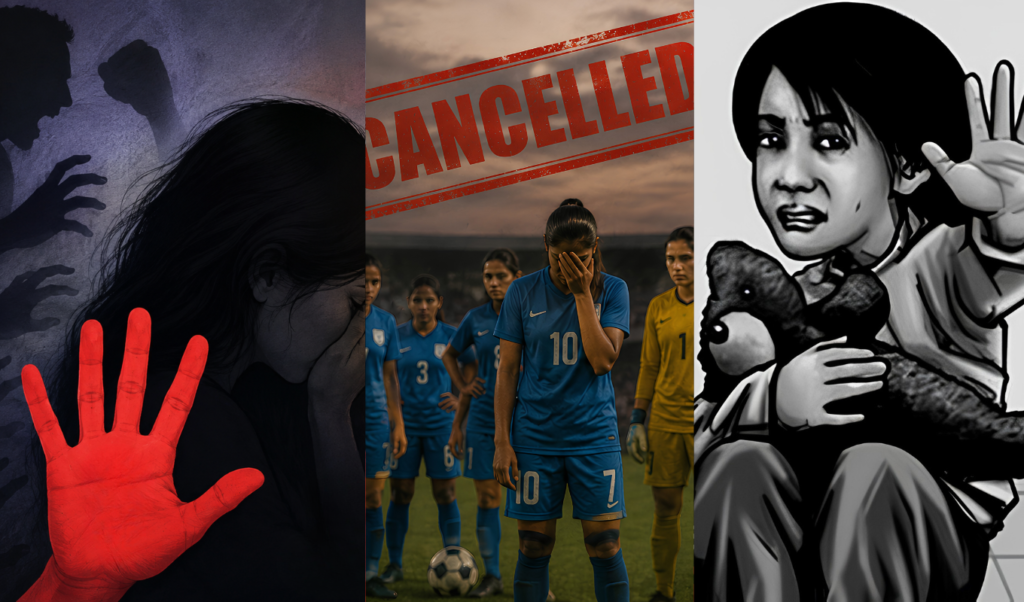
In January 2025, a women’s football match in Akkelpur, Joypurhat, was halted after local residents and a section of madrasa students vandalised the grounds. Police reports linked local Islamist groups to the incident, with one demonstrator asserting that women’s football was un-Islamic and that stopping it was a religious duty. A similar match was cancelled in Dinajpur around the same time. In Taraganj, Rangpur, local leaders of Islamic Andolan announced programmes to block another women’s football match, prompting the local administration to impose Section 144 and cancel the event altogether.
These events extend beyond the domain of sports. Playing sports is not a crime; whether a woman plays football is a matter of personal choice. When organized groups attempt to enforce restrictions under religious pretexts, it represents an infringement not just on sports, but on women’s autonomy in public life.
Challenges Facing Women Artists
A similar dynamic has surfaced within the cultural sector. In February 2025, the Actors’ Equity Bangladesh publicly expressed concern after female performers—including Mehazabien Chowdhury, Pori Moni, and Apu Biswas—faced resistance while attending showroom or restaurant openings. In November 2024, Mehazabien was scheduled to open a showroom in Chattogram but refrained from attending due to safety concerns following local religious opposition.
In February 2025, during the Ekushey Book Fair, a publisher’s stall was targeted and vandalised over the display of books by feminist author Taslima Nasrin, leading police to temporarily close the stall.
These instances bring fundamental questions back to the surface: Is the goal merely to keep women safe inside their homes, or should they remain free to make independent choices regarding their professions, views, attire, artistic expression, and lifestyles?
Opposition to Reforms for Women’s Rights
In November 2024, the interim government established the Women’s Affairs Reform Commission. The commission submitted numerous recommendations aimed at securing equal rights for women across various sectors, including marriage, divorce, inheritance, property ownership, parliamentary representation, workplace equity, and violence prevention.
These recommendations encountered organized pushback. On 3 May 2025, Hefazat-e-Islam organized a major rally in Dhaka demanding the dissolution of the commission and the withdrawal of its report. Associated Press estimated that roughly 20,000 people attended the rally.
Human Rights Watch similarly noted that conservative religious groups launched public campaigns against proposals concerning women’s inheritance, marital rights, and gender equality. The situation escalated to the point where 110 citizens issued a joint statement protesting personal attacks, derogatory remarks, threats, and incitement against commission members. Furthermore, 22 female professionals called on the government to act against those spreading hate and issuing threats.
The 2025 Factsheet on Bangladesh by the US Commission on International Religious Freedom (USCIRF) also noted offensive statements targeted at reform commission members and cited an incident where a female rights activist and professor was transferred following threats from religious groups.
Religious freedom is a fundamental right, but so too is gender equality. Asserting one right should not mean erasing another.
International Assessments
Observations from the European Union Agency for Asylum (EUAA) in its Bangladesh Country Focus 2025 report offer further context.
The report noted that while long-term rates of non-partner physical and sexual violence had previously shown declines, violence against women and girls trended upward following the political shift amid law and order challenges. This included public assaults and gang rapes, drawing on data from Bangladesh Mahila Parishad and ASK.
A nuanced perspective remains necessary: attributing every incident of violence against women solely to political shifts oversimplifies a multifaceted reality. Sexual violence is rooted in systemic impunity, social attitudes, domestic dynamics, law enforcement capacity, reporting trends, and media coverage.
At the same time, structural changes in a country’s political and social environment directly impact law enforcement and public order. When social norms shift or the perceived deterrence of legal punishment wanes, crime rates are inevitably affected.
Looking Ahead
Bangladesh was far from free of violence against women during Sheikh Hasina’s tenure. Rape, child marriage, dowry-related violence, domestic abuse, and workplace harassment remained prevalent social issues. Yet, during that same period, Bangladesh held a leading position in South Asia across international indices tracking female literacy, political participation, and gender parity.
The core question today is the stability of those foundational gains.
In 2025, police records showed a nearly 27 per cent increase in rape cases and a 25 per cent rise in violence against women and children. ASK recorded a 76 per cent increase in rape and gang-rape incidents in the first half of 2025 compared to the previous year, while child rapes rose by roughly 75 per cent in the first seven months. By mid-2026, HRSS observed a 56 per cent increase in overall violence against women and girls compared to the same period in 2025.
When these figures are viewed alongside incidents of public harassment, moral policing, disruptions to women’s sports, threats against female performers, and opposition to gender-reform initiatives, a concerning picture emerges.
A society is not truly safe for women if their security depends on remaining indoors. Real safety exists when a woman can step outside, navigate public spaces, participate in sports, choose her profession, select her attire, express her views, and make choices about her own life without fear.
Women in Bangladesh have secured many of these rights over recent decades. Rolling back this progress affects not only women, but the broader socio-economic development of the country.
Beyond political disagreements, a essential question remains: Are women in Bangladesh facing threats solely from criminal elements, or is a section of society actively attempting to restrict their freedoms and public presence?
Data alone may not fully resolve the debate, but the events of the past two years provide clear ground for concern.
For a nation that once led South Asia in narrowing the gender gap, seeing its women now forced to defend their physical safety, their freedom of movement, and their autonomy marks a critical turning point. Preserving this progress is vital—because when women are pushed back, the whole nation steps back with them.