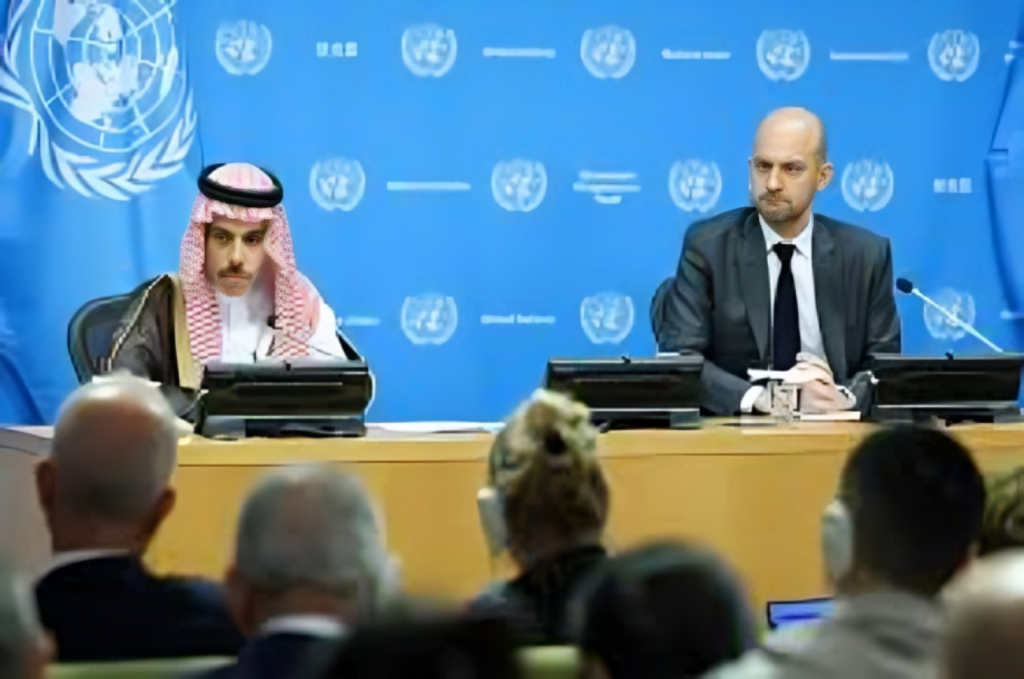
Strong appeals were made at a United Nations conference on Monday, jointly chaired by France and Saudi Arabia, insisting there is no alternative to a two-state solution between Israelis and Palestinians. The three-day summit, held in the absence of both Israel and the United States, focused on reviving the peace process amid ongoing war in Gaza.
French Foreign Minister Jean-Noël Barrot stated unequivocally:
“Only a political, two-state solution will help respond to the legitimate aspirations of Israelis and Palestinians to live in peace and security. There is no alternative.”
The conference gained further momentum after French President Emmanuel Macron declared that France would formally recognise the State of Palestine in September. Luxembourg hinted it might follow suit, with potential for other European countries to make similar announcements as the summit continues.
Palestinian Leadership Demands Recognition
Palestinian Prime Minister Mohammad Mustafa made an impassioned appeal at the session’s opening:
“All states have a responsibility to act now.”
He called for international recognition of Palestinian statehood and proposed deploying an international force to help secure it. He also urged that Hamas relinquish its control over Gaza and disarm as part of any lasting solution.
European Stances and UN Support
More than 200 British Members of Parliament have recently voiced support for recognition of Palestinian statehood. However, UK Prime Minister Keir Starmer maintained that such recognition must be part of a “wider plan”.
UN Secretary-General António Guterres remarked during the session:
“The two-state solution is farther than ever before.”
Historical Context and Global Recognition
| Fact | Details |
| UN Partition Plan (1947) | Proposed separate Jewish and Arab states |
| Israel Founded | 1948 |
| States Recognising Palestine | At least 142 of 193 UN member states (as of now) |
| Palestinian State Proclaimed | 1988 (by Palestinian leadership in exile) |
While most UN members have long backed the two-state solution, continuing violence in Gaza and Israel’s expanding settlements have cast doubt over its feasibility.
Gaza War and Future Uncertainty
The current conflict in Gaza began after a deadly attack by Hamas prompted Israel’s large-scale military response, leading to tens of thousands of Palestinian deaths and widespread destruction.
Barrot underscored:
“It would be an illusion to think that you can get to a lasting ceasefire without having an outline of what’s going to happen in Gaza after the end of the war and having a political horizon.”
Focus Areas of the Conference
While no major breakthroughs were announced, discussions are centred on:
- Reform of the Palestinian Authority
- Disarmament and political exclusion of Hamas
- Normalization of relations between Arab states and Israel
Saudi Foreign Minister Faisal bin Farhan Al Saud stressed that former US President Donald Trump could be a “catalyst” in ending the Gaza war, although he ruled out any immediate plans by Riyadh to normalise ties with Israel.
US and Israeli Absence
The United States criticised the summit, calling it “unproductive and ill-timed” and labelling it a “publicity stunt”. Israeli Ambassador to the UN, Danny Danon, dismissed the meeting entirely, stating:
“This conference does not promote a solution.”
Jordanian Foreign Minister Ayman Safadi condemned ongoing Israeli actions including settlement expansion, land confiscations, and violations at holy sites.
As the war continues, despite intermittent “tactical pauses” announced by Israel, humanitarian concerns in Gaza remain at the forefront of the global discussion.