Bangladesh’s banking sector has suffered a severe blow as escalating non-performing loans (NPLs) and mounting provision shortfalls pushed the capital deficit of 21 banks to a staggering Tk 2,94,000 crore at the end of the March quarter.
Data from Bangladesh Bank highlights a worsening systemic crisis. The Tk 2.94 lakh crore shortfall marks a steep rise from the Tk 2.74 lakh crore recorded in the December quarter. Although capital surpluses in a few solvent institutions offset a portion of the damage, the overall net capital deficit across all 61 operating banks in the country reached Tk 2,39,000 crore in March—up by roughly Tk 22,000 crore from Tk 2.17 lakh crore three months earlier.
The crisis stems directly from a dramatic expansion in defaulted loans, which surged to Tk 5,88,704 crore by the end of March, accounting for an unprecedented 32.26 percent of total outstanding credit in the banking network. Under central bank rules, commercial banks must set aside high regulatory provisions against bad loans. These provision requirements directly erode net profits, forcing distressed lenders into net operating losses that completely wipe out their capital reserves. Central bank figures confirm that the total provision shortfall across the industry climbed from Tk 1,98,260 crore in December to Tk 2,05,665 crore in March, before expanding further to Tk 2,22,357 crore by the end of June.
Economists and senior industry figures point to decades of aggressive lending practices, political influence in loan approvals, and weak regulatory oversight as the root causes of this systemic decay. Syed Mahbubur Rahman, Managing Director and CEO of Mutual Trust Bank, noted that rising non-performing assets trigger a chain reaction, where mandatory high-rate provisioning systematically drains capital foundations. Former Lead Economist at the World Bank’s Dhaka office, Zahid Hussain, warned that persistent capital deficits in roughly one-third of the nation’s banks risk undermining depositor confidence and creating contagion effects across the entire financial system.
The industry’s Capital-to-Risk-Weighted Assets Ratio (CRAR)—a key metric of financial stability—fell deeper into negative territory at minus 3.17 percent in March, down from minus 2.64 percent in December. This remains vastly below the international Basel III benchmark requirement of 12.5 percent. NRBC Bank Managing Director and CEO Md. Touhidul Alam Khan emphasised that failing to maintain mandatory CRAR levels triggers severe consequences, including dividend freezes, bans on incentive bonuses, inflated borrowing costs, and reduced profitability.
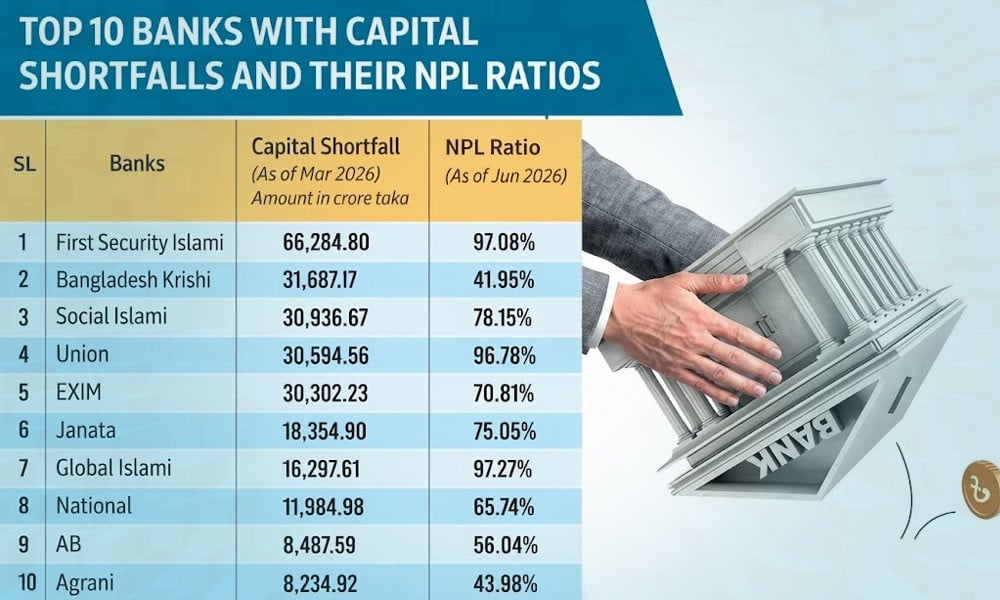
| Bank Name | Capital Deficit (in BDT Crore) |
| First Security Islami Bank | 66,264.80 |
| Bangladesh Krishi Bank | 31,687.17 |
| Social Islami Bank | 30,936.67 |
| Union Bank | 30,594.56 |
| EXIM Bank | 30,302.23 |
| Janata Bank | 18,354.90 |
| Global Islami Bank | 16,297.61 |
| National Bank | 11,984.98 |
| AB Bank | 8,487.59 |
| Agrani Bank | 8,234.92 |
First Security Islami Bank recorded the single largest deficit, standing at Tk 66,264.80 crore. State-owned specialised lender Bangladesh Krishi Bank followed with a deficit of Tk 31,687.17 crore, alongside significant capital shortfalls across both private Islamic and conventional commercial banks.