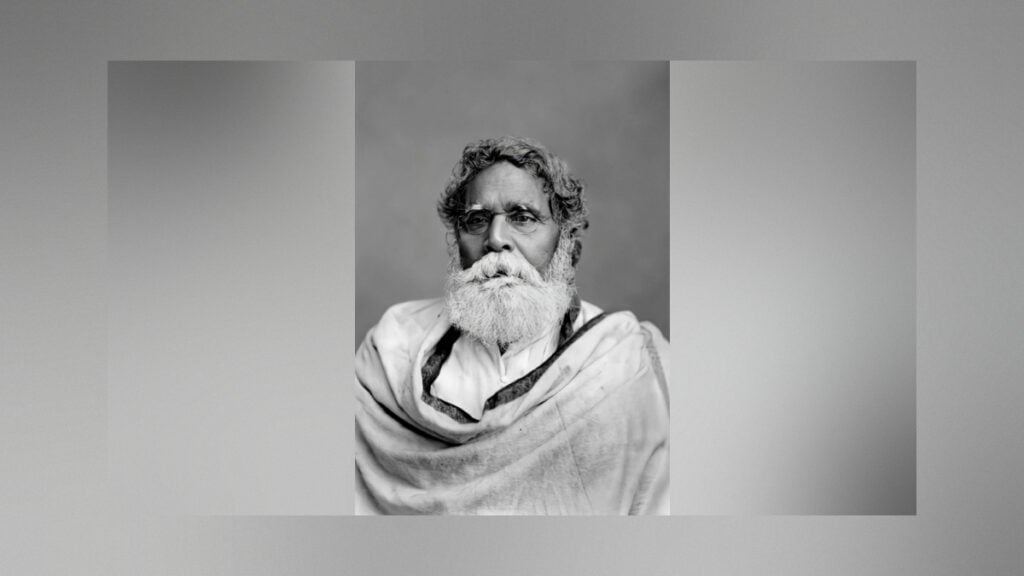
Rajnarayan Basu was one of the prominent intellectual figures of the Bengal Renaissance, whose work helped shape the intellectual, cultural and social identity of modern Bengalis. A thinker, writer, translator, educator, social reformer and early advocate of nationalist consciousness, he devoted much of his life to reconciling India’s rich intellectual traditions with the demands of a changing modern society.
His celebrated work Sekal Ar Ekal—literally, ‘Then and Now’—stands as a remarkable bridge between two eras. Through memories of the past, observations of contemporary society and reflections on change, Basu examined how Bengali society was being transformed during the nineteenth century. His life and writings continue to offer an insight into a period when education, rational thought, social reform, literature and cultural self-awareness were reshaping Bengal.
Early life and education
Rajnarayan Basu was born on 7 September 1826 in Borāl village, in present-day South 24 Parganas district of West Bengal, India. His father, Nandkishore Basu, was influenced by the liberal ideas associated with Raja Rammohan Roy and encouraged an intellectual environment at home.
From an early age, Basu showed a strong appetite for learning. After studying at Hare School in Calcutta, he entered Hindu College, where he came into contact with Western philosophy, science, literature and rationalist thought. At the same time, he developed a lasting interest in Indian philosophy, religion and cultural traditions.
The interaction between these two intellectual traditions became an important feature of his later thinking. Rather than viewing modernity and tradition as mutually exclusive, Basu sought to understand how elements of both could contribute to the intellectual and social development of Bengali society.
Brahmo faith and social reform
Basu’s adoption of the Brahmo faith marked an important stage in his intellectual and social journey. He moved towards a more liberal and rational approach to religion, challenging forms of social and religious orthodoxy that he regarded as obstacles to human progress. His decision was not without consequences. Biographical accounts indicate that his views brought him into conflict with conservative sections of society and contributed to pressure that eventually led him to leave his native Borāl.
Despite such opposition, Basu remained committed to his principles. He regarded education, reason, morality and human values as essential foundations for social advancement.
During the 1850s, he expressed support for widow remarriage and worked towards the advancement of women’s education. While serving as a teacher in Midnapore, he took initiatives connected with a library, a girls’ school, adult education and debating activities. For Basu, education was not simply a means of individual advancement; he viewed it as a force capable of transforming society as a whole.
His reformist outlook extended beyond religious questions. He also spoke against social practices and customs that he believed hindered intellectual and moral development. Education, religion, ethics and social reform were closely connected in his thinking.
Teaching and literary work
Teaching formed a significant part of Basu’s professional life. In 1849, he joined Sanskrit College as a teacher of English. In 1851, he became headmaster of the Midnapore District School.
His years in Midnapore were particularly important to his contribution to education and cultural life. Alongside his teaching responsibilities, he encouraged educational development, the spread of Bengali language and literary activity. He was also associated with efforts to establish an institution for music education.
Basu’s intellectual interests extended across languages and disciplines. He wrote essays, delivered speeches, translated works and engaged with questions of philosophy, religion, education and society in both Bengali and English.
Among his notable literary activities was his English translation of Michael Madhusudan Dutt’s Meghnad Badh Kavya, through which he sought to make one of Bengali literature’s major works accessible to a wider readership. He also worked on English translations of the Upanishads.
National consciousness and Bengali identity
Rajnarayan Basu was also an important early figure in the development of Bengali cultural and national consciousness. His understanding of patriotism was closely associated with respect for the mother tongue, indigenous culture, history and literary heritage.
He believed that a people’s sense of identity was closely connected with knowledge of its own language and cultural traditions. His writings and speeches therefore frequently encouraged self-respect and a renewed appreciation of Bengal’s intellectual and cultural heritage.
Basu became associated with the Hindu Mela, established through the initiative of Nabagopal Mitra. The organisation sought to encourage indigenous culture, physical activity and a sense of national consciousness among Bengalis. Basu’s involvement reflected his broader interest in cultural awakening and the development of collective self-awareness.
His intellectual influence extended into the next generation. His grandson, Sri Aurobindo, later emerged as a major intellectual and nationalist figure, and Basu’s ideas formed an important part of the intellectual inheritance that reached him through the family.
Sekal Ar Ekal: Connecting past and present
One of Rajnarayan Basu’s best-known works is Sekal Ar Ekal, published in 1874. The book presents a comparison between earlier Bengali society and the world in which Basu himself lived. Drawing on personal memories, social experiences and observations of changing customs, he offered a detailed picture of a society undergoing profound transformation.
The work has significance not only as a literary text but also as a record of social history. It captures aspects of nineteenth-century Bengali life at a time when traditional practices were encountering new ideas brought by education, reform movements and changing intellectual currents.
His Atmacharit, or autobiography, is another important contribution to Bengali literature. It recounts aspects of his childhood, education, professional life and intellectual development while also providing glimpses of the wider society in which he lived. Published after his death, the work has remained a valuable source for understanding aspects of nineteenth-century Bengali society and the intellectual environment of the Bengal Renaissance.
Among his other notable works are The Superiority of Hinduism, A History of Hindu or Presidency College, writings and lectures on the Bengali language and literature, Bividha Prabandha, Bṛiddha Hindur Asha and Brahma Sadhan. Through these works, Basu explored religion, history, education, literature, morality and social life.
The Deoghar years
After retiring from government service in 1868, Basu left Midnapore and moved to Deoghar. Retirement from formal employment, however, did not mark the end of his intellectual activities.
He continued to write and reflect on literature, philosophy, religion and society during the later years of his life. His intellectual pursuits remained closely tied to questions of personal discipline, moral development, social welfare and the cultural future of Bengal.
His later years thus continued the pattern that had defined much of his life: intellectual enquiry accompanied by an enduring interest in education, reform and cultural identity.
Sri Aurobindo’s tribute
Rajnarayan Basu’s name may be less familiar to many readers today than those of some of his contemporaries, but his influence can also be traced through the life of his grandson, Sri Aurobindo Ghose.
Aurobindo held his maternal grandfather in deep respect and wrote a sonnet in his memory. The tribute reflected his affection for Basu and his appreciation of the older man’s character and intellectual legacy.
The relationship between the two generations illustrates how ideas developed during the Bengal Renaissance could pass from one generation to another. Basu’s emphasis on cultural identity, intellectual independence and national consciousness formed part of the broader intellectual environment inherited by the younger generation.
Death and enduring legacy
Rajnarayan Basu died on 18 September 1899 at the age of 73.
His death brought to a close the life of a man who had witnessed and participated in a crucial period of social and intellectual change. Bengal in the nineteenth century was moving through a complex transition, with established customs and inherited beliefs encountering new approaches to education, religion, literature and social organisation.
Basu occupied an important place within that transition. His contribution lay partly in his effort to connect the intellectual resources of the past with the possibilities of the modern age. He did not regard respect for tradition and the pursuit of modernity as necessarily contradictory. Instead, his work sought to establish a dialogue between the two.
His writings also demonstrate the breadth of nineteenth-century Bengali intellectual life. Literature, education, religious reform, social questions and emerging ideas of national identity were often interconnected, and Basu engaged with each of these areas throughout his career.
Remembering Rajnarayan Basu is therefore also a way of revisiting a formative period in Bengal’s cultural history. His life reflects the importance of education, rational enquiry, literary activity and cultural self-awareness in the making of a modern intellectual society.
More than a century after his death, his writings remain part of the historical record of the Bengal Renaissance. Through Sekal Ar Ekal, his autobiography, essays, translations, educational initiatives and reformist ideas, Rajnarayan Basu left behind a legacy that connected the world he inherited with the future he imagined.
He remains remembered as a Bengali intellectual who sought to weave together the lessons of the past and the aspirations of a changing age.