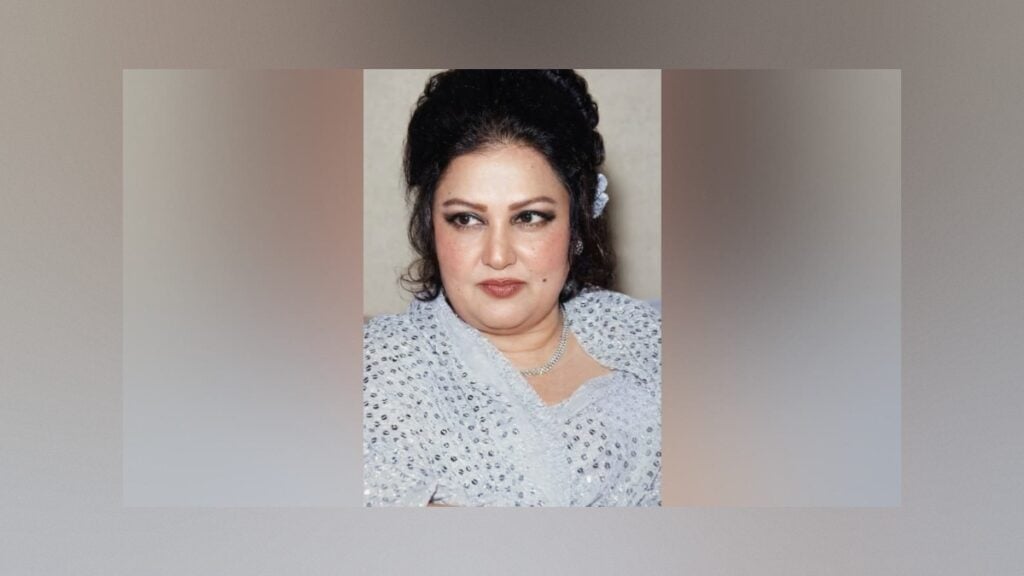
‘Jo bhik liya tera, wohi mujhe qabool hai’—lines such as these carried an emotional depth that became inseparable from the voice of Malika-e-Tarannum Noor Jehan. Revered as the ‘Queen of Melody’, she became one of the defining figures of South Asian music, leaving an enduring mark on both cinema and popular culture.
Born Allah Rakhi Wasai on 21 September 1925 in Kasur, Punjab, then part of British India, Noor Jehan grew up in a large family of 11 children. Her parents, Imdad Ali and Fateh Bibi, were connected to a musical environment, and music became part of her life from an early age. Her natural vocal ability was recognised during childhood, setting her on a path towards a career that would eventually span more than six decades.
Noor Jehan began her artistic journey as a child performer, working in both acting and singing. As her career developed, however, music increasingly became the centre of her professional identity. Her career crossed the political and cultural transition from British India to Pakistan, allowing her to become an important figure in the region’s changing entertainment landscape.
Her versatility was among her most distinctive qualities. She drew from the traditions of Hindustani classical music while also excelling in ghazals, film songs, folk music and patriotic compositions. She recorded songs in several languages, including Urdu, Punjabi, Pashto, Sindhi and Persian. Although different sources have offered varying estimates of the number of songs she recorded, the scale of her recorded work remains a significant part of her legacy.
Her contribution to cinema was equally notable. Noor Jehan was not only an actress and playback singer but also became involved in film direction, making her one of the early women associated with directing in Pakistani cinema. Her career therefore extended beyond performance, reflecting a broader involvement in the creative side of the film industry.
Her collaborations with other leading singers also became part of Pakistan’s musical history. Duets with Ahmed Rushdi, in particular, gained popularity among film audiences and demonstrated her ability to adapt her powerful voice to different musical settings.
Recognition followed her throughout her career. In 1965, she received Pakistan’s prestigious Pride of Performance award for her contribution to acting and music. Her patriotic songs during the 1965 India-Pakistan war also became widely popular in Pakistan, placing her voice at the centre of a period of heightened national sentiment.
She later received other state honours, including the Tamgha-e-Imtiaz and Sitara-e-Imtiaz. Her contribution was also recognised through lifetime achievement honours during and after her lifetime, reflecting the lasting importance attached to her work.
Behind the celebrated public career was a personal life marked by major changes. Noor Jehan married Shaukat Hussain Rizvi in 1942, and they had three children. One of them, Zile Huma, later followed her mother’s path and became a singer. Noor Jehan and Rizvi divorced in 1953.
In 1959, she married Ejaz Durrani. They also had three children, but the marriage ended in divorce in 1970. Despite these personal upheavals, Noor Jehan continued to build a remarkable career and remained a prominent presence in the world of music.
The emotional force of her singing was central to her appeal. Whether she was singing about love, separation, longing, happiness or sorrow, she brought a distinctive intensity to the words. Her voice had the ability to turn a song into an intimate emotional experience, allowing listeners to connect with the sentiment rather than simply hear the melody.
Noor Jehan died on 23 December 2000, bringing to an end the life of an artist whose career had stretched across some of the most significant cultural changes in the region. Yet her passing did not mark the end of her influence.
Her recordings continue to circulate through radio broadcasts, films, archived recordings and modern digital platforms. For new generations of listeners, her voice remains a link to an earlier era of South Asian music, while for those who grew up with her songs, it continues to evoke memories and emotions associated with a remarkable period in the region’s cultural history.
Noor Jehan was much more than a celebrated singer. She was an actress, filmmaker and an influential cultural figure whose career helped shape the sound of Pakistani cinema and popular music. Her ability to move between musical forms and languages gave her an extraordinary breadth as a performer.
More than two decades after her death, the significance of her work remains visible in the continued interest in her recordings and the respect accorded to her name. Her voice belonged to a particular era, but its emotional appeal has never been confined to that era.
Noor Jehan may have fallen silent in 2000, but the songs she left behind continue to speak. Through those recordings, the Queen of Melody remains a living part of South Asia’s musical memory.