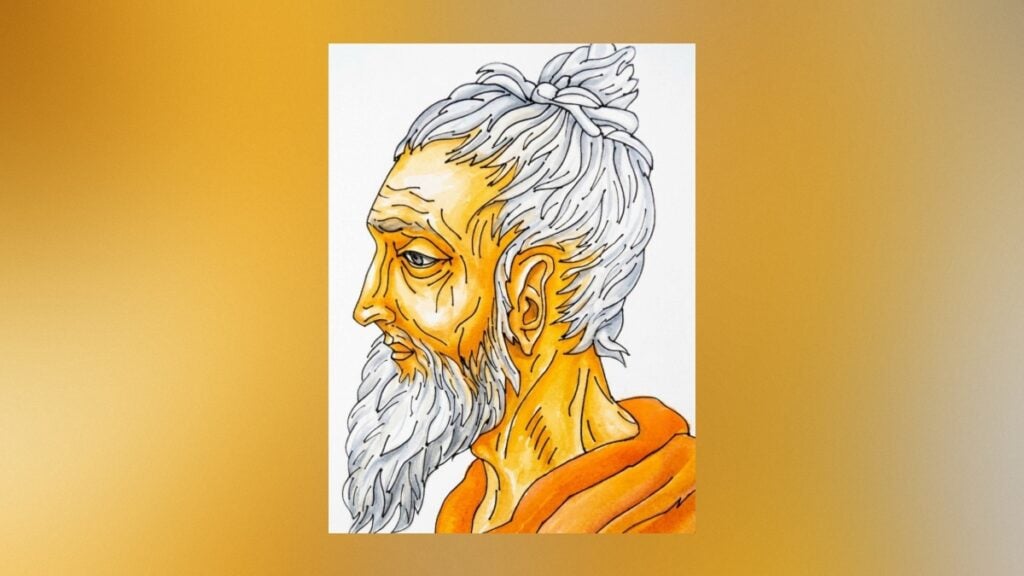
“To worship humanity is to become a person of gold.”
These timeless lines reflect the philosophy of Fakir Lalon Shah, the revered Baul saint, songwriter and humanist whose songs have travelled from the villages of Bengal to the wider world of music and culture. Also widely known as Lalon Sai, he devoted his life to exploring the nature of human existence, the search for inner truth and the importance of treating every person with dignity.
Lalon was more than a folk musician or spiritual practitioner. He was a philosopher who challenged caste distinctions, religious intolerance and social divisions through his songs and way of life. At the heart of his teachings was the belief that humanity should take precedence over inherited identities and social status. His lifelong spiritual quest centred on the search for the Moner Manush — the person of the heart, representing an inner truth that cannot be discovered through outward appearances alone.
His message remains relevant today, offering a powerful reminder that compassion, equality and mutual respect are essential to a humane society.
A life shaped by spiritual enquiry
The precise details of Lalon Shah’s birth, birthplace and family background remain subjects of debate among researchers. He is commonly believed to have been born around 1772, although reliable historical evidence establishing his exact birth date and year is limited. Little is known with certainty about his early life.
According to popular accounts, Lalon became seriously ill at one point and received care and shelter from a spiritual practitioner named Siraj Sai. The experience is widely associated with the development of his spiritual outlook, although details of the episode remain rooted largely in oral tradition.
Lalon eventually established his spiritual centre at Chheuriya, in Kushtia, where he gathered disciples and developed a distinctive tradition of spiritual practice. His community placed emphasis on inner qualities rather than religious affiliation, caste or social standing. The dignity of the individual, irrespective of background, occupied a central place in this way of life.
Nineteenth-century Bengal was marked by entrenched social hierarchies, caste prejudice and religious divisions. Against this backdrop, Lalon used his songs to question the assumptions that separated people from one another. He challenged the idea that birth, religion or inherited social identity could determine a person’s worth.
His questions were simple but profound: What truly defines a human being? Is it religion, caste, ancestry or the humanity within?
Those questions continue to challenge societies where prejudice and discrimination remain persistent concerns.
Songs that gave voice to humanity
Lalon’s compositions occupy an important place in the heritage of Bengali folk music. His songs bring together spiritual reflection, love, self-discovery, the relationship between the body and the soul, and the search for a deeper understanding of existence.
His language was rooted in everyday life, yet the ideas expressed through it reached far beyond any particular community. He often conveyed complex philosophical questions through familiar images and simple words, making his work accessible to ordinary listeners while leaving considerable scope for interpretation.
One of his best-known songs, Shomoy Gele Shadhon Hobe Na — commonly translated as “When Time Passes, the Opportunity for Spiritual Practice Will Be Lost” — reflects on the fleeting nature of life and the urgency of self-realisation. Its message is that the pursuit of truth and personal transformation cannot be postponed indefinitely. Human life is limited, and the opportunity to understand oneself must be embraced while it remains.
Another celebrated composition, Shob Loke Koy Lalon Ki Jaat Shongshare, questions the meaning of caste and social identity. By asking what caste Lalon belongs to, the song exposes the contradictions inherent in a society that divides people according to inherited labels.
His work invites listeners to consider whether any outward characteristic can truly establish one person’s superiority over another. Rather than accepting social conventions unquestioningly, Lalon urges people to look beyond appearances and recognise the shared humanity that connects them.
Songs such as Khachar Bhitor Ochin Pakhi, Milon Hobe Koto Dine and Amar Moner Manusher Shone explore the mysteries of existence, the longing for spiritual union and the desire to discover an elusive inner truth.
The images of the unknown bird, the hoped-for meeting and the person of the heart have become enduring features of his musical and philosophical legacy. They allow listeners to approach his work in different ways, whether through spiritual belief, emotional experience or personal reflection.
For Lalon, music was not merely entertainment. It was a means of questioning established beliefs, examining the self and encouraging people to look beyond the boundaries imposed by society.
Lalon’s influence on Bengali literature and beyond
Lalon Shah’s influence extended well beyond the Baul communities in which his songs developed. His music and philosophy attracted the attention of writers, poets, musicians and intellectuals, helping to establish the Baul tradition as an important part of Bengal’s cultural heritage.
Rabindranath Tagore showed a particular interest in Lalon’s songs and ideas. Tagore’s engagement with Baul music and his efforts to introduce aspects of this tradition to wider audiences helped bring greater recognition to its philosophical and artistic significance.
Although Lalon and Tagore belonged to different social and cultural worlds, both explored themes of spiritual freedom, the relationship between the individual and the universal, and the search for truth beyond rigid conventions. Their shared interest in the inner life of human beings created an important point of connection between folk spirituality and modern Bengali literature.
Lalon’s humanist outlook also invites comparisons with ideas found in the work of other Bengali writers and artists, including Kazi Nazrul Islam, whose writings frequently challenged oppression and defended human dignity. Such parallels do not make their philosophies identical, but they demonstrate how questions of equality, freedom and humanity have continued to shape Bengal’s creative traditions.
The American poet Allen Ginsberg also developed an interest in Bengal’s Baul heritage. His engagement with the region’s spiritual and cultural traditions helped draw international attention to forms of expression that had long flourished outside conventional literary and musical institutions.
Today, Lalon’s legacy reaches audiences far beyond Bangladesh. His songs are performed, studied and interpreted by musicians and cultural practitioners who find in them questions that remain universal: Who are we? What gives life meaning? Why do people divide themselves, and how might they learn to live together?
A philosophy that transcends religious and social boundaries
Lalon’s enduring importance lies not only in the beauty of his compositions but also in the challenge his philosophy presents to conventional thinking. He questioned the authority of social labels and encouraged people to discover truth through reflection, experience and an understanding of others.
The concept of the Moner Manush remains central to interpretations of his work. It can be understood as a search for the deepest truth within oneself, an encounter with the beloved or a spiritual realisation that transcends ordinary distinctions. Its richness has allowed generations of listeners to find different meanings in the same songs.
His emphasis on the human being offers a particularly relevant perspective in an age when religious divisions, prejudice and social inequality continue to affect communities around the world. Lalon’s work does not provide a simple answer to every modern problem, but it asks a fundamental question that remains difficult to ignore: can a society truly progress while denying the dignity of some of its members?
His songs encourage a different starting point — understanding before judgement, compassion before hostility and humanity before division.
Remembering Lalon Shah on his death anniversary
On 17 October, Lalon Shah’s death anniversary is an occasion to remember a spiritual thinker whose influence has endured across generations. His life and compositions remain an integral part of Bangladesh’s cultural identity, while his humanist message continues to resonate with audiences across borders.
His legacy is preserved not only in recordings, performances and cultural commemorations but also in the continuing efforts of singers, researchers and admirers to interpret his songs and keep the Baul tradition alive.
Remembering Lalon means more than celebrating a remarkable figure in Bengali folk music. It means revisiting the values he championed: equality, self-awareness, spiritual freedom and respect for every human being.
Fakir Lalon Shah left no conventional philosophical treatise comparable to those of many celebrated thinkers. Instead, he communicated his ideas through songs that continue to invite reflection and debate. Their power lies in their ability to make profound questions feel personal, immediate and relevant to everyday life.
His voice continues to travel through the generations, carrying a vision of humanity that refuses to be confined by caste, religion or social status. As long as people seek a deeper understanding of themselves and one another, Lalon’s songs will retain their place in Bengal’s cultural and spiritual life.
On his death anniversary, homage is paid to the Baul saint whose music placed humanity at the centre of spiritual life. May his songs continue to live in people’s voices, his philosophy endure in their hearts, and his message of compassion illuminate the path for generations to come.