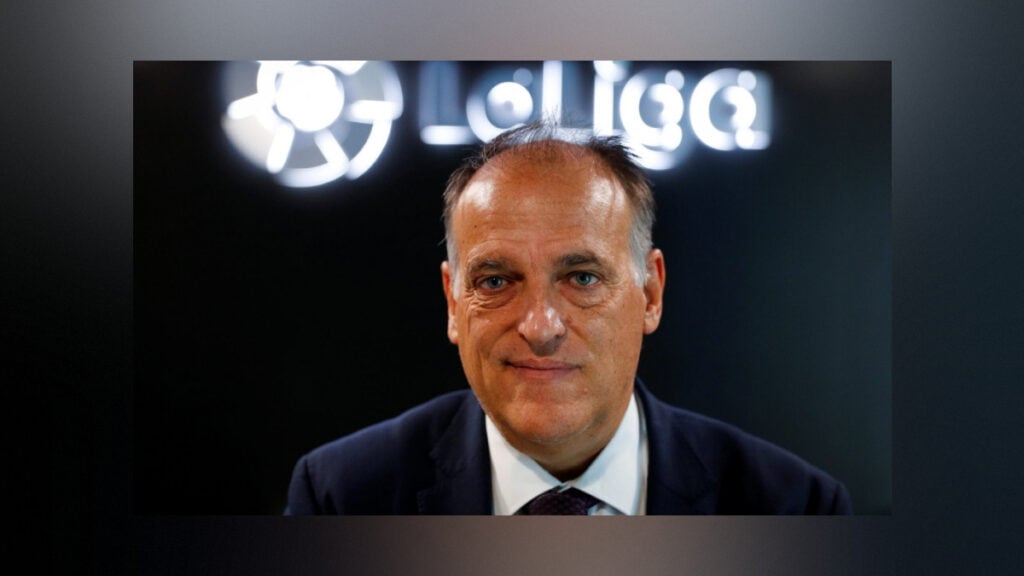
La Liga president Javier Tebas is facing the possibility of disciplinary sanctions after comparing Real Madrid’s criticism of refereeing decisions to propaganda techniques associated with Nazi Germany. The controversial remarks have intensified an already strained relationship between the Spanish football authorities and the country’s most successful European club.
Spain’s National Sports Council (CSD) has referred the matter to the Administrative Tribunal for Sport (TAD), seeking an assessment of whether Tebas violated regulations concerning dignity, respect and appropriate conduct in professional sport.
The dispute stems from Real Madrid’s persistent criticism of refereeing standards in La Liga. The Spanish giants have repeatedly used their official television channel, Real Madrid TV, to challenge decisions made by match officials, question the consistency of refereeing and highlight incidents they believe have adversely affected the club.
Tebas has frequently criticised the broadcaster’s approach, arguing that its coverage risks undermining confidence in the integrity of Spanish football.
The latest controversy began on 16 October, when the 64-year-old La Liga president published a strongly worded message on social media.
In the post, Tebas accused Real Madrid of operating a coordinated communications strategy through a network of spokespersons directed by the club itself.
He alleged that the approach involved selectively presenting favourable information, repeatedly making insulting claims, generating suspicion and publicly identifying perceived adversaries.
Tebas then compared those methods to the propaganda strategies employed by Joseph Goebbels, Nazi Germany’s minister of propaganda under Adolf Hitler.
The historical reference immediately attracted criticism because of Goebbels’ central role in spreading Nazi ideology and manipulating public opinion through state-controlled propaganda.
Real Madrid reacted angrily to the comparison and demanded Tebas’ immediate resignation as president of La Liga.
The controversy subsequently reached Spain’s sporting authorities, with the CSD submitting the matter to the Administrative Tribunal for Sport for examination.
According to the council, Tebas’ remarks could constitute a serious disciplinary offence under Article 76.4(b) of Spain’s Sports Law 10/1990.
The provision has been cited in connection with conduct considered incompatible with the dignity and decorum expected within sporting competitions and institutions.
Should the tribunal determine that a violation occurred, the La Liga president could face disciplinary measures, potentially including a formal warning, a financial penalty or a temporary suspension, depending on the applicable legal framework.
However, the referral does not establish wrongdoing, and no disciplinary sanction has been confirmed.
Tebas has defended his comments, insisting that the comparison was intended to describe a particular method of public communication rather than insult Real Madrid supporters or attack the club’s values.
In a subsequent statement, he maintained that his criticism concerned the manner in which Real Madrid presented allegations about refereeing decisions.
He also questioned why the CSD and Spain’s sporting authorities had not taken a similarly critical approach towards the club’s television broadcasts.
Tebas pointed to allegations aired by Real Madrid TV suggesting that the refereeing system was corrupt and that the league championship was being unfairly influenced.
He asked why the Ministry of Sport and the CSD remained silent when such accusations were made publicly.
The La Liga president argued that describing a sporting competition as fraudulent could itself damage the dignity of football and undermine confidence in the institutions responsible for organising matches.
He also questioned whether repeated allegations against match officials could harm referees, competing clubs and millions of supporters who follow Spanish football.
His response raised a broader issue concerning the standards applied to public criticism within professional sport.
While clubs have the right to question refereeing decisions and demand accountability, allegations involving corruption or deliberate manipulation carry implications beyond individual matches.
Such claims can affect public confidence in match officials and the perceived fairness of a competition, particularly when circulated through official club communication channels.
Real Madrid’s television coverage has become a prominent feature of the club’s disagreements with Spanish refereeing authorities. Its broadcasts frequently examine contentious incidents and challenge decisions that the club considers inconsistent or unfair.
The practice has contributed to wider debate over the relationship between football clubs, referees and the organisations responsible for administering domestic competitions.
For Tebas, the central concern appears to be the effect of repeated accusations on La Liga’s credibility. Real Madrid, meanwhile, has maintained a critical stance towards refereeing decisions and has strongly objected to the president’s historical comparison.
The latest confrontation has moved beyond a disagreement over match officiating, bringing questions of professional conduct and disciplinary accountability into focus.
The reference to Nazi propaganda has made the dispute particularly sensitive, given the historical significance of the comparison and the responsibilities associated with Tebas’ position as head of Spain’s leading domestic football competition.
Attention now turns to the Administrative Tribunal for Sport, which has been asked to examine whether the comments breached the relevant sporting regulations.
Its assessment will be central to determining whether the controversy results in formal disciplinary proceedings or remains a public disagreement between the La Liga president and Real Madrid.
For now, Tebas continues to defend the intention behind his remarks, while Real Madrid has made clear its opposition to the comparison.
The outcome could carry wider significance for Spanish football, particularly in defining the boundaries of acceptable public criticism between senior sporting officials and the clubs they oversee.