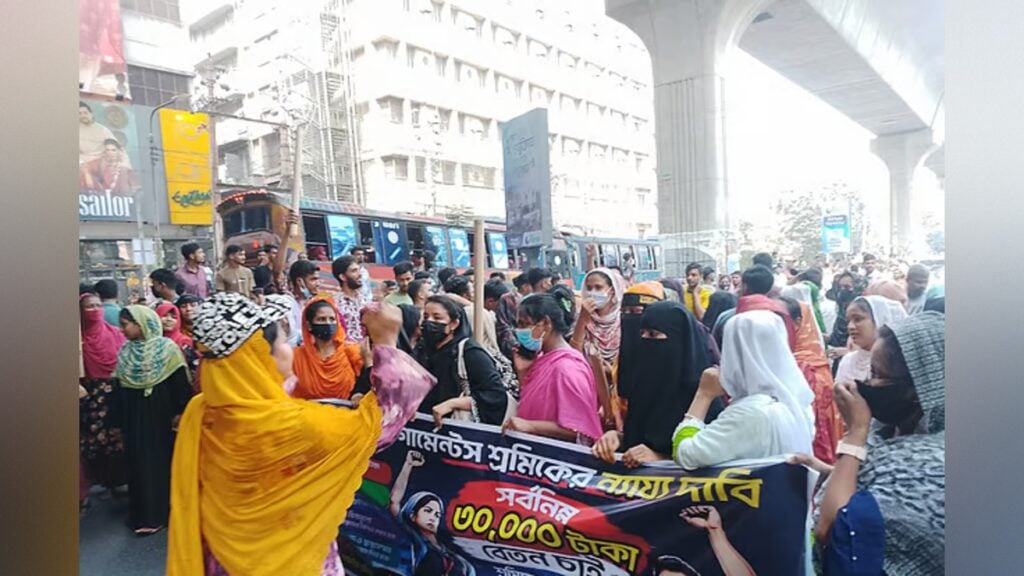
According to police sources, several hundred workers gathered at the roundabout to press for higher wages. Their protest escalated into a road blockade, disrupting the movement of vehicles through one of Mirpur’s key transport junctions.
The obstruction affected traffic on the roads connected to the intersection, leaving commuters facing delays. Mirpur-10 is an important transport hub in the capital, serving a large number of residents, workers and passengers travelling to different parts of Dhaka. Any disruption at the junction can affect traffic movement in the surrounding neighbourhoods.
The workers’ principal demand is for the minimum monthly wage to be set at Tk 30,000. Their protest highlights continuing concerns over wages and the cost of living among employees in Bangladesh’s garment sector, a major source of employment and a cornerstone of the country’s export economy.
For garment workers, monthly earnings must cover essential expenses, including food, housing, transport and other household necessities. Wage disputes can therefore become a source of tension when workers believe their income is insufficient to meet their living costs. However, no further details were immediately available about the specific factories involved in Thursday’s demonstration or the workers’ discussions with their employers.
Hasan Mohammad Naser Rikabdar, deputy commissioner of the police’s Mirpur division, confirmed that the workers had occupied the road to demand a minimum monthly salary of Tk 30,000. He said police were attempting to persuade them to leave the road and restore normal traffic movement.
There was no immediate confirmation of an agreement between the workers and factory management, nor was it clear when the blockade would end.
The immediate priority for the authorities is to ease the congestion and reopen the affected roads. The outcome of the protest will depend on whether the workers can reach an understanding with the relevant authorities and employers over their wage demands.