The political arena in India has once again been stirred by controversy surrounding the Bengali language. A storm of criticism has erupted after Delhi Police, in an official letter, allegedly referred to Bengali as a “Bangladeshi language”. This contentious classification has provoked widespread backlash—most notably from football fans at Kolkata’s Salt Lake Stadium, who made their feelings known during a high-profile match.
Stadium Protest: A Poignant Banner
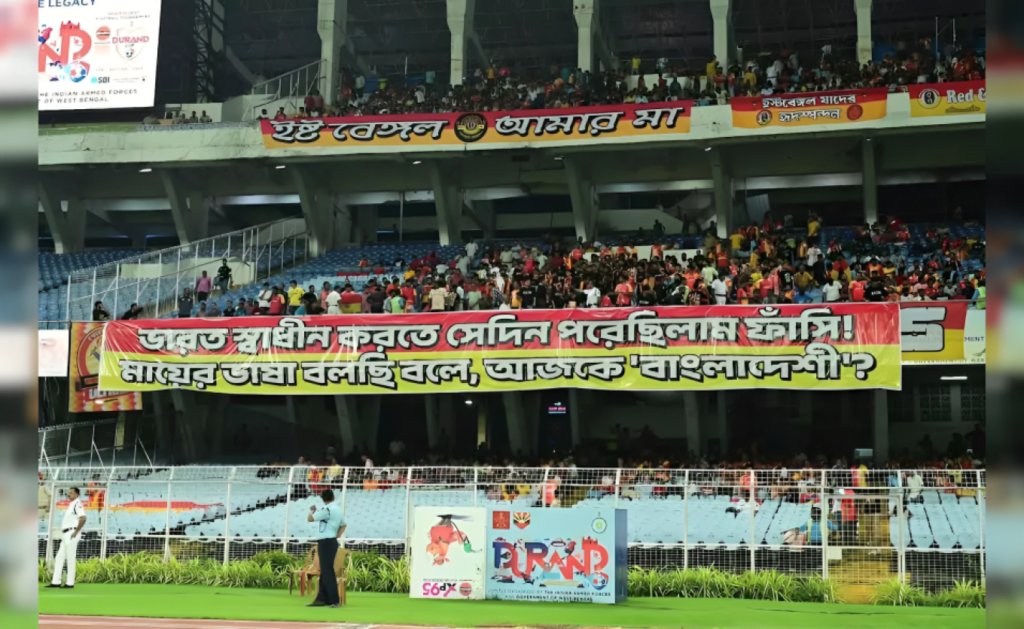
On Wednesday, 6 August, during the Durgapur Cup match between East Bengal and Namdhari Football Club, East Bengal supporters displayed a large banner with the powerful message:
“We were hanged for freeing India,
Now we’re called Bangladeshi for speaking our mother tongue.”
The banner starkly highlighted the irony and emotional pain felt by many—those whose forebears sacrificed their lives for India’s independence now face insult for speaking their native language. The image of the banner went viral on social media within hours.
The Controversy: Delhi Police Letter Sparks Outrage
The controversy originated when an inspector of Delhi Police sent an official letter to a staff member of Bangabhawan (the West Bengal government guesthouse in Delhi). In the letter, while requesting a translation, Bengali was reportedly described as a “Bangladeshi language”.
This ignited strong protest from the Trinamool Congress (TMC). Party leaders argued that Bengalis across various Indian states, especially Delhi, are being deliberately targeted and disrespected.
Political Reactions
Mamata Banerjee, Chief Minister of West Bengal and Trinamool Congress leader, expressed her fury on X (formerly Twitter):
“Such terminology is disgraceful, insulting, anti-national, and unconstitutional. It is an affront to every Bengali-speaking Indian citizen.”
She further questioned:
“Look at how Delhi Police, which functions under the Union Home Ministry, refers to Bengali as a Bangladeshi language!”
BJP’s Response
A senior Bharatiya Janata Party (BJP) leader countered these allegations, saying that the letter did not intend to insult the Bengali language. Instead, he claimed the term “Bangladeshi” was used in an immigration context, referencing certain dialects, sentence structures, and pronunciations that differ from standard Indian Bengali.
He elaborated:
“The official language of Bangladesh is phonetically distinct, including dialects such as Sylheti, which even many Indian Bengalis find difficult to understand.”
Historic Role of Football Stands in Political Expression
Political and social messaging from the football terraces is nothing new in Kolkata. In 2020, supporters protested against the National Register of Citizens (NRC) in the stadium, carrying a banner that read:
“This land was bought with blood, not with papers.”
East Bengal’s Deep-Rooted Connection to Displacement
A significant number of East Bengal fans are descendants of refugees who migrated from Bangladesh (then East Bengal) during and after Partition. The legacy of displacement, loss of homeland, and resettlement is deeply woven into the club’s identity.
As such, the gallery of East Bengal has long served as a powerful venue for protest against injustice and marginalisation—particularly when it involves issues of language and identity. Last year, East Bengal and Mohun Bagan fans also united in demanding justice following the rape and murder of a female doctor from R. G. Kar Medical College.
Timeline of Events
| Date | Event |
| 6 August 2024 | Protest banner displayed by East Bengal supporters at Salt Lake Stadium |
| Recent Weeks | Delhi Police letter describes Bengali as “Bangladeshi language” |
| 2020 | Anti-NRC protest banner displayed during match |
| Ongoing | Political debate between TMC and BJP on Bengali identity and labelling |
The incident reflects ongoing tensions over linguistic identity in India and underscores how cultural pride continues to find expression not just in parliament or protests, but in the beating heart of Kolkata’s football stands.