Portugal observed a day of national mourning on Thursday after the death toll from the derailment of one of Lisbon’s most iconic funiculars, the Glória, rose to 17 fatalities, with 21 people injured.
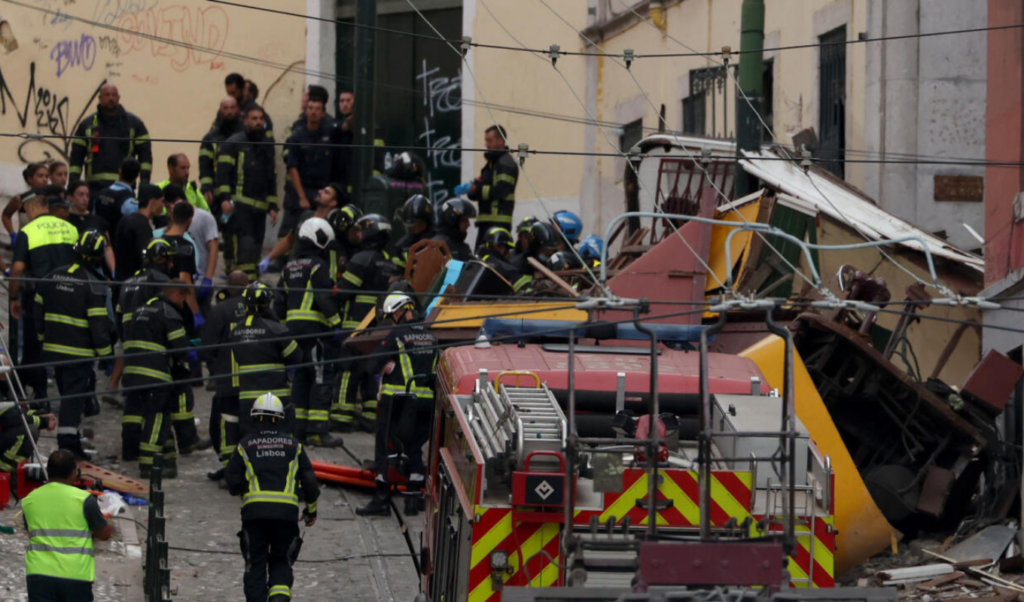
The tragic accident occurred on Wednesday evening in one of the capital’s busiest tourist areas, when the yellow Glória funicular veered off its steep tracks near Liberty Avenue and collided with a building.
Emergency services confirmed that 15 people (eight men and seven women) were killed instantly, while two more died later from their injuries.
At least 11 foreigners were among the injured, representing several nationalities:
| Nationality | Number of Injured |
| German | 2 |
| Spanish | 2 |
| French | 1 |
| Italian | 1 |
| Swiss | 1 |
| Canadian | 1 |
| South Korean | 1 |
| Moroccan | 1 |
| Cape Verdean | 1 |
The German foreign ministry reported that its Lisbon embassy was working with Portuguese authorities to identify victims. A police source, quoted by Observador, said a German man was killed, his wife remains in critical condition, and their three-year-old child sustained minor injuries.
An emergency official confirmed that a three-year-old child was among the injured, though nationality was not disclosed
Footage broadcast on local television showed police and rescue teams working overnight around the wreckage, the funicular lying on its side against a wall.
A woman interviewed by TV channel SIC described the violent impact: “The train struck the building with brutal force and collapsed like a cardboard box.”
Images also showed another funicular halted just a few metres away on the same track, while stunned tourists and residents looked on.
Lisbon’s Mayor, Carlos Moedas, described the tragedy as “a disaster our city has never experienced before”.
Prime Minister Luis Montenegro issued a statement saying the accident had “brought grief to families and dismay to the country”.
From Brussels, European Commission President Ursula von der Leyen extended condolences to the victims’ families.
Authorities have launched a formal investigation into the incident.
In the wake of the crash, officials suspended Lisbon’s three other funiculars pending safety inspections.
According to Carris, Lisbon’s public transport operator:
- All maintenance protocols were observed.
- General maintenance is performed every four years – most recently in 2022.
- Intermediate maintenance takes place every two years – last completed in 2024.
- For the past 14 years, maintenance has been outsourced to a private contractor.
Pedro Bogas, head of Carris, emphasised:“Everything was scrupulously respected.”
The Glória funicular, first launched in 1885 and electrified in 1915, is a treasured part of Lisbon’s cultural heritage.
It is not only a practical transport link up the city’s steep hills but also a popular tourist attraction, frequently featured on postcards and souvenirs.
A Spanish tourist, Antonio Javier (44), told AFP that his family narrowly avoided the tragedy: “We are a little relieved we did not take the funicular – the queue was too long.”
This accident is being regarded as one of Lisbon’s most devastating transport tragedies in modern times, raising fresh concerns over safety checks on historic infrastructure still in daily use.