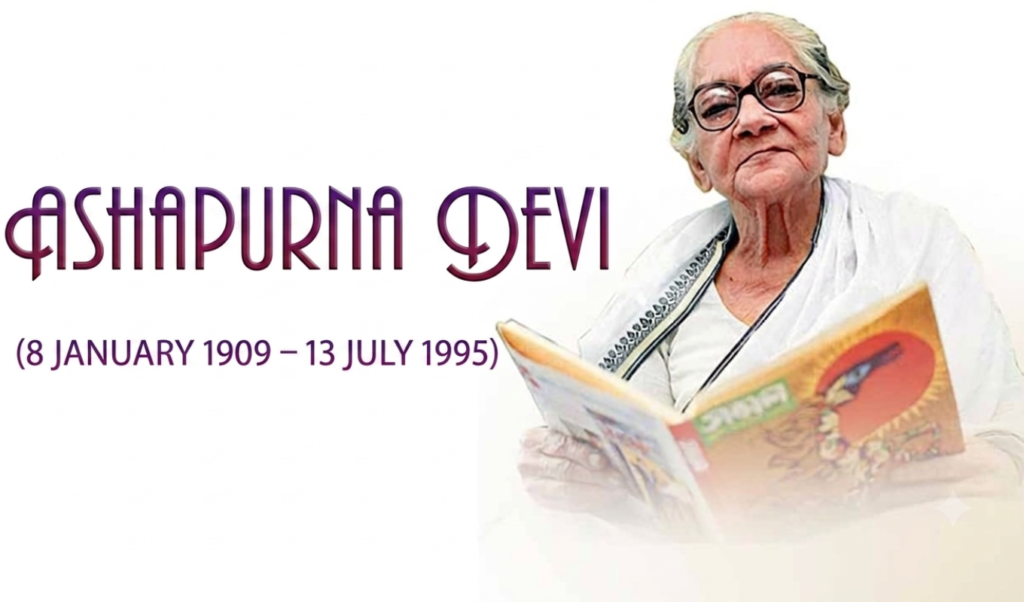
Certain luminaries in Bengali literature cast a light that transcends time, guiding successive generations. Ashapoorna Devi remains one such radiant star. Far beyond a popular novelist, she was a profound storyteller, a keen social observer, a unique voice of humanitarian consciousness, and one of the finest literary commentators on the dignity and liberation struggle of Bengali women.
Her extensive body of work captures the intricate joys, sorrows, hopes, and anxieties of middle-class Bengali life. She masterfully portrayed the tensions of family relationships, invisible societal discrimination, the silent tears of women, and their protracted struggle for self-actualisation. She firmly believed that genuine social transformation cannot be achieved merely through legislation or governance, but must stem from a shift in human psyche, conscience, and values—a conviction that lent her literature its distinct power and longevity.
Born on 8 January 1909 into a conservative yet culturally inclined family in Calcutta, her father, Harendranath Gupta, was a painter, and her mother, Saralasundari Devi, was an avid lover of literature. Due to the rigid social customs of the era, daughters were seldom sent to formal educational institutions. Consequently, she never stepped inside a school or college. Yet, an insatiable thirst for knowledge, an boundless love for books, and sheer self-effort shaped her into an extraordinary, self-taught intellectual. Within the four walls of her home, she expanded her intellectual horizon without limits.
Her literary journey began at the tender age of thirteen when her first poem was published in a children’s periodical. This marked the commencement of an unyielding literary career spanning over seven decades. Her prolific pen produced over 150 novels, more than 2,500 short stories, numerous children’s books, essays, and memoirs. Such a vast and multi-dimensional creative output remains remarkably rare in modern literature.
Ashapoorna Devi’s literary universe centred entirely on human experience, particularly the stifled pain, suppressed dreams, social disparity, and domestic oppression faced by women. Avoiding slogans or overt political rhetoric, she unveiled profound truths through the natural flow of daily life, deeply moving her readers. Her prose was simple, transparent, and unpretentious, yet possessed extraordinary underlying strength.
Her immortal trilogy—’Pratham Pratishruti’ (The First Promise), ‘Subarnalata’, and ‘Bakulkatha’—stands as an unparalleled landmark in Bengali literature. These three novels serve as an epic chronicle of the lives, struggles, dignity, and yearning for freedom across three generations of women. This trilogy transcends mere fiction; it is a vital document for understanding the history and evolution of Bengali society.
Beyond this trilogy, works such as ‘Agnipariksha’, ‘Jogbiyog’, ‘Balaygras’, ‘Chhayasurya’, and ‘Nabajanma’ illustrated the subtlest nuances of the human psyche with a skill that continues to captivate readers today. Many of her novels were adapted into critically acclaimed films and television serials, enriching the cultural landscape of Bengal.
In recognition of her monumental contributions, she was honoured with India’s highest literary award, the Jnanpith Award, in 1976. Her accolades also included the Sahitya Akademi Award, the Rabindra Puraskar, the Padma Shri, and the Deshikottam. However, her greatest reward remained the enduring affection of millions of readers across generations.
Though she passed away on 13 July 1995, her creative legacy remains untouched by death. She demonstrated that quiet resistance can rewrite history, and that education and self-respect are the true pathways to human liberation. On the anniversary of her passing, this timeless storyteller is remembered with the deepest reverence. As long as the Bengali language endures, her immortal words will continue to inspire truth, justice, equality, and human freedom.