The Sydney Opera House hosted, for the first time, a celebration of the Bengali New Year titled the ‘Baishakhi Festival and Joy’ on the evening of 17 April. The event brought together members of the Bangladeshi diaspora in Australia and featured a structured programme of music, dance, poetry recitation, and cultural performances rooted in Bengali tradition.
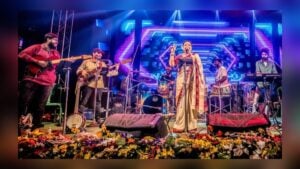
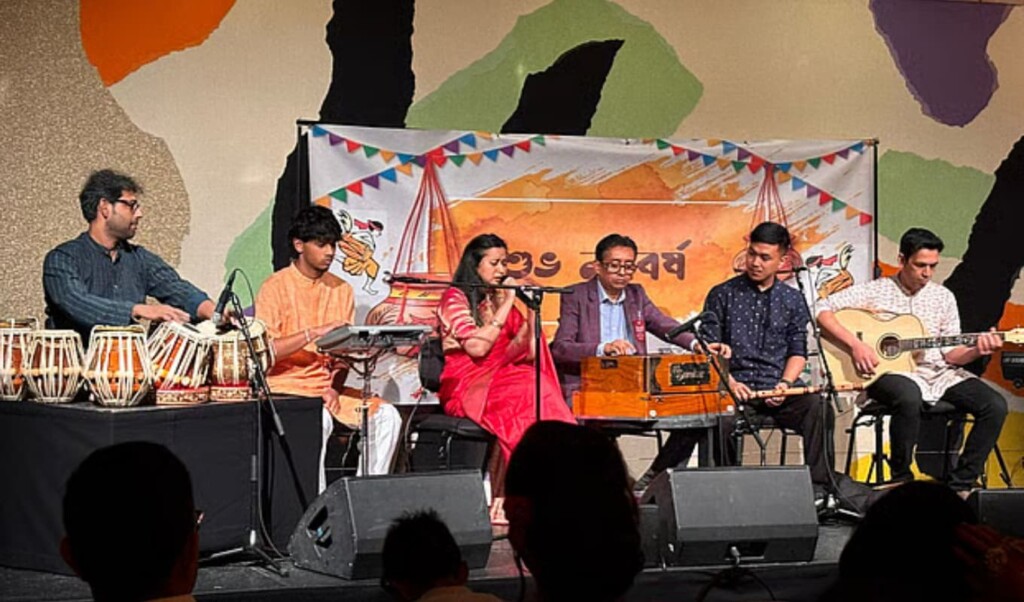
As audiences entered the performance hall, they were greeted by familiar Bengali musical arrangements performed with traditional instruments including the dhol, khol, cymbals, and ankle bells. The soundscape reflected established forms of Bangladeshi folk and classical music. The programme included staged dance presentations alongside renditions of widely recognised Bengali songs.
The musical segment featured group and solo performances of several well-known compositions. These included “Eso He Boishakh”, performed collectively, as well as “Haire Manush Rongin Fanush”, “Aaj Ei Brishtir Kanna Dekhe”, and “Harano Diner Kotha Mone Pore Jai”. Additional items in the programme included “Rail Line Bohe Somantoral” and the Nazrul Sangeet composition “Alga Koro Go Khopar Badhon”. The performances were delivered in sequence as part of a scheduled cultural programme.
Outside the venue, members of the Bangladeshi community organised a procession featuring national flags and cultural banners. Visitors and tourists present at the site observed the procession, and applause was recorded during the activity.
The event included official messages from Australian political leaders. The Prime Minister of Australia, Anthony Albanese, conveyed a greeting message to the Bangladeshi community. In his statement, he said, “This diversity is the strength of the country.” The Premier of New South Wales, Chris Minns, attended the event in person. He interacted with attendees, participated in informal discussions, and took photographs with members of the community. He later posted on social media stating, “Bangalis are now an integral part of Sydney. The Opera House event reflects their talent and unity.”
The programme was jointly organised by Bornobhumi Media, Bangladesh Ladies Club, and Bangladesh Press Media and Cultural Club. Organisers stated that the initiative was intended to present Bengali cultural expression at a globally recognised venue.
A range of performers contributed across multiple segments, including music, dance, spoken word, and instrumental accompaniment. The programme structure incorporated recitation, audio drama, and live musical instrumentation.
Participants and Roles
| Category | Names |
|---|---|
| Music Performers | Nabila Afridi, Lubaba Islam, Omia Matin, Mehedi Hasan, Mamun Hasan Khan, Rashnan Zaman, Nishat Siddiqui |
| Dance Performers | Shreyoshi Das, Ankita Roy, Oishita Roy, Swagata Chatterjee, Debjani Pal, Poulomi Panda |
| Poetry / Audio Drama | Moloy Biswas (poetry recitation), Nusrat Jahan (audio drama), Nabila Afridi (audio drama) |
| Instrumentalists | Abhijit Dan (tabla), Sohel Khan (guitar), Rashnan Zaman (keyboard), Sabin Gising (flute), Srijit Dan (sound control) |
| Presenters | Asad Shams, Roksana Hossain Jeba |
The event followed a structured cultural format combining traditional Bengali artistic forms with stage presentation in a formal international venue.