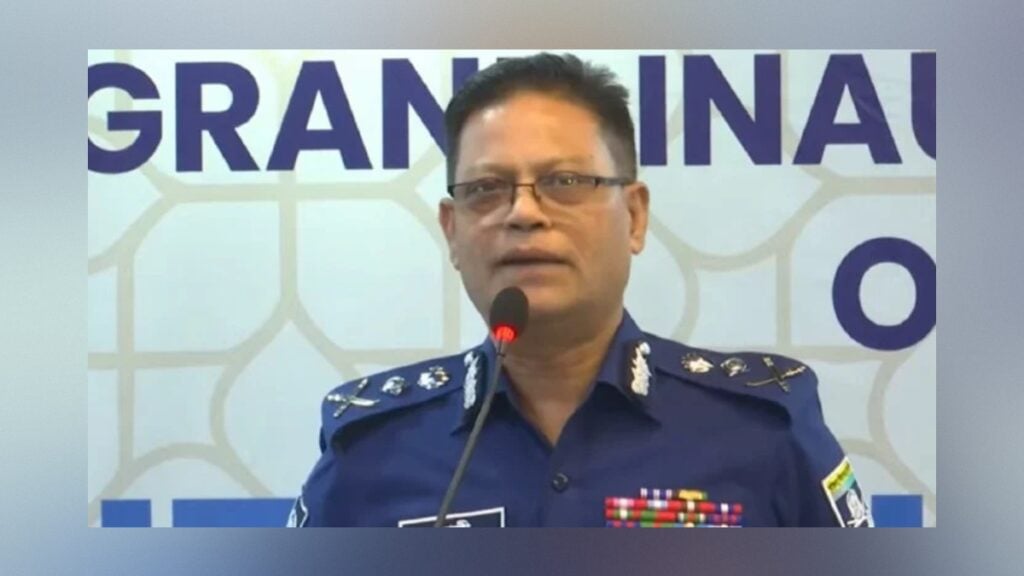
He made the remarks on Monday, 26 October, at the formal inauguration of the ‘Community Islamic Bank System’ in Dhaka’s Chawkbazar.
The police chief also called on citizens to respect the law, warning that personal freedom should not be treated as permission to act without restraint. He emphasised the role of the police in maintaining public order and ensuring that people could live in peace and security.
“People need the police to live in peace and security. Freedom does not mean that anyone can do whatever they want,” the IGP said.
He urged people not to take the law into their own hands and argued that the police should not be blamed automatically whenever an incident occurs.
Addressing the responsibilities of law enforcement agencies, Fakir said political developments and questions about who might return to the country or when were not the primary concern of the police. Their duty, he said, was to take whatever action was required under the law and the Constitution.
“Our responsibility is to apply the law and the Constitution wherever and whenever necessary. If crossfire is required and the government allows it, we will do so,” he said.
The remarks bring renewed attention to the use of force in law enforcement and the limits within which security agencies should operate. The IGP did not, however, provide further details about the circumstances in which such action might be considered or explain the specific legal basis for his comments.
IGP Alleges Political Links to Drug Trade
Fakir also expressed concern about the spread of drugs in neighbourhoods across the country, alleging that political figures associated with the former ruling Awami League had supported activities contributing to the problem.
He further acknowledged that some police personnel had been involved in drug-related activities, adding that such involvement had not been entirely eliminated.
“Today, drugs are widespread at gatherings in neighbourhoods and local communities. Who created this situation?” he asked.
The IGP alleged that leaders of the then ruling party had provided support or encouragement that helped the drug problem grow. He also acknowledged that some members of the police force had been involved in the activities, with some allegedly continuing to be implicated.
His comments highlighted concerns about the relationship between drug trafficking, political influence and alleged misconduct within law enforcement agencies. However, the allegations against political figures and police personnel were not accompanied by further details during the remarks reported at the event.
Around 27 Police Officers Sent to Jail in Two Months
The police chief said action had been taken against members of his own force as part of efforts to address internal misconduct.
According to Fakir, around 27 police officers had been sent to jail over the previous two months.
He presented the action as evidence that the police were attempting to address wrongdoing within their own ranks rather than focusing exclusively on offences committed by members of the public.
“We have sent around 27 police officers to jail in the past two months. You are seeing that we are cleaning up our own house first,” he said.
He also complained that the measures had been subject to various interpretations that, in his view, misrepresented the actions being taken.
The statement did not specify the identities of the officers, the allegations against them or the legal status of their respective cases. Being sent to jail does not, by itself, establish guilt; the outcome of each case depends on the relevant legal proceedings.
Law Enforcement and Accountability
The IGP’s remarks addressed two related issues: the need for firm action against crime and the responsibility of the police to maintain discipline within their own organisation.
Drug-related crime remains a public concern, particularly where allegations of political protection or involvement by law enforcement personnel arise. Addressing such problems requires credible investigations, accountability for misconduct and the consistent application of the law.
His comments on crossfire also raise questions about the use of force by security agencies. Any such action must be assessed against applicable law and constitutional protections, including the right to life and safeguards against unlawful use of force.
Although Fakir stressed that police operations should be guided by the law and the Constitution, he offered no detailed clarification of how his proposed approach to crossfire would operate in practice.
The event therefore served as a platform for the police chief to reaffirm his stated commitment to law enforcement, warn against taking the law into one’s own hands and highlight disciplinary action against police personnel accused of wrongdoing.