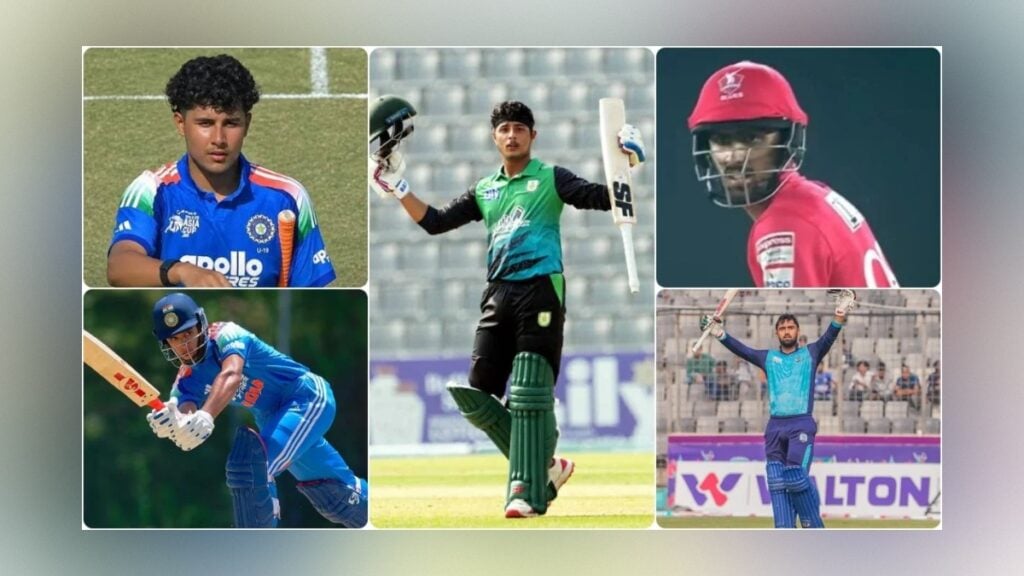
A new group of young cricketers is now emerging, with the sons of former international stars beginning to attract attention through their performances in domestic and age-group competitions. Among them are the children of Indian greats Virender Sehwag and Rahul Dravid, former Pakistan all-rounder Abdul Razzaq and Afghanistan’s veteran Mohammad Nabi. Bangladesh also has a promising name in Jishan Alam, son of former national cricketer Jahangir Alam.
While their famous surnames naturally attract attention, these youngsters are beginning to demonstrate that they have ambitions and abilities of their own.
Aryavir Sehwag: Inheriting His Father’s Aggressive Instinct
Virender Sehwag was one of the most destructive opening batters of his generation. His fearless approach, particularly in Test cricket, frequently unsettled opposition bowlers. Rather than relying on conventional defensive methods, he preferred to attack from the outset, regardless of the format or match situation.
Sehwag made history as the first cricketer to score a Test triple century and an ODI double century. He also played important roles in India’s victories at the 2007 ICC World Twenty20 and the 2011 ODI World Cup.
His son, Aryavir Sehwag, is now beginning to make his own impression in cricket. Representing India’s Under-19 set-up, the young batter has already demonstrated his ability to produce substantial scores.
One of his notable performances came against the United Arab Emirates, when he struck an impressive 160-run innings. The knock highlighted his potential as a top-order batter and brought him into the spotlight.
The comparisons with his father are understandable, particularly given their shared attacking approach. However, Aryavir still has a long journey ahead before he can establish himself in senior international cricket. His immediate challenge is to maintain consistency and make the most of opportunities at youth level.
Anvay Dravid: Continuing a Tradition of Discipline
Rahul Dravid remains one of the most respected figures in Indian cricket. Nicknamed ‘The Wall’ for his exceptional defensive technique and concentration, he built a remarkable career through patience, determination and consistency.
As a batter, he was particularly influential in Test cricket, where his ability to occupy the crease for long periods made him one of India’s most dependable players. He also captained the national side before moving into coaching.
Dravid later guided India to the final of the 2023 ODI World Cup as head coach. His contribution to the development of younger cricketers has also been widely recognised.
His son, Anvay Dravid, is following a similar sporting path. He represents Karnataka in age-group cricket and has earned selection for India’s Under-19 side. He has also featured in the Under-19 Asia Cup, gaining valuable experience in a competitive international environment.
Anvay’s progress is attracting attention because of his family background, but his future will depend on his own performances. Establishing a distinct identity and maintaining consistency will be essential as he moves towards higher levels of the game.
Ali Razzaq: Following His Father’s All-rounder Legacy
Former Pakistan all-rounder Abdul Razzaq was renowned for his powerful batting and effective medium-pace bowling. He frequently delivered important contributions in difficult situations, helping Pakistan recover from challenging positions with both bat and ball.
His son, Ali Razzaq, appears to be developing along similar lines.
The 22-year-old is also an all-rounder, combining medium-pace bowling with an aggressive batting approach. His performances in domestic cricket have already attracted interest, particularly because of his ability to contribute with the bat.
Ali made his domestic T20 debut this year and immediately made an impression, scoring 45 runs from just 26 deliveries. The innings offered an early indication of his attacking capabilities in the shortest format.
He had already shown considerable promise in first-class cricket. During the final round of the President’s Trophy, he scored 64 and 111 in the same match, demonstrating his ability to make substantial contributions across both innings.
Such performances have strengthened his reputation as a promising young cricketer. However, Pakistan’s domestic cricket structure is highly competitive, and securing a place in the national team will require sustained performances with both bat and ball.
Jishan Alam: Bangladesh’s Emerging Prospect
Bangladesh also has a father-and-son cricketing connection to follow.
Jahangir Alam, Jishan Alam’s father, represented Bangladesh in international cricket in 1999. He played three matches for the national side as an opening batter and wicketkeeper. Although his international career was relatively brief, he was known for his performances in domestic cricket.
His son, Jishan Alam, is now attempting to establish himself as a potential future member of Bangladesh’s national team.
Jishan has attracted attention through his aggressive batting in domestic competitions. His ability to score quickly has been particularly noticeable in the two white-ball formats.
His reported strike rates of 110 in List A cricket and 138 in T20 cricket underline his attacking approach. In modern limited-overs cricket, where scoring momentum often plays a decisive role, such qualities can make a young batter particularly valuable.
Bangladesh have been looking for players capable of bringing greater aggression to their batting line-up, especially in shorter formats. Jishan’s performances could therefore strengthen his prospects of attracting attention from the national selectors.
However, the transition from domestic cricket to the international stage is never straightforward. He will need to demonstrate consistency against stronger opposition and turn promising starts into substantial scores.
Hasan Esakhil: A Rare Opportunity to Play Alongside His Father
The father-and-son combination of Mohammad Nabi and Hasan Esakhil stands out among the names on this list.
The main reason is the possibility that they could represent Afghanistan together while Nabi remains active in international cricket.
Mohammad Nabi is one of the most influential figures in Afghanistan’s cricketing history. He was part of the country’s early international journey and played in Afghanistan’s first recognised match against Scotland in 2009.
An accomplished all-rounder, Nabi has contributed significantly to Afghanistan’s rise in international cricket. His experience, leadership and performances with both bat and ball have made him an important figure in the national set-up.
Remarkably, the 41-year-old continues to play professional cricket, maintaining his involvement in the game well into the later stages of his career.
His son, Hasan Esakhil, is also making progress. He has developed a reputation in Afghan domestic cricket through his fearless and attacking batting. His development has already taken him beyond the domestic circuit, with an international appearance at the Asian Games.
However, father and son have yet to share the field for Afghanistan’s senior national team.
If Nabi extends his career for a little longer and Hasan secures a regular place in the national side, the country could witness a rare sporting moment: a father and son representing the same national team at the same time.
A Famous Name, but a Career of Their Own
The emergence of these young cricketers highlights a familiar feature of professional sport. Growing up in families closely connected to cricket can provide children with early exposure to the game, valuable guidance and an understanding of the demands of professional competition.
Yet a famous surname cannot guarantee success. International cricket requires technical ability, mental strength, physical fitness and, above all, consistency.
Aryavir Sehwag, Anvay Dravid, Ali Razzaq, Jishan Alam and Hasan Esakhil are all at different stages of their development. Some have already represented their countries at youth or international level, while others are working towards opportunities in senior cricket.
Their fathers have left significant marks on the game in India, Pakistan, Bangladesh and Afghanistan. Now the responsibility rests with the next generation to build their own reputations.
Whether they eventually match or surpass their fathers’ achievements remains uncertain. What is clear, however, is that a new generation of cricketing families is beginning to attract attention, and their progress will be worth following in the years ahead.