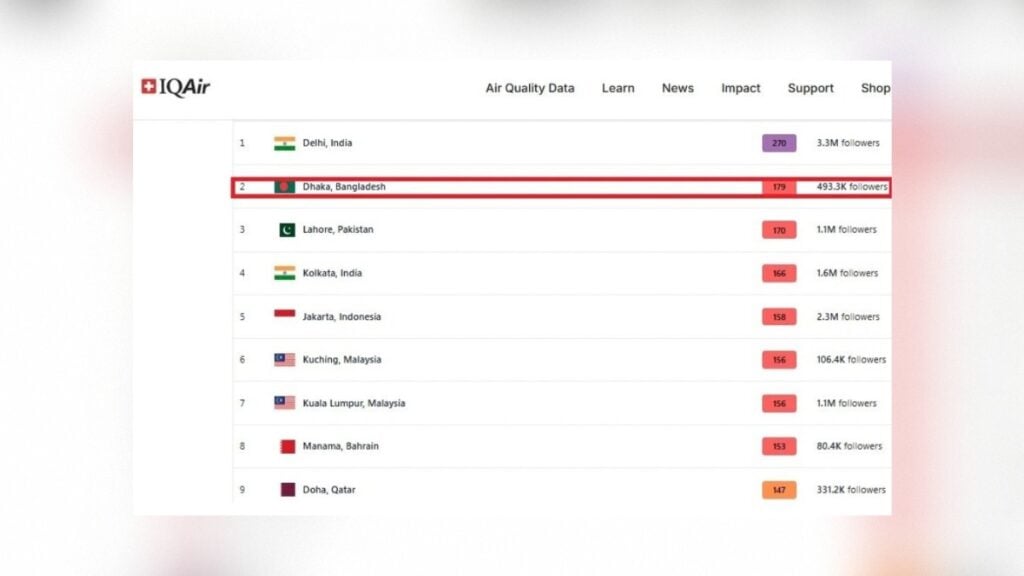
Dhaka ranked as the world’s second-most polluted city on Monday, with an Air Quality Index (AQI) score of 179, placing the capital’s air in the ‘unhealthy’ category.
According to data from IQAir, a Switzerland-based air quality monitoring organisation, India’s capital New Delhi topped the list with an AQI score of 270. The reading placed Delhi’s air in the ‘very unhealthy’ category, while Dhaka followed in second place with a substantially lower but still concerning level of pollution.
Pakistan’s Lahore ranked third with an AQI score of 170. India’s Kolkata stood fourth at 166, while Jakarta, the capital of Indonesia, ranked fifth with a score of 158.
The figures were recorded on Monday, 5 October, amid continuing concerns over dust, smoke and harmful particulate matter in the air. Dhaka’s ranking highlights the persistent challenge of managing air pollution in one of the world’s most densely populated urban areas.
IQAir classifies AQI readings from zero to 50 as ‘good’, indicating that air quality poses little or no risk. Scores between 51 and 100 are considered ‘moderate’. A reading from 101 to 150 is categorised as ‘unhealthy for sensitive groups’, while 151 to 200 is classified as ‘unhealthy’.
AQI levels between 201 and 300 are considered ‘very unhealthy’, while readings above 300 fall into the ‘hazardous’ category. Dhaka’s score of 179 therefore means that the city’s air has reached a level at which exposure can pose health concerns for the wider population, rather than only particularly vulnerable groups.
Bangladesh’s AQI is assessed using several major air pollutants. These include particulate matter such as PM10 and PM2.5, along with nitrogen dioxide (NO₂), carbon monoxide (CO), sulphur dioxide (SO₂) and ozone (O₃). Of these, fine particulate matter is a particular concern because very small particles can enter deep into the respiratory system.
Dhaka’s air pollution has been linked to several sources. A report published in March 2019 by Bangladesh’s Department of Environment and the World Bank identified brick kilns, vehicle emissions and dust from construction sites as three major contributors to pollution in the capital.
Construction and road dust can add large quantities of particles to the urban atmosphere, while vehicle exhaust contributes a range of pollutants. The combined impact becomes more noticeable when pollutants remain concentrated in the air, creating difficult conditions for people living and working in the city.
Poor air quality is not merely an environmental concern. It can have serious consequences for public health. According to the World Health Organisation (WHO), exposure to air pollution is associated with diseases and conditions including stroke, heart disease, chronic obstructive pulmonary disease, lung cancer and acute respiratory infections.
The WHO estimates that air pollution contributes to around seven million deaths worldwide each year. Children, older people and those with existing respiratory or cardiovascular problems can be particularly vulnerable to the effects of polluted air.
Dhaka’s latest ranking once again underlines the scale of the city’s air pollution problem. Long-term improvement will depend on controlling major sources of emissions, reducing dust from construction and roads, and maintaining effective monitoring of air quality across the capital.