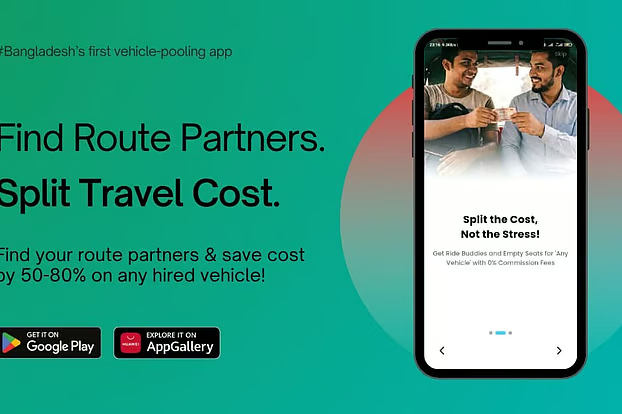
A new vehicle-pooling application is being used in Dhaka to help commuters reduce travel costs and improve transport efficiency by allowing passengers heading in the same direction to share rides in private cars, CNG-run auto-rickshaws and rickshaws.
A resident of Jatrabari, identified as Azadul Islam (pseudonym), illustrates the typical commuting challenge faced by many city dwellers. He travels daily from Jatrabari to Motijheel using buses, CNG auto-rickshaws or rickshaws, and then takes the metro rail to Karwan Bazar, where he works at a private organisation. His return journey follows the same pattern in reverse. Like many commuters, he faces overcrowded buses, risks of pickpocketing, and unpredictable fare demands from auto-rickshaws. Rickshaw fares, though relatively lower, have also increased in recent times.
Against this backdrop, Azadul and others have often considered the benefit of sharing rides with passengers travelling along similar routes, thereby splitting transport costs. This practical commuting concern has led to the development of a technological solution.
App-based pooling initiative
Three students from the Department of Urban and Regional Planning at Bangladesh University of Engineering and Technology (BUET)—Zobayer Khan, Mustakim Morsed and Abul Basar—have developed a vehicle-pooling application named “JyGo”.
The core idea behind the platform is to connect passengers travelling at similar times and along similar routes. Once matched, users can share a single vehicle and split the fare, reducing individual travel expenses significantly.
The developers state that the system is designed to optimise seat usage in private transport and reduce the number of vehicles on the road, which may also contribute to easing traffic congestion and lowering fuel consumption.
Cost-sharing mechanism
For example, if a CNG-run auto-rickshaw charges 400 Bangladeshi taka for a trip from Karwan Bazar to Jatrabari, and three passengers are matched through the app, the fare is divided among them. In such cases, each passenger pays only a portion of the total cost.
The developers claim that users may save between 50 and 80 per cent of their usual travel expenses, depending on ride matching efficiency. The service currently does not charge any commission from users.
Usage and growth
The app was launched in January on both the Google Play Store and Huawei App Gallery. Within approximately three months, it has gained over 7,500 users, with new users joining daily. It has also been ranked fourth among ride-hailing companies in the global startup network F6S listing.
Key features of JyGo
| Category | Details |
|---|---|
| Core function | Matches passengers travelling on similar routes |
| Ride types | Scheduled daily routes and instant ride matching |
| Cost model | Fare shared among passengers |
| Estimated savings | 50–80% reduction in travel cost |
| Safety features | User verification, live location tracking, emergency call option |
| Female safety option | Gender preference setting for women-only shared rides |
| Commission | None currently charged |
| Coverage | Currently Dhaka-based |
Operational process
Users download the app from digital app stores and register using their name and mobile number. Two main ride options are available: scheduled routes for regular commuters and instant rides based on live location matching. The system connects nearby passengers heading in the same direction.
Safety and limitations
Given concerns about travelling with strangers, the platform includes identity verification, live tracking and emergency contact features. A gender preference option allows women to choose female-only ride-sharing arrangements.
However, the system still faces limitations. The relatively small user base means that matching passengers on certain routes can take time, and delays may occur during ride requests. The developers acknowledge that the effectiveness of such a platform depends heavily on user volume.
Future expansion
The founders plan to expand the service beyond Dhaka, with potential international rollout under consideration. Pilot operations in Malaysia are planned for next month, followed by possible expansion into India and Sri Lanka.
Academic perspective
Professor Ishrat Islam of BUET’s Department of Urban and Regional Planning has described the initiative as promising, noting that shared mobility concepts could add a new dimension to urban transport systems. However, she also emphasised the importance of strengthening safety mechanisms as the system grows.
In summary, JyGo represents an emerging attempt to integrate digital matching technology with everyday commuting needs in Dhaka, aiming to reduce transport costs while improving efficiency in a densely populated urban environment.