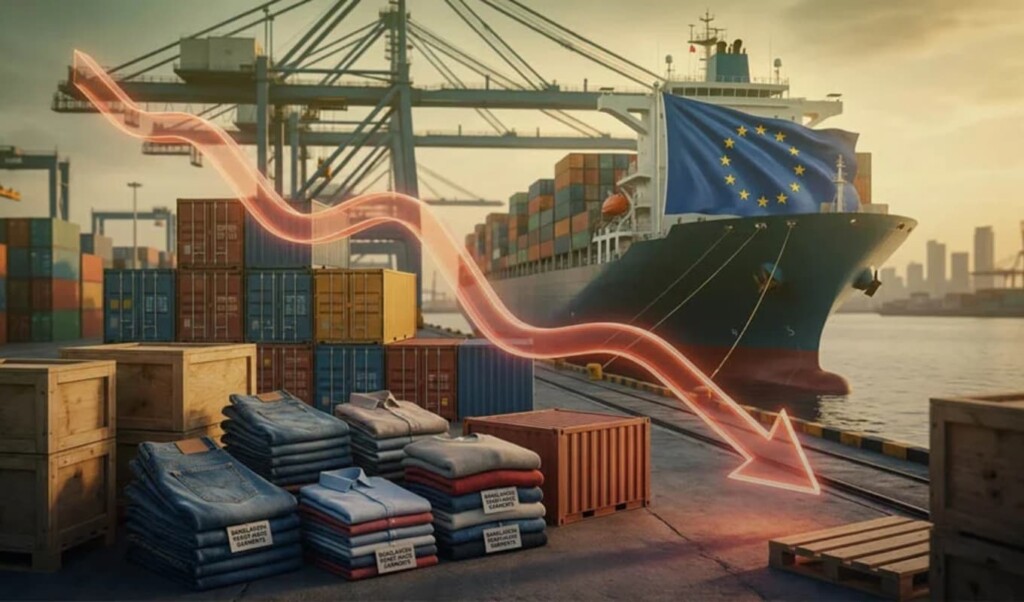
A reliance on low-cost manufacturing is no longer sufficient to secure Bangladesh’s dominant standing in the global apparel trade. Official trade data reveals that the South Asian garment giant is losing ground in the European Union (EU) market, even as regional competitors like Vietnam manage to grow export revenues by shifting towards higher-value product categories.
Data published by Eurostat, the EU’s official statistical portal, indicates that total apparel imports by European brands and retailers fell by 9.70 per cent year-on-year to €41 billion in the first six months of the current year. However, the contraction was particularly pronounced for Bangladesh, which saw its export value to the bloc slide by 16.43 per cent to €8.64 billion. Consequently, Bangladesh’s share of total EU garment imports dipped from 22.73 per cent to 21.03 per cent over the same period.
In contrast, Vietnam demonstrated strong resilience through a high-value export strategy. Whilst its total shipped volume in weight decreased by 11.52 per cent, Vietnam’s total export revenue edged up by 0.36 per cent to €2.07 billion. This growth was driven by a 13.43 per cent rise in its average unit price, which reached €29.32 per kilogram. By comparison, Bangladesh experienced a double blow: export volumes fell by 8.22 per cent, while its average price dropped by 8.94 per cent to €13.88 per kilogram—less than half the average value fetched by Vietnamese apparel.
Key trade metrics from the first half of the year highlight these shifting market realities:
-
Overall EU Import Market: Total apparel purchases dropped 9.70 per cent to €41 billion, despite a brief 3 per cent uptick recorded in June.
-
China’s Leadership: Maintained its status as the primary apparel supplier to the EU, commanding a 28.80 per cent market share.
-
Bangladesh’s Retrenchment: Recorded a 16.43 per cent decline in export revenue and an average unit price drop to €13.88 per kilogram, though June saw a slight 0.87 per cent revenue bump due to a 6.53 per cent increase in volume.
-
Vietnam’s Margin Advantage: Secured €2.07 billion in export sales with an average price of €29.32 per kilogram, allowing revenue to grow by 0.36 per cent despite lower overall volume.
Industry representatives attribute this disparity to differences in product specialization and domestic production stability. Sheikh H. M. Mustafiz, Director at the Bangladesh Garment Manufacturers and Exporters Association (BGMEA), highlighted that volatile cotton prices have driven global retail demand toward synthetic and man-made fibre (MMF) clothing. Vietnam’s manufacturing base is heavily oriented toward MMF products, whereas Bangladeshi factories remain concentrated on cotton-based garments.
Additionally, Bangladeshi exporters face growing headwinds at home, including weeks of severe gas and electricity shortages that jeopardize order fulfillment during the crucial summer sourcing cycle. With neighboring competitors such as India benefiting from trade arrangements and stronger buyer links, Bangladesh’s apparel sector faces an urgent imperative to modernize energy supplies, diversify into synthetic textiles, and upgrade its product offerings.