Some journalists in Bangladesh are becoming increasingly cautious about expressing their views on social media, fearing harassment, threats, professional repercussions and other possible consequences, according to a small-scale survey conducted by Dataful.
The findings come from the first edition of Dataful’s ‘Expression Pulse’, an initiative examining journalists’ experiences of expressing themselves in digital spaces. The survey sought to understand how concerns about possible repercussions have influenced journalists’ willingness to speak publicly on matters of public interest.
According to Dataful, the survey was conducted between 10 and 25 August and focused on journalists’ experiences over the preceding six months. A total of 22 media professionals took part in the exercise.
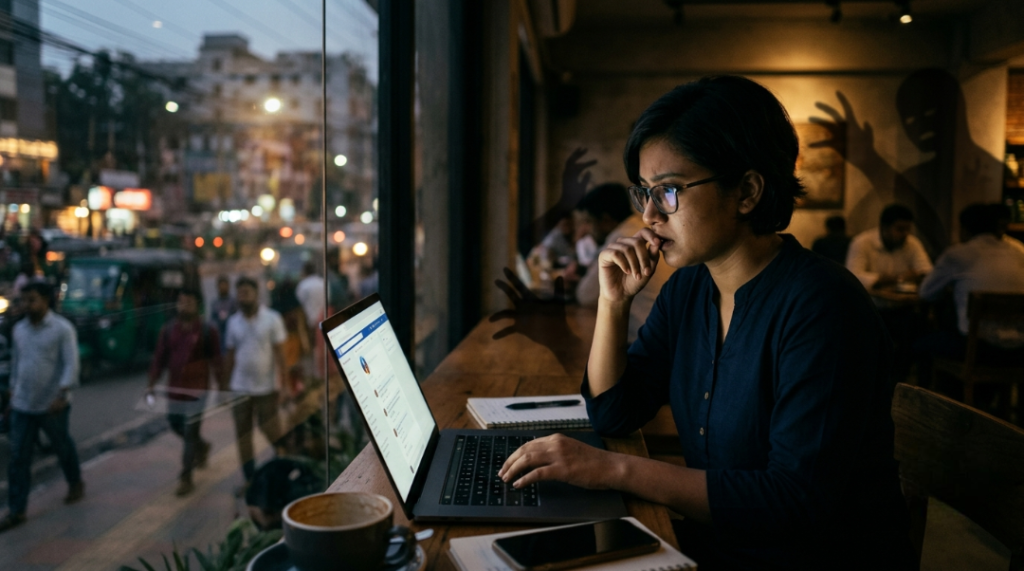
The findings suggest that the fear of consequences is influencing how some journalists use social media. Of the 22 respondents, 18 said they had refrained from expressing their views online on issues concerning the public interest because they were worried about what might happen afterwards. Among them, 13 said they had done so frequently.
Other journalists’ experiences are influencing behaviour
One of the most significant findings concerns what the report describes as a ‘chilling effect’ — where the experience of one person can discourage others from exercising their own freedom of expression.
All 21 respondents who answered a question about whether the harassment or attack of another journalist over online expression affected their own willingness to speak said that it did.
Twelve journalists said such incidents affected them ‘significantly’, while nine said they were affected ‘to some extent’.
The finding indicates that the consequences faced by one journalist may extend beyond the individual involved. When journalists witness colleagues being targeted, they may reassess their own exposure to risk before commenting on contentious issues.
This can gradually influence the wider digital environment, particularly when journalists are expected to discuss politically or socially sensitive matters as part of their professional and public roles.
Sensitive subjects increasingly being avoided
The survey also identified several subjects that journalists are currently reluctant to discuss openly on social media.
These include politics, political parties and political figures, criticism of the government, religion, communal issues, law and order, the economy, foreign policy and matters involving sexual violence, including rape.
Nineteen journalists who participated in the survey said they currently avoid discussing such subjects on social media.
The level of comfort journalists feel when expressing themselves online also appears to have declined. Fifteen of the 22 respondents said they were less comfortable expressing their views on social media than they had been six months earlier.
Of those 15 journalists, nine described the decline in their comfort level as ‘much lower’, while six said it was ‘somewhat lower’.
Online threats can have offline consequences
The concerns identified in the survey extend beyond online criticism or abusive comments. Some respondents said they were worried about organised online harassment, threats, the disclosure of personal information, reputational damage and professional consequences.
They also cited workplace pressure, political reactions and possible legal complications among the issues that influence their decisions.
For some journalists, the concern goes further still: they fear that disputes originating online could eventually affect their personal safety or that of their families.
That possibility can create a particularly strong deterrent. A journalist deciding whether to publish a personal opinion may not only consider the immediate reaction on social media, but also whether the expression could lead to consequences outside the digital sphere.
The survey indicates that these concerns are already affecting professional life. Thirteen respondents said worries about negative consequences had influenced both their personal expression and their professional journalism.
Freedom of expression remains a wider concern
The findings come against a longer-running debate in Bangladesh over freedom of expression in the digital public sphere.
Concerns surrounding laws governing online speech have previously been raised by journalists, rights groups and other observers. The Digital Security Act, which preceded the Cyber Security Act, was particularly controversial, with critics arguing that its provisions could contribute to self-censorship among journalists and others using digital platforms.
The broader issue is not limited to legislation. Online abuse, coordinated harassment, threats and the possibility of professional or personal repercussions can also shape how freely journalists participate in public debate.
For journalists, social media has become an important space for commenting on current affairs, sharing reporting and engaging with audiences. At the same time, the risks associated with public expression can make that space difficult to navigate, particularly when discussions involve politically sensitive or contentious subjects.
Dataful’s survey seeks to capture how those pressures are being experienced by journalists at an individual level and whether their behaviour has changed over time.
Survey has important limitations
Dataful has cautioned against treating the findings as a nationally representative picture of journalists in Bangladesh.
Only 22 media professionals participated in the survey, and they were not selected through random sampling. As a result, the findings cannot be used to claim that all Bangladeshi journalists share the same experiences or concerns.
Instead, the survey provides a limited snapshot of how a group of journalists perceive online expression and the risks associated with it.
Even with those limitations, the responses point to a recurring concern: the fear of possible consequences may affect not only what journalists publish, but also what they choose not to say.
The survey’s findings therefore highlight a wider question about the health of digital public debate in Bangladesh — whether journalists can discuss matters of public interest openly, or whether the experiences of harassment and threats are encouraging some to retreat from online expression.