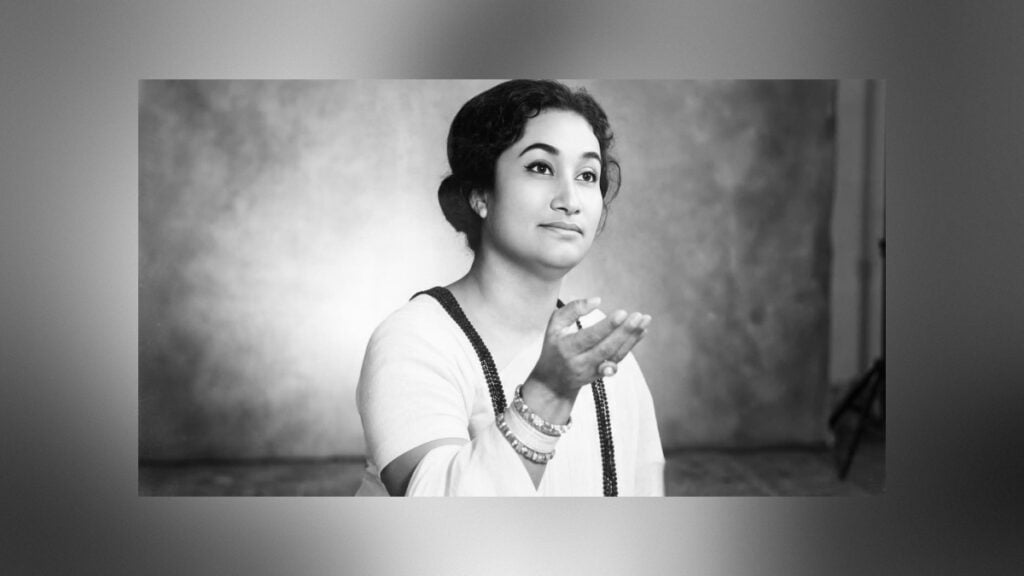
Some voices do more than sing. They capture the emotions of an era and become part of a nation’s cultural memory. Firoza Begum was one such artist. Revered as one of the most distinguished exponents of Nazrul Sangeet, she gave a distinctive musical identity to the songs of Bangladesh’s national poet, Kazi Nazrul Islam.
Through her voice, Nazrul’s compositions found an extraordinary range of expression. Love, separation, devotion, humanity and rebellion were all reflected in her performances. Her contribution to the tradition of Nazrul Sangeet across the subcontinent has therefore continued to command respect long after her death.
Firoza Begum was born on 28 July 1930 in the village of Ratuil Ghonapara in Gopalganj. She was born into a prominent family. Her father was Khan Bahadur Mohammad Ismail and her mother was Begum Kowkabunnesa.
Her interest in music developed at an early age. At just 10, she came into contact with Kazi Nazrul Islam and had the opportunity to receive training in his songs directly from the poet. That early association became a defining influence on her musical journey and helped shape her lifelong connection with Nazrul’s work.
Her talent was evident while she was still a schoolgirl. During her sixth-grade studies, she performed on All India Radio. In 1942, when she was only 12, an HMV 78-rpm record featuring her voice and Islamic songs was released. Her early appearance on radio and commercial recordings established her as a remarkably gifted young performer.
Her musical development was also influenced by composer, singer and lyricist Kamal Dasgupta. The two married in 1955. Firoza Begum had been living in Kolkata since 1954 before returning to Dhaka in 1967.
Although she performed across several musical genres, her most enduring identity was as a singer of Nazrul Sangeet. Her first record of Nazrul’s songs was released in 1949. Over the years, her voice became closely associated with the poet’s compositions, and her performances helped bring their emotional and musical depth to generations of listeners.
After Nazrul became seriously ill, preserving the correct tunes and musical traditions of his compositions became an important concern. Firoza Begum played a significant role in maintaining and presenting his songs appropriately, contributing to the continuity of the Nazrul Sangeet tradition.
In her interpretation, Nazrul’s songs could take on very different moods. Songs of love carried tenderness; songs of separation conveyed longing and melancholy; devotional pieces expressed reverence; while compositions rooted in protest and resistance carried strength and intensity.
Her repertoire was not limited to Nazrul Sangeet. She also performed modern Bengali songs, ghazals, qawwali, bhajans, hamd and naat. Her musical career took her beyond Bangladesh, and she participated in more than 380 solo musical programmes in different countries. Her distinctive voice and performance style established her as a widely recognised artist across the region.
Over the course of her long career, numerous recordings of her performances were released in different formats, including LPs, EPs, audio cassettes and CDs. She performed on stage and radio and left a lasting mark through her recorded work as well.
One memorable moment came in 1972, when she performed alongside Kamal Dasgupta at the Banga Sanskriti Sammelan in Kolkata. Their appearance reflected both their professional partnership and their shared place in the musical landscape of the time.
Firoza Begum’s contribution to music was recognised with numerous awards and honours. In 1979, she received the Independence Award, Bangladesh’s highest civilian honour. She also received the Ekushey Padak, Netaji Subhas Chandra Award, Satyajit Ray Award, Nasiruddin Gold Medal, Bangladesh Shilpakala Academy Gold Medal, Nazrul Academy Award and Churulia Gold Medal, among other distinctions.
Burdwan University awarded her an honorary D.Litt degree. In 2011, she received the Meril-Prothom Alo Lifetime Achievement Award, while in 2012 she was honoured with the ‘Banga Samman’ by the Government of West Bengal.
Yet her greatest legacy lies beyond the list of awards. It rests in the way she interpreted and preserved Nazrul’s music for generations of listeners. Her performances allowed audiences to experience the many dimensions of Nazrul’s artistic world through a voice that was both distinctive and deeply expressive.
Firoza Begum died on 9 September 2014. Her death marked the passing of one of Bangladesh’s most celebrated voices in Nazrul Sangeet. But her music did not disappear with her.
Her recordings continue to carry her voice to new listeners. For those who grew up hearing her songs, they remain connected with memories of love, longing, devotion and resistance. For younger generations, her recordings offer an enduring gateway to the musical legacy of Kazi Nazrul Islam.
Firoza Begum’s life was closely intertwined with one of the richest traditions in Bengali music. She did not merely sing Nazrul’s compositions; through her interpretation, she helped preserve their emotional character and keep them alive in the public imagination.
On her death anniversary, she is remembered not simply as a celebrated singer, but as an important figure in the cultural history of Bangladesh. Her voice may have fallen silent in 2014, but the songs she left behind continue to resonate.
Firoza Begum remains a lasting name in Bengali music—a singer whose artistic legacy continues to live through the timeless songs of Nazrul Islam.