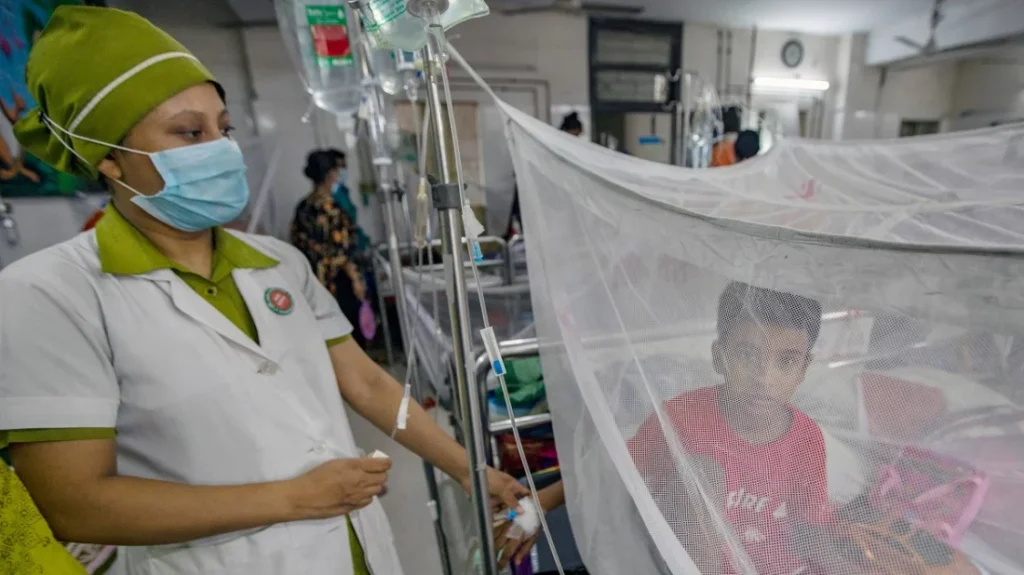
Five more people have died from dengue in Bangladesh over the past 24 hours, taking the country’s death toll from the mosquito-borne disease to 102 this year.
The latest figures were released by the Directorate General of Health Services (DGHS) in a daily dengue update on Tuesday, 1 September. The report also recorded 1,324 new hospital admissions during the same period, pushing the total number of people hospitalised or treated for dengue this year to 37,170.
Dhaka Division accounted for the largest share of new admissions, with 578 patients admitted over the 24-hour period. Khulna Division followed with 246 cases, while 139 patients were admitted in Chattogram Division.
The figures also show a significant number of new cases in several other parts of the country. Barishal recorded 121 admissions, Rajshahi 114, and Mymensingh 87. Rangpur reported 34 new patients, while five people were admitted in Sylhet.
The latest distribution highlights the continuing spread of dengue beyond the capital. Although Dhaka recorded by far the highest number of new admissions, the sizeable figures from Khulna, Chattogram, Barishal and Rajshahi indicate that healthcare facilities in several regions are also dealing with a growing number of patients.
Dengue is transmitted primarily by the Aedes mosquito, which can breed in relatively small collections of stagnant water around homes, workplaces and other urban and residential areas. As a result, controlling mosquito breeding sites remains a key part of efforts to contain transmission.
The rising number of hospital admissions also places additional pressure on health facilities, particularly in areas where patient numbers increase rapidly over a short period. Early detection and appropriate medical supervision are therefore important, especially for patients whose condition may deteriorate after the initial fever subsides.
Common symptoms of dengue include high fever, headache, muscle and joint pain, weakness, nausea and vomiting. Some patients can develop more serious complications, including bleeding, fluid loss and circulatory problems. People experiencing symptoms consistent with dengue are generally advised to seek medical assessment rather than relying solely on self-medication.
The latest figures come as public health authorities continue to face the seasonal challenge of controlling Aedes mosquitoes. Removing stagnant water from flowerpots, discarded containers, rooftops, construction sites and other potential breeding grounds can help reduce mosquito populations around residential areas.
Household precautions are also relevant when someone is infected. Protecting dengue patients from further mosquito bites can reduce the chance of mosquitoes acquiring the virus from an infected person and subsequently transmitting it to others.
With 1,324 new admissions recorded in a single day and the annual death toll now standing at 102, the latest DGHS figures underline the continuing burden of dengue on Bangladesh’s healthcare system. The concentration of new admissions in Dhaka, alongside substantial numbers in other divisions, also points to the need for sustained mosquito-control and disease-prevention measures across the country.