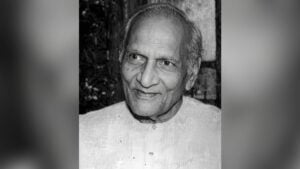
In the vast expanse of Bengali literature, very few poets have managed to articulate the collective consciousness, existential struggles, and socio-political awakenings of a nation with as much resonance as Farrukh Ahmad. Revered as the pioneering voice of the Muslim Renaissance in Bengal, his work transcends mere aesthetic beauty. Through a masterly fusion of Arabic and Persian vocabulary, rooted traditions, and a fiercely rebellious spirit, he carved an enduring legacy. His seminal query from the famous poem Panjeri—”How long until dawn breaks, O Panjeri?”—remains a timeless cry for liberation, echoing the timeless human longing to emerge from dark oppression into the light of a new morning.
Formative Years and Academic Journey
Born on 10 June 1918 in Majhail village, situated in the Sreepur Upazila of Magura district, Syed Farrukh Ahmad was the son of Khan Sahib Syed Hatem Ali, a police inspector, and Begum Raushan Akhtar. His fascination with verse began in early childhood, prompting him to start writing while still a teenager.
He completed his Matriculation from Khulna Zilla School in 1937, before progressing to Ripon College in Kolkata, where he passed his Intermediate in Arts (IA) in 1939. Subsequently, he enrolled at Scottish Church College to pursue a BA Honours degree in Philosophy and English Literature. Although he left prior to graduation, records indicate he continued his academic pursuits at City College, Kolkata. These formative years exposed him to Western philosophy, modern political thought, and humanist ideals, laying a rich intellectual foundation for his burgeoning literary career.
Professional Career and Editorial Endeavours
Farrukh Ahmad entered the civil service in 1943, taking up a post at the IG Prison Office in Kolkata, before moving to the Civil Supply Department the following year. Yet, administrative duties never diminished his passion for the written word. In 1945, he assumed the editorship of the prestigious monthly journal Mohammadi, an experience that placed him at the very heart of Kolkata’s contemporary literary and cultural discourse.
Following the partition of the subcontinent, he relocated to Dhaka and joined Radio Pakistan as a staff artist. During his tenure at the broadcaster, he directed Khelaghar, an enormously popular children’s radio programme. Through this platform, he played a pivotal role in nurturing youthful imaginations, promoting creative thinking, and fostering an engaging educational environment. Throughout his working life, he maintained an extraordinarily diverse output, spanning poetry, satirical verses, sonnets, and children’s literature.
Ideological Evolution and Social Consciousness
The poet’s intellectual journey saw significant shifts over time. As a student, he was drawn to M.N. Roy’s radical humanism and aligned himself with leftist political movements. Later, the spirit of the Pakistan Movement and Islamic revivalist philosophy deeply influenced his creative direction. While frequently lauded as the “Poet of the Muslim Renaissance”, confining his legacy strictly to a single religious or political identity does a disservice to the multifaceted nature of his oeuvre. His work consistently advocated for moral dignity, self-respect, and resistance against social decay.
When the Bengali Language Movement erupted in 1952, he stood firmly in defence of his mother tongue and the cultural rights of the Bengali people. His writings frequently contained sharp critiques of religious bigotry as well as the oppressive policies of the ruling Pakistani regime. Biographical accounts also highlight his support for the 1971 War of Liberation. Ultimately, while scholars may debate his shifting political allegiances across different historical eras, his artistic genius and unique linguistic contributions remain beyond dispute.
Lash: Witnessing the Devastation of Famine
The horrific Bengal Famine of 1943 wrought unprecedented devastation, leaving millions dead and destroying the social fabric of the region. Out of this human tragedy emerged Farrukh Ahmad’s striking poem Lash (The Corpse). The work marked a defining moment in his career, confronting readers with the grim realities of hunger, poverty, and human helplessness.
In Lash, he shed the role of a detached romantic artist to become an uncompromising witness to history. The poem forced society to confront its own conscience, demonstrating that art in times of crisis must serve a higher purpose than mere aesthetic decoration; it must feel the collective anguish and demand moral accountability.
Sat Sagarer Majhi: Establishing a Unique Poetic Voice
Published in 1944, Sat Sagarer Majhi (The Sailor of the Seven Seas) stands as Farrukh Ahmad’s undisputed masterpiece. The collection introduced a groundbreaking poetic diction to Bengali literature. Maritime imagery—raging seas, distant horizons, ships, and intrepid sailors—serves as a grand allegory for human ambition, spiritual questing, and the search for new frontiers.
A defining feature of the collection was his seamless integration of Arabic and Persian words into native Bengali rhythms. Rather than treating tradition as a static historical relic, he used it as a dynamic force to project future aspirations. The volume firmly established his reputation as an innovator capable of blending rich vocabulary, strict metrical discipline, and vivid imagination.
Panjeri: The Searching Cry for a New Dawn
Among his most celebrated creations, Panjeri holds a special place in the Bengali literary canon. The title refers to the helmsman or guide navigating a vessel through perilous, dark waters. To a crew lost at sea, the Panjeri represents direction, hope, and survival.
The central refrain—“How long until dawn breaks, O Panjeri?”—carries deep metaphorical weight. The night signifies stagnation, despair, and systemic injustice, whilst the dawn represents liberation, renewal, and progress. Through the desperate queries of the lost sailors, the poet interrogated his own generation, demanding to know how much longer society would tolerate darkness and delay its eventual awakening.
Literary Style and Notable Works
Farrukh Ahmad was a master of form and structure. His ability to weave classical Islamic heritage with modern poetic expressions resulted in a style that was both traditional and remarkably forward-looking. He demonstrated exceptional skill in composing sonnets, showcased brilliantly in Muhurter Kabita, and gained widespread acclaim for his razor-sharp satirical verse.
His literary output was both vast and varied:
-
Sat Sagarer Majhi (1944): His landmark debut poetry collection.
-
Sirajam Munira (1952): A major poetic work rooted in Islamic history and heritage.
-
Naufel O Hatem (1961): A celebrated verse drama.
-
Dholai Kabita (1963): A brilliant collection highlighting his satirical craft.
-
Muhurter Kabita (1963): A masterclass in sonnet composition.
-
Hatemtai (1966): An epic narrative poem based on legendary tradition.
-
Pakhir Basa (1965): A charming collection of children’s literature.
-
Nutan Lekha (1969) & Harafer Chhara (1970): Delightful educational works designed for young readers.
-
Chharar Asar (1970): A testament to his enduring contribution to nursery rhymes and juvenile verse.
Farrukh Ahmad’s legacy remains a guiding light in Bengali poetry, reminding readers that even in the deepest night, the quest for dawn must never cease.