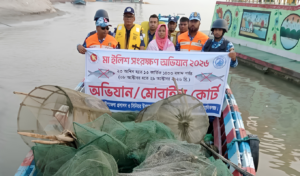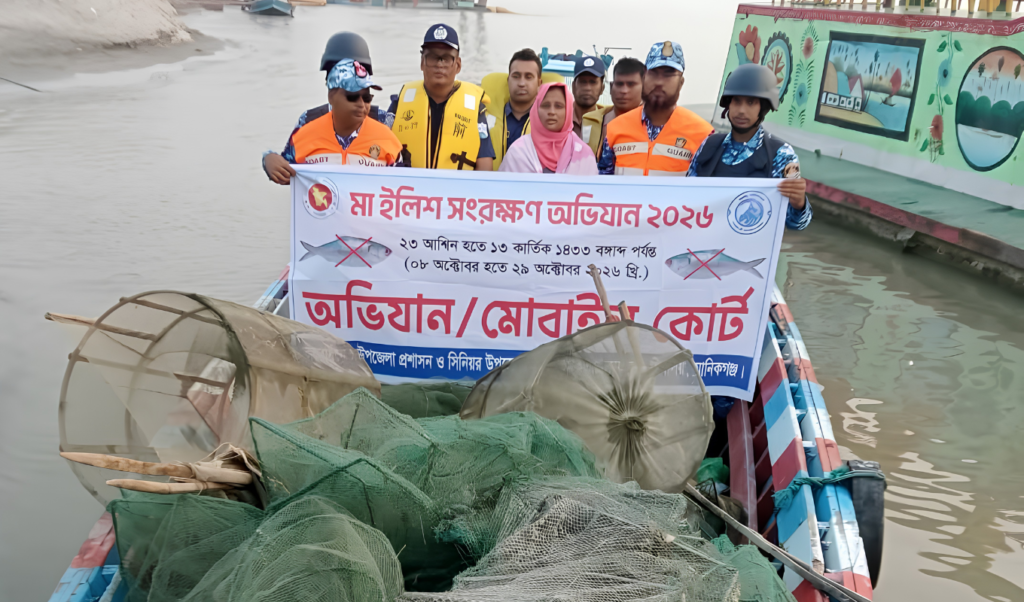
Fisheries officials in Manikganj have seized and publicly destroyed illegal fishing gear valued at approximately 602,000 Taka (£3,800) during an extensive anti-poaching drive conducted on the Jamuna River in Daulatpur upazila. The coordinated enforcement operation netted 15,000 metres of banned monofilament current nets, 38 fine-mesh box traps locally known as ‘China Duari’ nets, and roughly one kilogramme of egg-bearing mother Hilsa fish.
The operation took place on Saturday, 10 October, as part of the rigorous nationwide campaign orchestrated by the government to protect breeding Hilsa during their peak spawning season. Guided by Upazila Fisheries Officer Suraiya Akter Tonni and executed on the water by Assistant Fisheries Officer Md Mizanur Rahman, the team was accompanied by a dedicated contingent of local police personnel and key departmental staff. Enforcement vessels traversed critical aquatic stretches along the Jamuna River, inspecting fishing craft and retrieving illegal gear hidden beneath the surface.
Following the maritime operations, authorities transported the vast collection of confiscated nets directly to the Daulatpur Upazila Parishad premises. In a bid to raise public awareness and send a clear deterrent message to commercial poachers, officials incinerated the prohibited gear in full public view. Meanwhile, the seized Hilsa fish was handed over to a destitute local resident in accordance with official protocol regarding perishable confiscated items.
This local drive forms a vital link in the mandatory 22-day national fishing ban running from 8 October to 29 October 2026. During this critical seasonal window, the harvesting, transportation, marketing, stockpiling, and sale of Hilsa are strictly prohibited across all designated riverine and coastal sanctuaries. Monofilament current nets and China Duari traps present a severe threat to river ecosystems because their ultra-fine synthetic mesh indiscriminately traps juvenile fish, fingerlings, and egg-laden adults alike.
Senior fisheries officials stressed that allowing mother Hilsa to spawn without disruption remains crucial for sustaining national fish stocks and safeguarding the livelihoods of millions of traditional coastal and riverine fishing communities. Local authorities confirmed that joint law enforcement patrols, river blockades, and market inspections will continue around the clock throughout the sanctuary zone until the statutory ban period concludes.