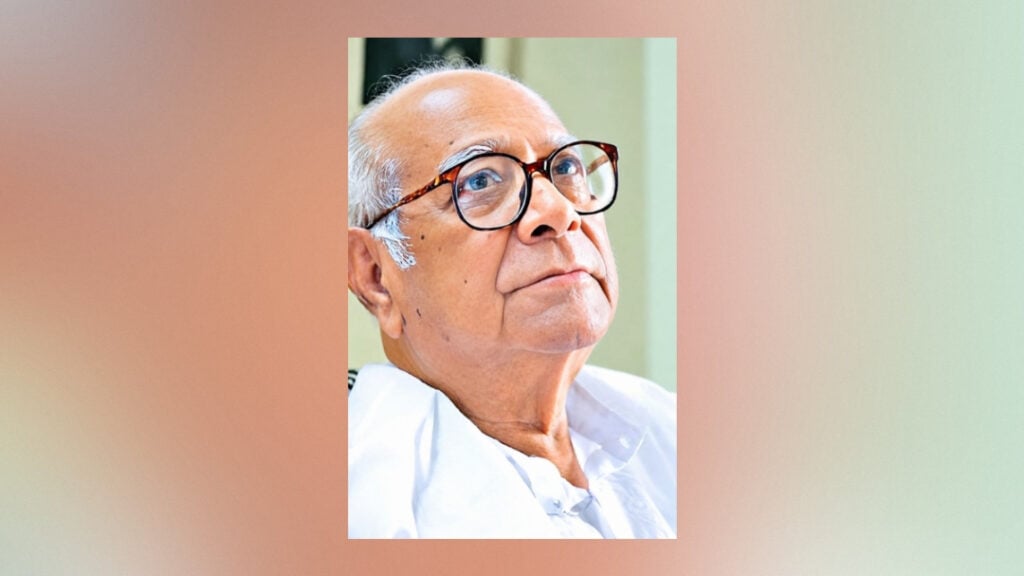
His full name was Makhdoomzada Shah Syed Kalim Ahmed Sharafi. Alongside his celebrated performances of Rabindra Sangeet, he earned widespread recognition for his patriotic songs. Yet his contribution to Bengali culture extended far beyond music. For more than six decades, he remained actively involved in progressive political, social and cultural movements. He regarded music not merely as an artistic pursuit but also as a means of expressing solidarity, defending human dignity and challenging injustice.
Kalim Sharafi was born on 8 May 1924 in Khayradihi village, under Suri subdivision in Birbhum district of West Bengal. His father was Sami Ahmed Sharafi and his mother was Alia Begum. He lost his mother when he was just four years old. During his childhood, he received his initial Arabic education from a religious teacher and learnt Bengali from a traditional scholar.
Although he grew up in a conservative family environment, his intellectual outlook gradually developed towards a more liberal and inclusive understanding of culture and society. His interests in music, literature, politics and social issues helped shape the distinctive personality for which he would later become widely respected.
His early life was marked by political awareness and resistance against injustice. While studying in the tenth grade, he became involved in the movement led by Netaji Subhas Chandra Bose to remove the Holwell Monument in Kolkata. Even as a teenager, he demonstrated leadership by taking charge of a school procession. His involvement in the protest brought him into direct confrontation with the police, and he was subjected to physical abuse.
In 1942, during the Quit India Movement against British colonial rule, Sharafi presided over a public meeting in his locality. A few days later, he was arrested under the Defence of India Act and sent to prison. Neither imprisonment nor police repression could weaken his determination to stand against injustice.
The following year, Bengal was devastated by the famine of 1943, which caused widespread starvation and suffering. At a time when thousands of people were struggling to survive, Sharafi joined fellow artistes in organising musical performances to raise funds for those affected. They travelled and sang to collect donations for famine victims.
This initiative reflected his belief that music could serve a greater purpose than entertainment. For him, songs were a powerful means of raising public awareness, promoting humanitarian solidarity and contributing to social change.
His contribution to the cultural landscape of East Pakistan, now Bangladesh, was particularly significant during the political and cultural struggles of the 1950s and 1960s. At a time when the Pakistani authorities sought to restrict the influence of Bengali culture, particularly Rabindra Sangeet, Sharafi emerged as one of the prominent voices resisting such restrictions.
In 1957, he made his debut as a playback singer by performing a Rabindra Sangeet composition in the film Akash Ar Mati. However, in 1958, his songs were prohibited from being broadcast on what was then East Pakistan Radio. The restriction remained in force until Bangladesh achieved independence in 1971.
The prohibition was part of a wider cultural environment in which Rabindranath Tagore’s works faced official resistance. Sharafi remained committed to the music despite the restrictions, continuing to uphold the artistic and cultural significance of Tagore’s compositions. His participation in the movement helped strengthen the position of Rabindra Sangeet within the Bengali cultural identity.
Sharafi also maintained a close association with the film industry. In 1962, he directed the film Sonar Kajol, featuring actors including Khalil, Sultana Zaman, Purnima Sengupta and Sumita Devi. Renowned filmmaker Zahir Raihan worked as an assistant on the production.
His involvement in filmmaking also extended to documentary productions. A documentary made under his musical direction received recognition at the Venice Film Festival. Later, his rendition of the song Pothe Pothe Dilam Chhoraiya Re in the film Surjashnan attracted considerable attention among music lovers.
He also produced a documentary on the life of Ramesh Shil, the celebrated Bengali folk poet and kabiyal. These projects demonstrated his interest in preserving different strands of Bengali musical and cultural heritage.
Throughout his long musical career, Sharafi placed greater emphasis on artistic quality and dedication than on the number of recordings he produced. His published albums included Ei Kathati Mone Rekho, Ami Jokhon Tar Duyare, Kalim Sharafir Jato Gaan, Rabindranath Thakurer Gaan and Nabajibaner Gaan. The lyrics and music of the last album were by Jyotirindra Moitra.
His performances were characterised by a deep understanding of Rabindra Sangeet, with particular attention to its lyrical meaning, emotional depth and musical expression. His voice helped introduce Tagore’s compositions to generations of listeners, while his patriotic songs reflected his commitment to the country and its people.
Sharafi’s engagement with social and political movements continued well into his later years. During the anti-autocracy movement of the 1990s, he played an important role in bringing artistes and cultural activists together against military-backed authoritarian rule.
He was also associated with the 1992 People’s Tribunal movement, which demanded the trial of those accused of committing crimes against humanity during Bangladesh’s Liberation War. His involvement in these activities came at a personal cost. In 1991, he was named as an accused in a sedition case, reflecting the political and legal pressures he faced because of his public activism.
His contribution to music and culture earned him numerous national and international honours. Among the most prestigious were the Ekushey Padak and the Independence Award, two of Bangladesh’s highest civilian recognitions. He also received the Nasiruddin Gold Medal, the Satyajit Ray Award and the Kirtiman Bangali recognition, alongside other distinctions.
His daughter, noted singer Alia Sharafi, lives in Canada, where she remains involved in various social and cultural activities.
Kalim Sharafi passed away on 2 November 2010, bringing to an end a remarkable life dedicated to music, culture and social commitment. Sixteen years after his death, his contribution remains an important part of Bangladesh’s cultural history.
His legacy cannot be measured solely by his recordings or the awards he received. He belonged to a generation of cultural personalities who considered artistic expression inseparable from social responsibility. His commitment to Rabindra Sangeet at a time of official restrictions, his participation in movements for democratic rights and his efforts to support disadvantaged communities through music all reflected the principles that guided his life.
For Sharafi, music was an expression of love, protest was a responsibility, and culture was a pathway towards human freedom. Through his interpretations, Rabindranath Tagore’s songs acquired a distinctive emotional resonance. Through his activism, he demonstrated the importance of standing against injustice and remaining faithful to one’s convictions.
Some people leave behind more than memories when they depart. Their voices, artistic contributions and ideals continue to inspire generations. Kalim Sharafi was one such figure. His name will remain deeply associated with the history of Bengali music and progressive cultural movements.
A heartfelt tribute to the memory of this legendary singer, cultural organiser and devoted practitioner of the arts.