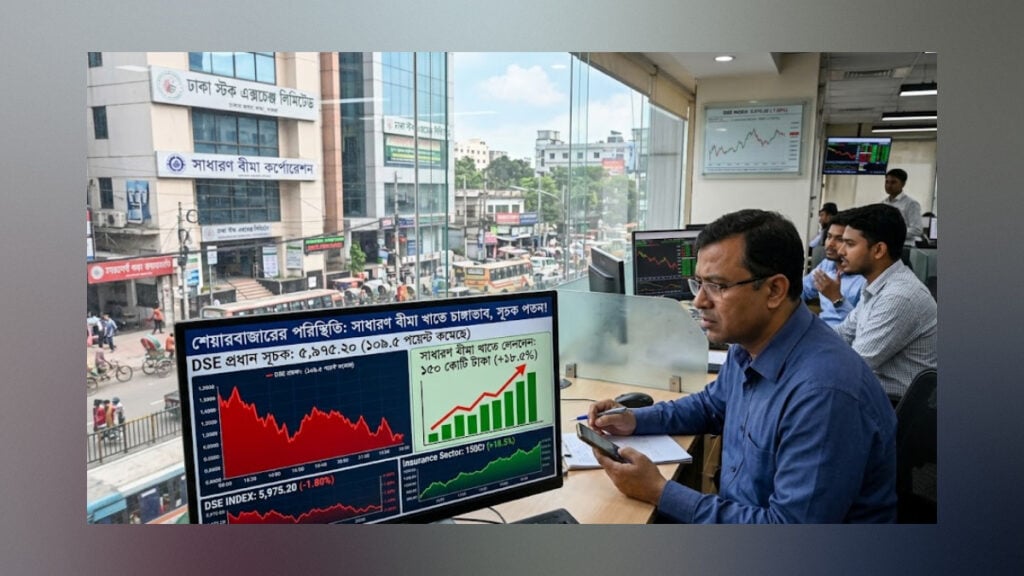
Dhaka’s stock market closed lower on Sunday as falling prices of large-cap securities put pressure on the benchmark index, despite a modest rise in overall trading turnover.
The benchmark DSEX index of the Dhaka Stock Exchange (DSE) declined by 6.9 points to settle at 5,526, compared with 5,533 in the previous trading session. The movement reflected weakness among large-cap shares, whose price changes can have a significant influence on the broader market index.
Trading activity, however, increased during the session. Turnover on the DSE rose by 2.6 per cent to Tk 740 crore, up from Tk 720 crore in the previous session, according to a report by Bangladesh Sangbad Sangstha (BSS).
The increase in turnover came even as the market ended in negative territory, indicating that investors remained active in buying and selling shares. Higher turnover does not necessarily translate into an increase in the benchmark index, as the direction of the market depends on the prices and trading activity of individual securities.
The textile sector generated the largest share of the day’s turnover, accounting for 27.2 per cent of total transactions. General insurance stocks followed, contributing 22.8 per cent, while pharmaceutical shares represented 10.1 per cent of turnover.
The broader market breadth was also tilted towards declining securities. Of the 395 issues traded on the DSE, 123 advanced, while 215 declined. A further 57 issues remained unchanged.
The figures show that the number of declining securities was substantially higher than those that gained during the session. This broad-based weakness, combined with the fall in large-cap securities, contributed to the decline in the DSEX.
The performance of individual sectors was mixed. While textile, general insurance and pharmaceutical shares accounted for significant portions of trading, the overall market remained under pressure because gains in some securities were not sufficient to offset losses elsewhere.
The Chittagong Stock Exchange (CSE) also recorded a mixed performance. Its selected index, CSCX, edged up by 0.3 points, while the All Share Price Index, or CASPI, fell by 5.6 points.
Sunday’s session therefore presented a contrasting picture for Bangladesh’s capital market. Trading turnover increased, with several sectors attracting substantial activity, but the broader direction remained negative as large-cap securities weakened and more listed issues declined than advanced.