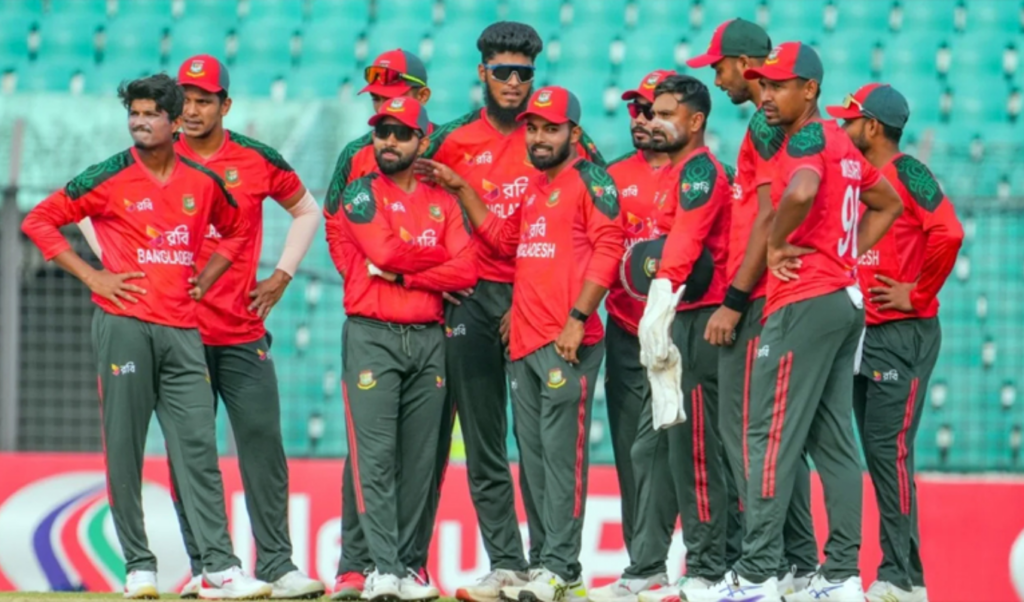
Following a disappointing loss in the third and final T20 International at Mirpur, Bangladesh captain Litton Das has publicly scrutinised the batting contributions of the team’s lower order. The defeat, occurring on Saturday, 2 May, was finalised via the DLS method, resulting in a 6-wicket victory for New Zealand. Consequently, the three-match series concluded in a 1-1 stalemate.
Litton’s post-match remarks were directed primarily at the bowling all-rounders and tail-end contingent, specifically Rishad Hossain, Mahedi Hasan, and Nasum Ahmed. The captain asserted that in the contemporary T20 landscape, it is no longer sufficient for bowlers to contribute solely with the ball; rather, significant offensive output is required from those occupying the lower-order positions.
Critique of Lower-Order Batting Standards
During the post-match press conference, the Bangladesh captain expressed his frustration with the lack of reliable “cameo” innings or secondary scoring from the bowlers. He observed that elite international cricket teams generally expect their spinners to be proficient with the bat, unless said bowlers possess rare and exceptional “mystery” spin capabilities that justify a singular focus.
Litton provided specific assessments for several players:
-
Mahedi Hasan: Although categorised as an all-rounder, Litton noted that Mahedi’s primary impact remains confined to his bowling. Despite possessing recognised batting talent, he is yet to record a half-century in international cricket—a milestone Litton believes is necessary to support the team’s total.
-
Rishad Hossain: While Rishad has a reputation as a leg-spinner capable of explosive short innings, the captain pointed out that his significant contributions remain limited to two specific performances against Sri Lanka in early 2024 (53 in an ODI and 48* in a T20I).
-
Nasum Ahmed: Although known primarily as an economical bowler, Nasum was included in Litton’s critique despite not featuring in either of the active matches in this series.
“This is exactly what I said,” Litton stated. “Rishad, Mahedi, and Nasum play as spinners, but across the world, spinners in top teams are also expected to bat. Unless you are a ‘Chinaman’ bowler with something extraordinary, you must contribute runs. Mahedi has the ability, but we need that performance to manifest in international matches. The same requirement applies to Nasum and Rishad.”
Match Analysis and the Batting Collapse
The final fixture was heavily disrupted by adverse weather conditions, leading officials to reduce the match to 15 overs per side. After being put in to bat, Bangladesh suffered a catastrophic middle-order collapse. At one stage, the home side lost seven wickets for just 39 runs, eventually being bowled out for 102 in 14.2 overs. By failing to bat out their full allocation of 15 overs, the team missed out on critical late-inning runs.
The innings’ most significant stand was a brief 22-ball partnership of 28 runs between Litton Das and Towhid Hridoy. Litton cited the early loss of wickets—where the team fell to 35-3 within the first 4.4 overs—as the turning point that placed the squad under insurmountable pressure. He noted that the pitch behaviour shifted throughout the innings, further complicating the recovery efforts.
Tactical Selection and Series Conclusion
Addressing questions regarding the team’s balance, particularly at the number seven position, Litton defended the decision to field bowling all-rounders like Mahedi Hasan (who remained unbeaten on 7 today) over specialist batters. He argued that removing a bowler to add batting depth would compromise the captain’s ability to complete the required bowling overs. “If there is a player in Bangladesh who can bat at seven and also provide four overs of bowling, please let me know,” Litton remarked pointedly.
The series overall provided a mixed narrative for the hosts. Bangladesh initially took a 1-0 lead with a 6-wicket victory in Chattogram on 27 April. However, with the second match on 29 April being abandoned due to rain, today’s victory allowed New Zealand to level the series.
New Zealand’s Bevan Jacobs was named Player of the Match for his decisive performance in the final, while Towhid Hridoy claimed the Player of the Series title for his consistent form across the fixtures. For Bangladesh, the series concludes with a directive from the captain that the lower order must evolve into more versatile contributors if the team is to find success on the global stage.