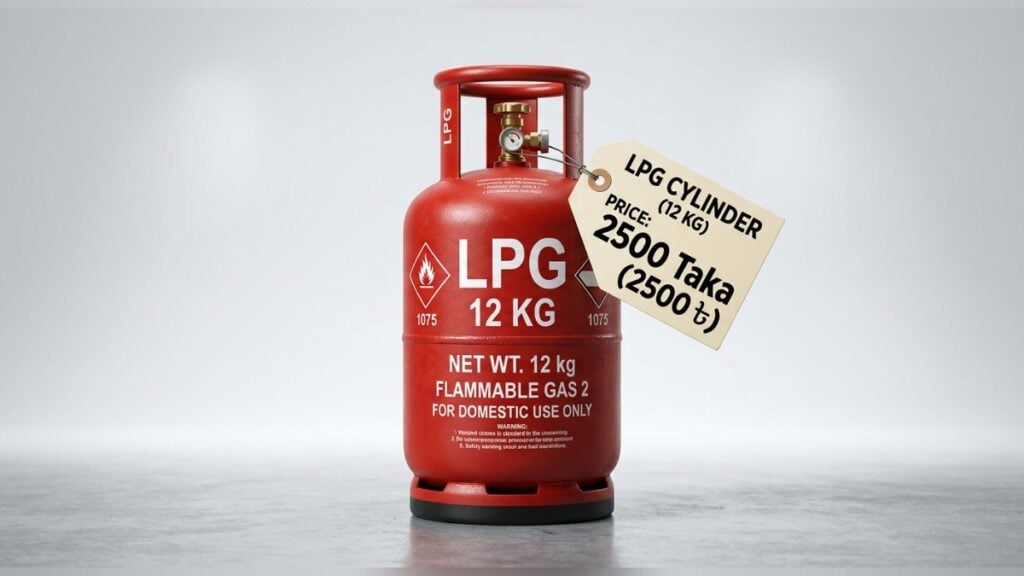
The price of liquefied petroleum gas (LPG) has risen sharply in Bangladesh, with consumers reporting that a 12kg cylinder is being sold for as much as Tk2,500 in parts of the market. The price is substantially higher than the rate set by the Bangladesh Energy Regulatory Commission (BERC), raising concerns over supply disruptions, distribution practices and alleged artificial shortages.
For September, BERC fixed the retail price of a 12kg LPG cylinder at Tk1,585. Yet consumers in Dhaka and elsewhere say they have recently been paying around Tk2,000, with prices in some places climbing to Tk2,300-Tk2,500. This represents an additional cost of roughly Tk700 to Tk1,000 compared with the official rate.
Some consumers have also claimed that cylinders are difficult to obtain even when they are willing to pay the higher price. Their complaints have fuelled allegations that supplies are being deliberately restricted at certain points in the distribution chain to push up retail prices.
The situation has placed an additional burden on households that depend on LPG for cooking. Small businesses, particularly food shops and other enterprises that use LPG regularly, are also facing higher operating costs.
Retailers blame higher procurement costs
Retail sellers have rejected the suggestion that they are solely responsible for the price increases. Their explanation is that they are having to purchase LPG from distributors and dealers at higher prices, making it difficult to sell cylinders at the rate fixed by BERC.
According to traders, selling at the official price when procurement costs are already elevated would leave retailers facing losses. They have therefore pointed towards distributors and dealers as the source of the higher prices.
The conflicting accounts have raised questions about where the additional cost is being introduced. If LPG is available nationally but consumers are still paying hundreds of taka above the regulated price, the distribution chain from importers and operators to dealers and retailers will come under closer scrutiny.
Government says there is no shortage
Energy Minister Iqbal Hassan Mahmood has said that Bangladesh does not face an overall shortage of LPG. Speaking at the Secretariat, he said action would be taken against those found creating artificial shortages and selling cylinders at excessive prices.
The government’s position contrasts with reports from consumers who say they are struggling to find LPG at the regulated price. Establishing whether the problem is a genuine supply disruption, a distribution bottleneck or localised stock withholding will therefore be central to resolving the current market uncertainty.
Authorities are also expected to examine whether traders are charging prices that exceed the rates set by the regulator and whether supplies are reaching retailers as intended.
Import dependence adds pressure
Bangladesh’s LPG market is heavily dependent on imports. Around 98 per cent of the country’s LPG is imported by private-sector companies, while roughly 80 per cent of the product is used by households.
That dependence means domestic prices can be affected by international LPG prices, shipping costs, import expenses and movements in the foreign exchange market. BERC takes such factors into account when setting monthly LPG prices.
The regulator’s fixed price, however, only provides a benchmark for the retail market. The effectiveness of that price ultimately depends on whether LPG can be supplied through the distribution network at costs consistent with the regulated rate.
For households, the immediate concern is straightforward: a cylinder officially priced at Tk1,585 is reportedly costing up to Tk2,500 in some markets. The difference can amount to nearly Tk1,000 for a single cylinder, turning what would normally be a routine household expense into a significant additional burden.
The government has indicated that consumers should not have to pay inflated prices if supplies are adequate. If investigations establish that artificial shortages or unjustified overcharging are taking place, enforcement measures could follow.
The current dispute has therefore shifted attention beyond the retail shops themselves. Consumers want LPG to be available at the regulated price, while traders say their own costs make that impossible. How authorities reconcile those competing claims—and where the extra cost is actually being generated—will determine whether the current price pressure eases or continues into the coming weeks.