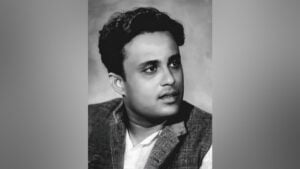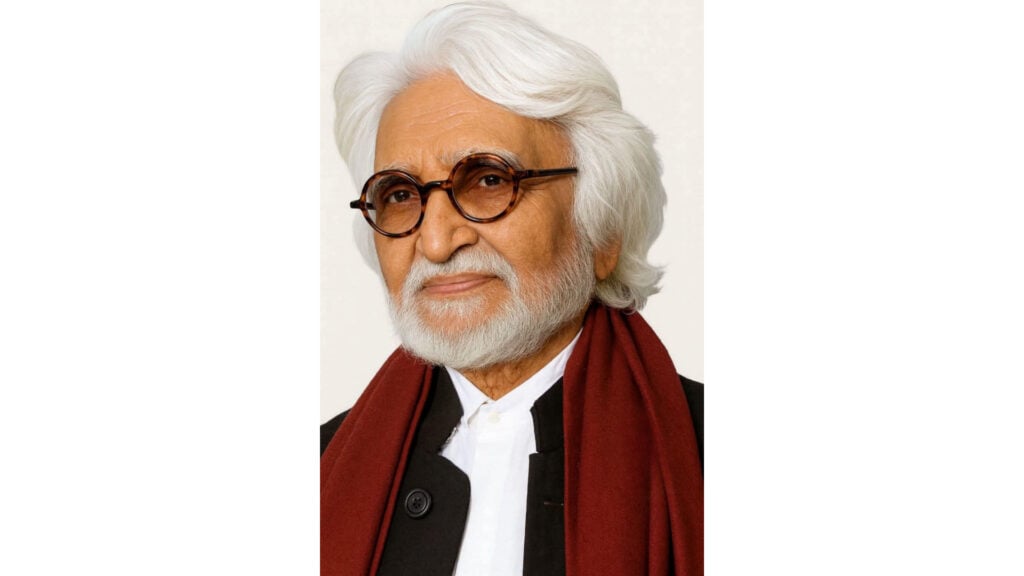
Maqbool Fida Husain, widely known as M.F. Husain, remains one of the most distinctive figures in modern Indian art. With bold lines, vivid colours and an unmistakable visual language, he transformed subjects drawn from Indian mythology, history, culture and everyday life into works that gained recognition far beyond the subcontinent.
For Husain, the canvas was more than a surface on which to paint. It was a space through which he could interpret life, capture the spirit of his time and express his imagination. His work brought together elements of Indian folk traditions and cultural memory with influences from modern Western art, creating a style that was recognisably his own.
Husain was born on 17 September 1915 in Pandharpur, Maharashtra. He lost his mother at an early age and later grew up in Indore, where his interest in art developed steadily. He did not follow the conventional route of formal art education. Instead, persistence, experimentation and close observation helped him develop the distinctive artistic vocabulary that would eventually make him an internationally recognised name.
In the early part of his career, Husain earned a living by painting cinema posters and billboards. The work required him to produce large-scale images quickly, using strong and expressive strokes. That experience contributed to the energetic lines and confident forms that later became characteristic of his paintings.
His subjects were remarkably varied. Ordinary people, urban life, rural settings, horses and episodes from Indian mythology all appeared repeatedly in his work. He also portrayed major historical and cultural figures, including Mahatma Gandhi and Mother Teresa. Rather than reproducing reality literally, Husain often reduced forms to powerful shapes and lines, allowing colour, movement and composition to convey emotion.
A significant turning point came in 1947, when Husain became one of the founding members of the Bombay Progressive Artists’ Group. The group emerged at a time when Indian artists were looking for new approaches to modern art and seeking to move beyond established conventions. Husain became one of the leading artists associated with this broader transformation in Indian painting.
His fascination with horses became particularly well known. In his paintings, the animal was often presented through vigorous lines and simplified forms, conveying movement and energy rather than anatomical detail. Mythological narratives from the Ramayana and Mahabharata also provided recurring inspiration, allowing him to explore Indian cultural traditions through a modern visual approach.
Husain’s creative interests extended beyond painting. In 1967, he made the short film Through the Eyes of a Painter. The film was screened at the Berlin International Film Festival and won the Golden Bear for the short-film category. The achievement demonstrated that his interest in visual storytelling was not confined to the canvas.
Popular culture also captured Husain’s imagination. He developed a particular admiration for Bollywood actress Madhuri Dixit, whose performances and appearance fascinated him. He was widely reported to have watched Hum Aapke Hain Koun..! several times. His interest in Dixit later became a memorable part of the public narrative surrounding the artist and his fascination with beauty and cinema.
Husain’s career was also marked by controversy. Several of his works became the subject of intense debate in India, while he faced legal challenges and threats. Amid the disputes, he spent extended periods outside the country. He began living in Qatar in 2006 and became a Qatari citizen in 2010. His experience subsequently became part of wider discussions about artistic freedom, religious sentiment and the boundaries of expression.
Despite the controversies surrounding some of his work, Husain received major recognition for his contribution to Indian art. The Government of India honoured him with the Padma Shri, Padma Bhushan and Padma Vibhushan. His paintings and other creative works have also found places in museums, galleries and private collections in different parts of the world.
Husain died on 9 June 2011 at the age of 95 in a London hospital. By then, he had already established a lasting place in the history of Indian modernism.
His legacy rests not only on individual paintings but also on the distinctive way he brought together different worlds. Indian mythology could exist alongside modern abstraction; cinema could inspire fine art; and everyday human experiences could be transformed through a few forceful lines and carefully chosen colours.
M.F. Husain’s career was a journey shaped by experimentation, imagination and an enduring fascination with visual expression. From painting cinema billboards to receiving international recognition, he followed an unconventional path and developed an artistic identity that was difficult to mistake for anyone else’s.
Years after his death, his work continues to attract attention and discussion. His paintings remain part of the story of modern Indian art, while his approach to colour, form and cultural subjects continues to define his place in its history.
On the anniversary of his death, M.F. Husain is remembered as an artist whose creative journey crossed boundaries of medium, tradition and geography. His physical presence is gone, but the colours and lines through which he interpreted the world continue to keep his artistic legacy alive.