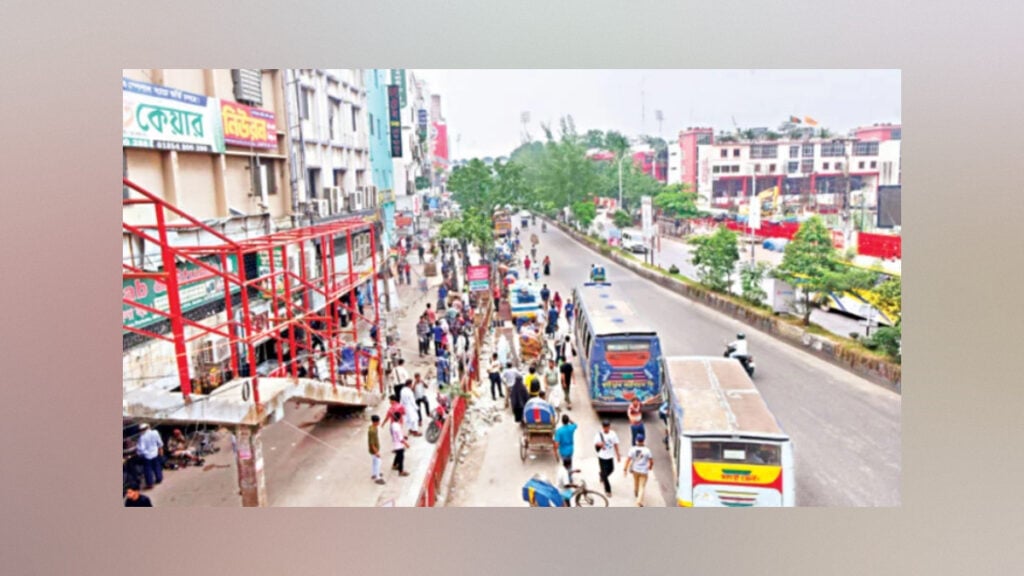
The appearance of footpaths across Mirpur in Dhaka has changed markedly within a single day, following a renewed eviction campaign by the Dhaka North City Corporation (DNCC). The area around Mirpur-10 roundabout, once routinely crowded with street vendors and congested traffic, was noticeably clearer on Thursday. Pedestrians were able to walk along the pavements with fewer obstructions, while fewer vehicles appeared to be parked indiscriminately on the roadsides.
The renewed operation followed clashes on Wednesday during an eviction drive targeting hawkers. Since then, the presence of street vendors has fallen sharply across several roads and footpaths in Mirpur. By Thursday, hawkers were barely visible in many of the areas where they had previously operated from the morning.
A visit to areas stretching from Mirpur-10 to Mirpur-14, as well as Mirpur-2 roundabout, Mirpur-12 and Shewrapara, found most pavements largely empty. Locations that would normally be occupied by vendors selling clothing, footwear, food and other goods had little or no trading activity.
A few metal frames used for makeshift stalls remained in places, but no merchandise was displayed. Some vendors were seen moving around nearby streets and observing the situation rather than setting up their usual stalls.
The change has been welcomed by pedestrians and local residents who said the clear pavements had made walking considerably easier. For vendors, however, the situation has brought uncertainty and frustration, as many depend on roadside trading for their daily income.
A clothing seller who operated beside Mirpur Hope School told Samakal that vendors now had no clear means of earning a living. He called on the authorities either to provide designated spaces or allow vendors to continue trading.
Ruman Islam, an employee at a local clothing showroom, said the number of hawkers in Mirpur had increased substantially over the past several years. According to him, congestion had become so severe that pedestrians sometimes struggled to use even the adjoining road. Vendors would also install metal frames and use them as makeshift shops.
Hawkers call for designated trading spaces
Sekender Hayat, general secretary of the Bangladesh Hawkers’ Union, said in a statement on Thursday that eviction alone would not resolve the problem. He argued that removing thousands of working people from pavements without providing alternatives would put their livelihoods at risk.
The organisation called for legislation governing street vending, designated locations where hawkers could operate, the preparation of an official list of vendors and an end to harassment of hawkers. It also demanded that vendors should not be removed without rehabilitation arrangements.
The dispute highlights the practical difficulty of managing busy urban pavements. Pedestrians require unobstructed walkways, while street vendors often depend on high-footfall areas to earn a living. The authorities’ latest actions have temporarily cleared several locations, but the question of how vending will be regulated in the longer term remains.
DNCC vows to continue eviction operations
DNCC Administrator Shafiqul Islam Khan visited journalist Sifat at his home in West Shewrapara on Thursday after the journalist was injured during clashes surrounding the eviction operation at Mirpur-10. The administrator enquired about his condition.
Speaking to journalists afterwards, Shafiqul Islam Khan said the campaign against illegal occupation of pavements would continue. He also said the authorities would consider constructive suggestions concerning the eviction campaign and the management of hawkers.
Regarding the possibility of pavements being occupied again, the DNCC administrator said pedestrian walkways would be kept open for public use. If vendors returned to the pavements, he said, the city corporation would take stronger action to remove them.
DSCC takes similar position
The Dhaka South City Corporation (DSCC) has also announced that hawkers would not be permitted to operate outside locations designated by the city corporation.
DSCC Administrator Abdus Salam made the statement on Thursday after inspecting cleanliness, the removal of illegal occupation from roads and issues related to public inconvenience in Dhaka’s Dhalpur area.
He said certain pavements and locations had been designated for hawkers. Vendors operating outside those authorised places could face eviction, seizure of their goods and legal action.
According to the administrator, strict action would also be taken if hawkers occupied pavements along major routes, including the main road from Zero Point towards Sadarghat, outside the designated areas.
The statements from both city corporations indicate that the authorities intend to keep major pedestrian routes open while limiting street vending to specified locations.
Four cases filed, 25 arrested
Meanwhile, four cases have been filed over clashes, vandalism and arson linked to the pavement eviction campaign. Three cases were lodged with Mirpur Model Police Station and one with Kafrul Police Station.
Police said around 1,000 people had been named as accused across the four cases. By Thursday night, 25 people had been arrested.
Mizanur Rahman, investigation inspector at Mirpur Model Police Station, said the city corporation had filed one case over the burning of a vehicle. Police had filed another over an alleged attack on law enforcement personnel, while traffic police filed a third case concerning an alleged attack on traffic police.
Between 400 and 500 unidentified people were named as accused in the three cases filed at Mirpur Model Police Station, according to the inspector. The 25 arrested individuals were sent to jail, he said.
Mohammad Saiful Islam, officer-in-charge of Kafrul Police Station, said the city corporation had filed the fourth case over the alleged burning of a city corporation vehicle. Between 400 and 500 people were named as accused in that case.
The latest eviction campaign has therefore brought a visible, if immediate, change to several busy parts of Mirpur. Pedestrians have gained more space to walk, while hawkers face uncertainty over where they can continue their businesses. With both city corporations stressing the use of designated locations, the next challenge will be maintaining clear pavements while addressing the concerns of people whose livelihoods depend on street vending.