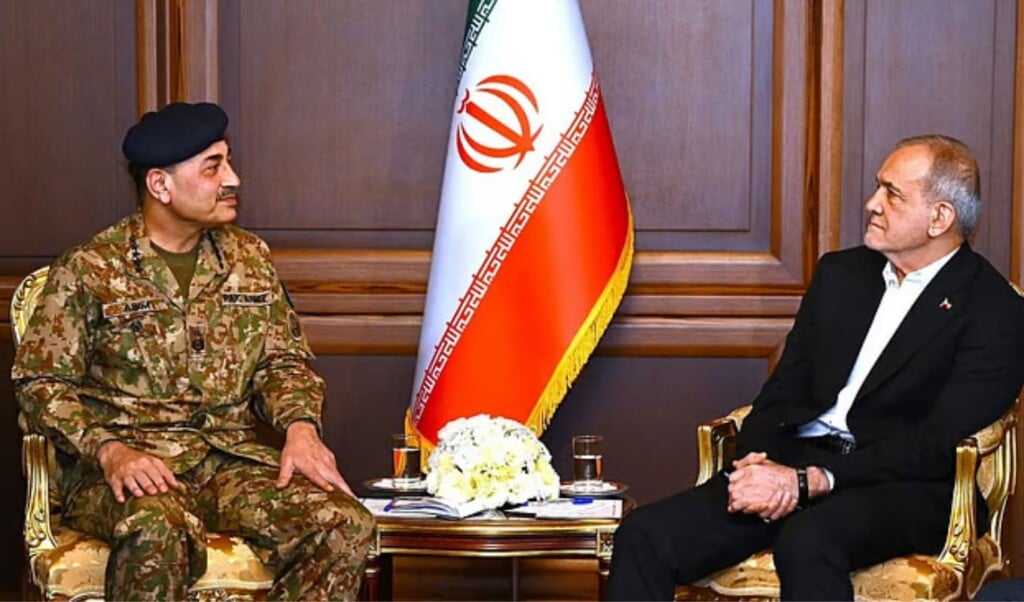
Pakistan’s Chief of Army Staff, Field Marshal Asim Munir, has been described as a central figure in renewed diplomatic efforts aimed at de-escalating tensions between Iran and the United States, according to accounts of recent high-level engagements.
On Wednesday evening, Munir arrived in Tehran, where he was received by Iran’s Foreign Minister and chief negotiator Abbas Araghchi. The reception, marked by a public embrace on arrival, underscored the significance attached to his visit in ongoing mediation efforts between Tehran and Washington.
The visit followed a series of unsuccessful negotiations earlier in the week. Four days prior, U.S. Vice President JD Vance had concluded a visit to Islamabad after extended discussions between Iranian and American representatives failed to produce an agreement following 21 hours of talks. Despite expectations of further engagement, subsequent arrangements remained uncertain amid continued geopolitical tensions, including reported restrictions affecting Iranian port access.
Following the breakdown of initial discussions, U.S. President Donald Trump announced maritime restrictions in the Strait of Hormuz, a move that heightened diplomatic pressure on all parties. Nevertheless, he also publicly acknowledged Munir’s involvement in maintaining communication channels between the two sides.
Munir is reported to have carried a new U.S.-backed proposal to Tehran, outlining a framework for renewed negotiations in Islamabad. Former Pakistani ambassador Maliha Lodi described him as the “driving force” behind the mediation process, suggesting that his personal engagement has been central to sustaining dialogue.
Timeline of Key Events
| Date/Stage | Development |
|---|---|
| 13 April | Iran and US delegations meet in Islamabad with Munir present |
| Following days | 21-hour negotiations conclude without agreement |
| Shortly after | US announces maritime restrictions in Strait of Hormuz |
| Midweek | Munir arrives in Tehran with new proposal |
| Proposed next step | Framework talks expected in Islamabad |
Reports indicate that Munir is among a small number of individuals able to communicate directly with senior leadership in both Tehran and Washington, facilitating the exchange of messages during sensitive negotiations. Observers note that much of the operational coordination is linked to Pakistan’s military headquarters in Rawalpindi, rather than solely through civilian diplomatic channels.
Former diplomat Lodi further stated that while Pakistan’s foreign ministry remains involved, its role is largely supportive, with greater reliance placed on military-led engagement in managing communication with both sides.
Analysts argue that Pakistan’s internal power structure, in which the military plays a significant role in foreign policy formulation, has enabled such mediation efforts to proceed with relative speed. Professor Avinash Paliwal of SOAS University of London noted that this institutional arrangement has contributed to Pakistan’s ability to act as an intermediary in selected international disputes.
Munir’s recent diplomatic activity extends beyond the Iran–US channel. He has undertaken visits to multiple capitals, including Washington and Riyadh, and has been associated with discussions on defence cooperation and economic agreements involving sectors such as minerals and emerging technologies.
He has also reportedly maintained direct engagement with U.S. leadership during President Trump’s tenure, with public remarks from the White House acknowledging his role in counterterrorism cooperation and broader regional security discussions.
Earlier tensions between Iran and Pakistan in 2024, along with subsequent regional developments, form part of the broader backdrop to current diplomatic engagement. Despite past friction, both sides have continued limited coordination on regional security concerns.
While the mediation process remains ongoing, officials and analysts agree that the outcome of these talks will influence not only Iran–US relations but also Pakistan’s standing as a facilitator in regional diplomacy.