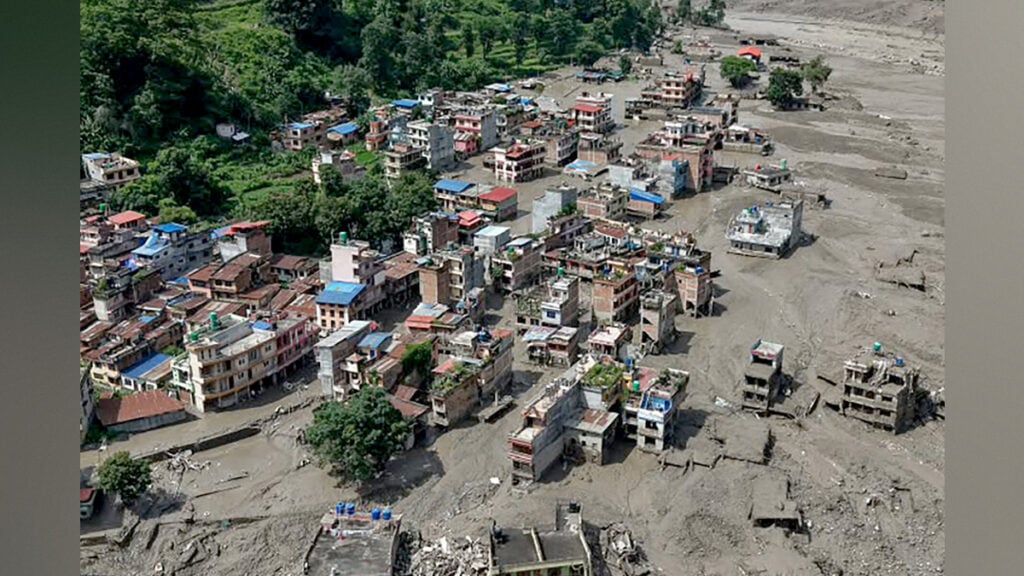
At least 300 Indian nationals are among the thousands of people reported missing following devastating flash floods in Nepal, the country’s Foreign Minister Shishir Khanal said on Thursday, 27 August. Most of the missing Indians are believed to have been travelling as pilgrims on the Kailash Mansarovar route, raising concerns over their safety as rescue teams continue to search affected areas.
Speaking at the NDTV World Anvesha Summit in Kathmandu, Khanal said at least 160 people had died in the disaster in the Rasuwa region, while many others remained unaccounted for. He described the flooding as an exceptionally destructive event, saying several settlements were swept away within a matter of hours.
The Rasuwa district, located in the mountainous north of Nepal, is an important route for pilgrims travelling towards the Kailash Mansarovar region. Because of its location, a significant number of foreign visitors, including Indian pilgrims, were present in the area when the disaster struck.
The sudden nature of the flooding has made it particularly difficult for authorities to establish contact with people who were in the affected areas. Roads and other transport links have been disrupted, while some communities remain difficult to reach. Officials are therefore working to verify the identities and locations of missing people and establish communication with those who may have survived.
Khanal said the Nepalese authorities were making efforts to contact the missing Indian nationals. The government is also maintaining communication with the embassies of countries whose citizens may have been caught in the disaster, with the safety of foreign nationals among the authorities’ immediate concerns.
The scale of the destruction has placed considerable pressure on Nepal’s emergency response agencies. Search and rescue operations in mountainous terrain are often complicated by damaged roads, unstable ground and rapidly changing weather conditions. In such circumstances, reaching isolated settlements and confirming casualty figures can take considerable time.
The disaster has also prompted an immediate humanitarian response from India. Khanal expressed particular gratitude to the Indian government for sending relief assistance to Nepal following the floods. The support is aimed at helping emergency response and relief operations as authorities focus on those who have been displaced or remain trapped in affected areas.
For Nepal, the priority now is to locate survivors, account for missing people and deliver essential assistance to communities hit by the flooding. Rescue teams are continuing their efforts while authorities work to assess the full extent of the damage.
The situation remains fluid, with the number of casualties and missing persons potentially subject to change as search operations progress and communication is restored with areas that remain cut off. For families in India whose relatives were travelling through the Rasuwa region, efforts to establish contact and confirm their whereabouts have become an urgent concern.