In 2024, political violence, conflicts, and suppression of dissent in Bangladesh displaced around 159,000 people. Of these, verified data shows that 2,800 individuals were internally displaced within the country, while the status of the remaining population—whether they stayed in Bangladesh or moved abroad—remains unclear.
This information comes from the International Displacement Monitoring Centre (IDMC) and the United Nations International Organization for Migration (IOM). IDMC most recently updated its data on its website in May 2024.
In the past, during the Awami League government, many people were displaced for years due to cases filed in absentia. Beyond this, religious conflicts, attacks on minority groups, and local disputes have also been identified as causes of internal displacement.
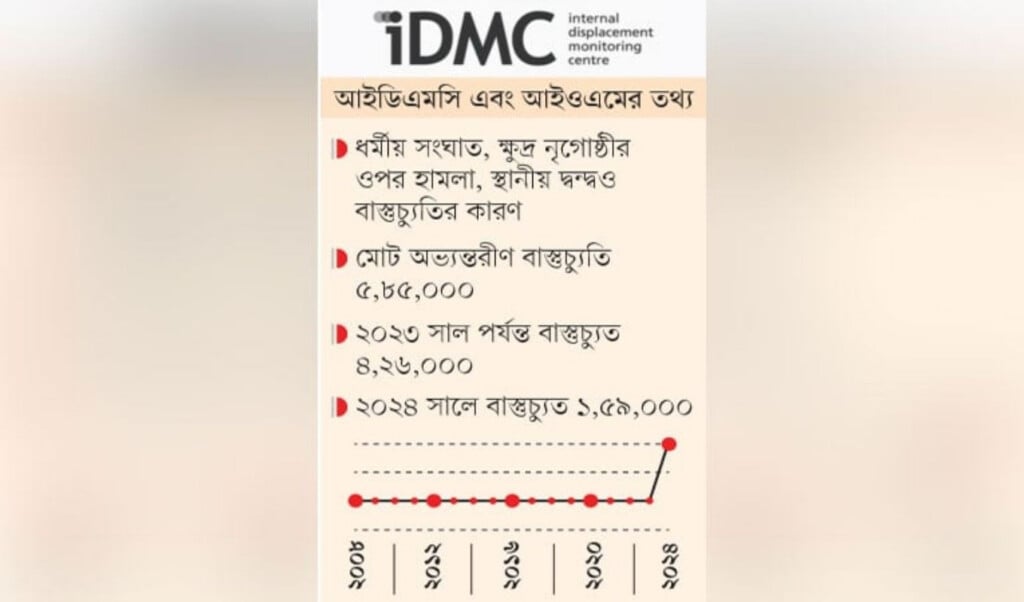
IDMC, an affiliate of the Norwegian Refugee Council (NRC), is among the leading organizations worldwide working on displacement issues. According to IOM and IDMC, political violence and conflicts in Bangladesh have internally displaced 585,000 people over the last 16 years, with 426,000 of them displaced over the first 15 years up to 2023. In the last year alone, political violence displaced 159,000 people.
IDMC notes that the total figure of 585,000 includes 275,000 people displaced in the Chittagong Hill Tracts between 1970 and 2009. Excluding this, 310,000 people were internally displaced by political violence over the last 16 years, averaging 19,375 people per year. However, the 159,000 displaced in the past year represents a significant spike.
A Foreign Ministry official, speaking on condition of anonymity, told Samakal that almost all UN agencies rely on IDMC data. IDMC compiles its reports using information from UN local offices, domestic and international NGOs, and government sources.
IOM and IDMC officials confirmed that Bangladesh witnessed widespread public uprisings in 2024. Alongside political violence and conflicts, religious clashes and local disputes also occurred, forcing large numbers of people to leave their homes. So far, evidence confirms the internal displacement of 2,800 people, while the situation of the rest—whether still in Bangladesh or abroad—remains uncertain.
According to IDMC and IOM, the highest number of people internally displaced due to conflict and violence in recent years was in 2017, with 6,000 people displaced. In comparison, the figures for 2018, 2019, 2020, 2021, and 2022 were 300, 29, 210, 150, and 120, respectively.
IDMC explained that the spike in 2017 occurred during June when armed conflict in the Chittagong Hill Tracts displaced 6,000 people. It remains unknown whether these individuals eventually returned to their homes. This explains why IDMC’s data shows 432,000 people displaced in 2017, but 426,000 in the following year.
Historically, the period from 1970 to 1977 saw the highest internal displacement due to armed conflict in the Chittagong Hill Tracts. By 2009, 275,000 people had been displaced in the hills, though IDMC has no verified data on whether they returned, so the figure remains in official records.
IDMC also tracks climate-related displacement. In 2024, around 2,402,000 Bangladeshis were internally displaced due to natural disasters such as river erosion, floods, and storms. Climate-related internal displacement remains the most prevalent in the country.
Muhammad Sajjad Hossain Siddiqui, Acting Chair of the Department of Peace and Conflict Studies at Dhaka University, noted that political factors have contributed significantly to internal displacement since 5 August of the previous year, though economic factors may also play a role.