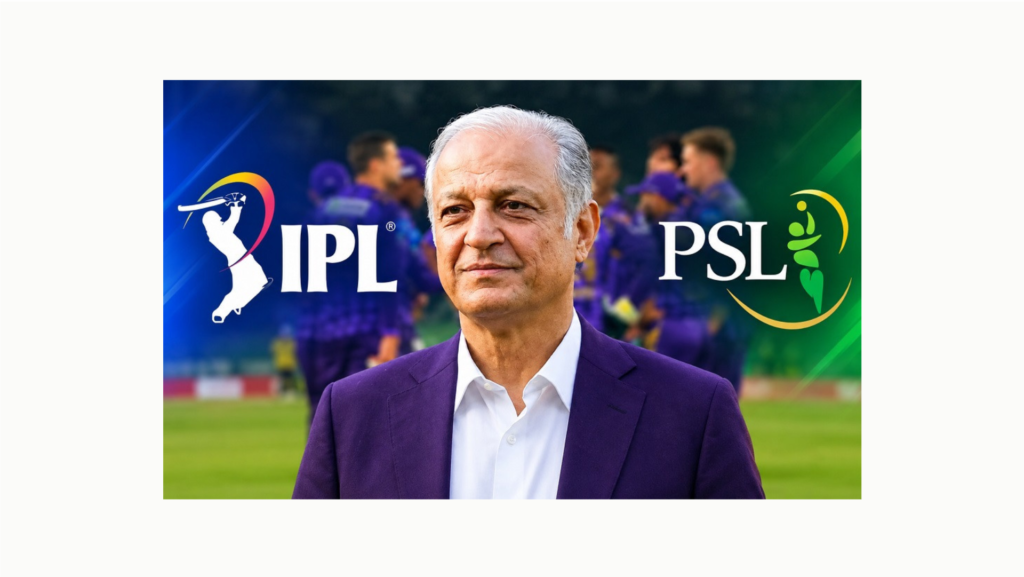
Quetta Gladiators owner Nadeem Omar is considering selling the franchise after years of financial losses and growing concerns about the Pakistan Super League’s (PSL) ability to compete commercially with the Indian Premier League (IPL).
Omar believes the financial gap between the two competitions has become too wide to bridge. While the IPL continues to benefit from enormous broadcasting deals, corporate sponsorships, merchandise sales and a vast commercial market, the PSL faces significant limitations in generating comparable revenue.
The Quetta Gladiators owner has indicated that he is willing to sell the franchise if he receives an attractive offer and his conditions are met. His comments have brought renewed attention to the financial challenges confronting the PSL and its franchise owners.
“I think this is the right time for us to say goodbye to the PSL. We are prepared to sell the Quetta Gladiators franchise if we receive a good offer and some of our conditions are fulfilled,” Omar said.
A major concern for Omar is the decision to schedule the IPL and PSL during overlapping periods. Since 2025, both tournaments have been held between March and May, creating direct competition for international players, sponsors and commercial attention.
In Omar’s view, the PSL cannot realistically compete with the IPL under the current circumstances. He pointed out that India’s cricket market is considerably larger than Pakistan’s and offers far greater opportunities for investment.
“We cannot compete with the IPL or its market. Our market is much smaller. Unfortunately, we do not have enough sponsors and commercial organisations willing to invest in the PSL on the scale that they do in the IPL,” he said.
The financial strength of the IPL is supported by several major revenue streams. Broadcasting rights, sponsorship agreements, ticket sales and merchandise are among the most important sources of income for its franchises. The commercial value of team brands also allows IPL sides to attract substantial investment and build relationships with businesses.
Omar believes the PSL has struggled to develop similar opportunities, particularly in merchandise sales. He identified counterfeit team products as one of the biggest obstacles facing franchises in Pakistan.
According to him, Quetta Gladiators sell their official jerseys for 1,000 Pakistani rupees, while imitation versions are available in the market for around 200 rupees. The substantial price difference makes it difficult for official products to attract buyers, directly affecting a potentially valuable source of franchise revenue.
He also highlighted the importance of ticket sales at home and away venues, alongside broadcasting income, in strengthening the commercial position of IPL franchises. The PSL, he suggested, has yet to achieve comparable returns from these areas.
Financial difficulties are not the only reason behind Omar’s decision to reconsider his involvement. He revealed that Quetta Gladiators had suffered losses for seven years, despite his efforts to establish the franchise as a successful cricketing and commercial venture.
Omar admitted that he had been unable to fulfil all the ambitions he had when he first invested in the team. Although he had several plans for its development, financial constraints and other challenges prevented him from implementing everything he had envisioned.
He purchased the Quetta Gladiators franchise ahead of the inaugural PSL season in 2016 for an annual fee of US$1.1 million. His ambitions, however, extended beyond financial returns. He wanted the franchise to contribute to the development of Pakistani cricket, particularly by providing opportunities for talented players from Balochistan.
One of his key objectives was to bring PSL matches to Quetta, allowing local supporters to watch the competition in their own city. He also hoped to use the franchise as a platform to identify and develop regional cricketing talent. Those ambitions, however, have not materialised as he had originally planned.
Despite his disappointment, Omar continues to regard the PSL as one of the leading franchise-based T20 competitions in the world. He believes it remains among the top three leagues, reflecting its standing in international cricket despite its commercial limitations.
Quetta Gladiators have also enjoyed considerable success on the field. The franchise has reached the PSL final four times and won the title once. However, sporting achievements have not been enough to guarantee the financial returns needed to sustain the business in the long term.
Omar’s comments underline a wider challenge for the PSL as it seeks to strengthen its position in the global franchise cricket market. Building a successful tournament requires more than competitive cricket and international participation. A sustainable commercial model, strong sponsorship networks, effective merchandise protection and reliable revenue streams are equally important.
The prospect of Quetta Gladiators changing ownership would mark a significant development for one of the PSL’s established franchises. Whether Omar ultimately proceeds with the sale will depend on receiving an offer that meets his expectations and satisfies the conditions set by the current ownership.