The vice-president of Rajshahi University Central Students’ Union (RACSU) has threatened action against news outlets and journalists over reports on the alleged assault of three students at Rajshahi University.
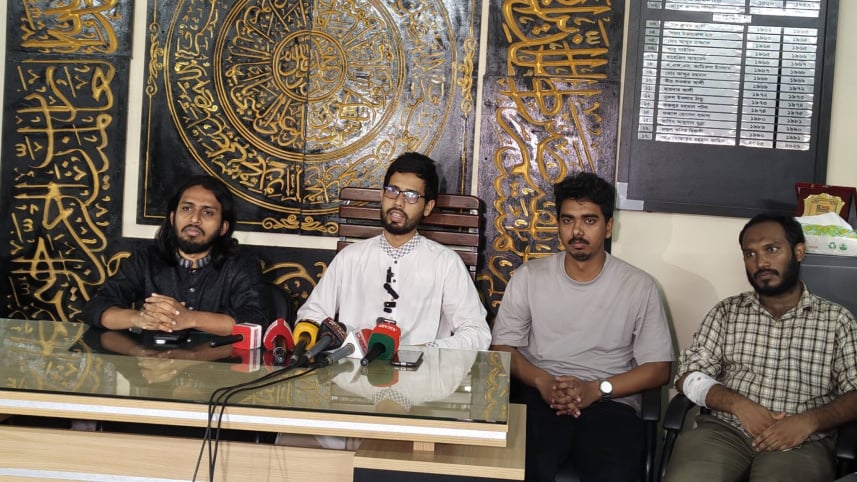
Moustakur Rahman Zahid made the remarks at a press conference held at the RACSU office on Tuesday evening, accusing several media organisations of presenting the incident in a one-sided manner and effectively taking the side of the banned Bangladesh Chhatra League.
Addressing journalists, Mr Zahid alleged that some reports published the previous day had portrayed the incident in a way that defended the student wing. He said RACSU was collecting those reports and warned that action would be taken against journalists responsible for what he described as such coverage.
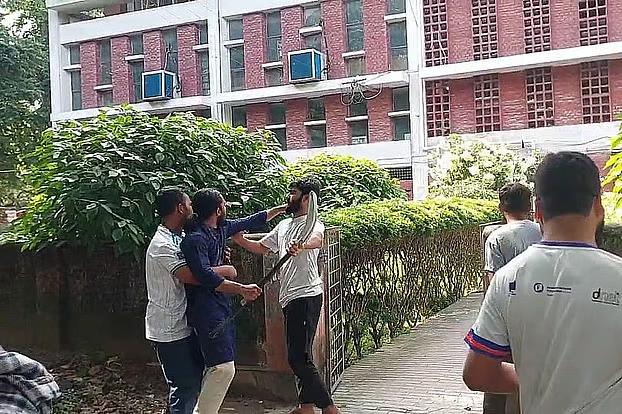
The RACSU vice-president also objected to media reports describing the incident as an ‘attack’. According to him, the students involved had acted in response to an earlier confrontation and their actions should instead be characterised as ‘resistance’.
“They attacked, and we resisted,” he said, questioning why journalists were reluctant to use the term ‘resistance’ when describing the incident.
The remarks come amid heightened tensions on the university campus over allegations of student violence, political affiliations and the role of student organisations. The latest dispute has also raised questions about how competing accounts of confrontations on campus are reported and interpreted.
Mr Zahid rejected allegations that students had been forced out of the university’s central library or that academic activities had been disrupted. He also disputed claims surrounding a human chain held outside the library, saying it had not been organised by ordinary students but by members associated with Bangladesh Jatiyatabadi Chhatra Dal.
He further accused sections of the media of failing to give sufficient attention to an earlier incident at the RACSU building. He claimed that one person had been beaten, two others had been attacked and one individual had sustained bleeding injuries. According to him, those incidents had not received comparable media attention.
Responding to a question about the political identities of those involved in the earlier confrontation, Mr Zahid said RACSU had identified the central figure in that incident, Anas, as being associated with Bangladesh Chhatra League. At the same time, he said the students’ union had also called for action against individuals allegedly linked to Chhatra Dal who were involved in the incident.
RACSU General Secretary Salauddin Ammar, who was also present at the press conference, defended the union’s description of the events. He argued that the choice of words used in news reports could influence public perceptions and questioned why the union’s characterisation of the incident as ‘resistance’ was not being reflected in media coverage.
The press conference also saw RACSU announce a six-point set of demands. The union called for action against those allegedly responsible for threatening a female student with death, as well as the arrest and prosecution of individuals accused of attacking the RACSU building and students.
It also demanded an investigation into alleged administrative inaction, effective measures to prevent violence and the misuse of political identities on campus, stronger security arrangements for students, and justice for individuals accused of past acts of violence and those allegedly associated with Bangladesh Chhatra League.
The controversy has placed renewed focus on the responsibilities of both university authorities and student representatives in maintaining a safe academic environment. While RACSU leaders have called for accountability over alleged violence and threats, their comments about taking action against journalists for unfavourable reporting have also prompted concerns over press freedom.
In a university setting, disputes over the accuracy or framing of reports can ordinarily be addressed through clarification, right of reply or the presentation of evidence. Any investigation into alleged violence, meanwhile, would require due process and impartial scrutiny, regardless of the political affiliations of those involved. The latest developments are therefore likely to keep attention on how Rajshahi University authorities respond to allegations of violence while ensuring both student safety and the freedom of journalists to report on events taking place on campus.