“Yeh duniya, yeh mehfil mere kaam ki nahi…”
Or “Chaahunga main tujhe saanjh savere…”
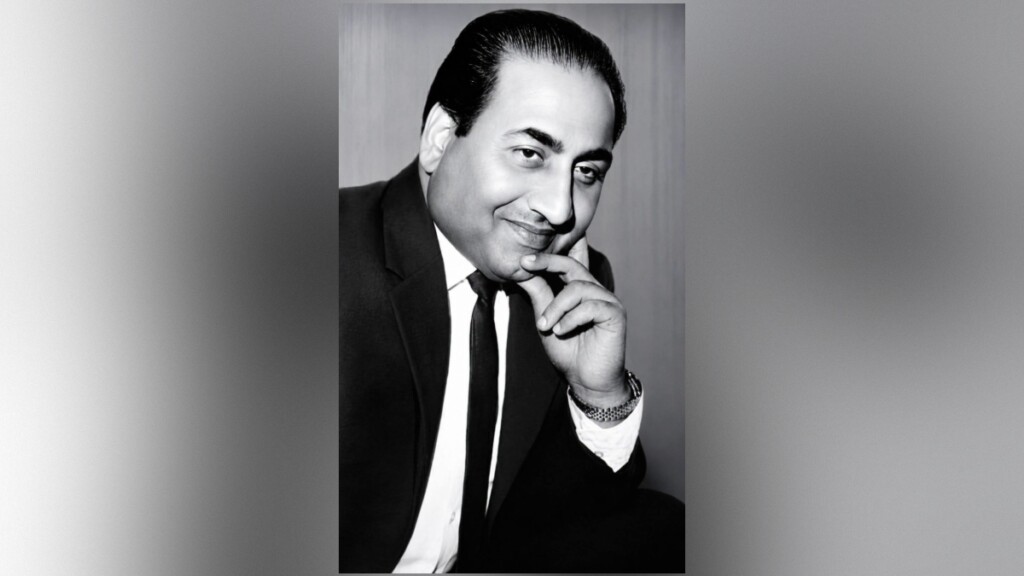
The voice that once enthralled the entire Indian subcontinent continues to resonate deeply in the hearts of millions. Transcending the boundaries of time, he remains immortal to music lovers everywhere—the legendary playback singer, Mohammed Rafi.
Born on 24 December 1924 in the village of Kotla Sultan Singh in Punjab, British India, Rafi was one of six children born to Haji Ali Mohammad. Affectionately nicknamed ‘Pheeko’ in his childhood, his musical journey began casually by imitating the chants and devotional hymns of a wandering fakir in his village.
His profound passion for music led him to the rigorous practice of classical Indian music. By the mid-1940s, he was training under distinguished maestros including Ustad Bade Ghulam Ali Khan, Ustad Abdul Wahid Khan, Pandit Jiwan Lal Mattoo, and Firoze Nizami. At just 13 years old, he made his public debut at a performance by the legendary K. L. Saigal in Lahore, instantly capturing the audience’s attention.
In 1941, Rafi made his debut as a film playback singer in Lahore under the musical direction of Shyam Sunder. Shortly thereafter, he moved to Bombay to establish himself in Hindi cinema. From 1949 onwards, his remarkable rise gathered momentum as he collaborated with eminent composers such as Naushad, Shyam Sunder, and the duo Husnlal-Bhagatram.
For the next four decades, Rafi reigned supreme over Indian film music. He became the preferred vocal collaborator for virtually every legendary composer of the era, including Naushad, O. P. Nayyar, Shankar-Jaikishan, S. D. Burman, Madan Mohan, and Laxmikant-Pyarelal.
Under Naushad’s direction alone, he recorded 149 songs, 81 of which were solos. His partnership with Shankar-Jaikishan yielded an astonishing 341 songs, including 216 solo renditions. Meanwhile, his timeless tracks composed by S. D. Burman for iconic films like Pyaasa, Kaagaz Ke Phool, Tere Ghar Ke Samne, Guide, Aradhana, and Abhimaan remain etched in cinematic history.
Composer O. P. Nayyar once remarked:
“Where there is no Mohammed Rafi, there is no O. P. Nayyar.”
This single line encapsulates the sheer magnitude of Rafi’s artistic brilliance.
Between 1945 and 1980, Rafi rendered thousands of songs. Whether it was classical compositions, ghazals, qawwalis, bhajans, patriotic anthems, romantic melodies, or playful tracks, he displayed peerless versatility across every genre. Beyond Hindi, he recorded songs in Bengali, Urdu, Punjabi, Marathi, Gujarati, Telugu, Kannada, Odia, Bhojpuri, Assamese, Sindhi, Persian, English, Dutch, and Spanish, solidifying his standing as a global musical icon.
Key Career Milestones
1924: Born in Kotla Sultan Singh, Punjab.
1941: Debut as a film playback singer in Lahore.
1949: Rise to mainstream prominence in Bombay cinema.
1980: Passed away in Mumbai at the age of 55.
On 31 July 1980, the legendary singer passed away at the age of 55. While his passing marked the end of a life, his voice lives on across generations, each discovering anew his emotive power, warmth, and extraordinary talent.
On his death anniversary, we pay our profound respects to his enduring legacy. The man may no longer be with us, but his voice and songs remain immortal in the hearts of music lovers everywhere.