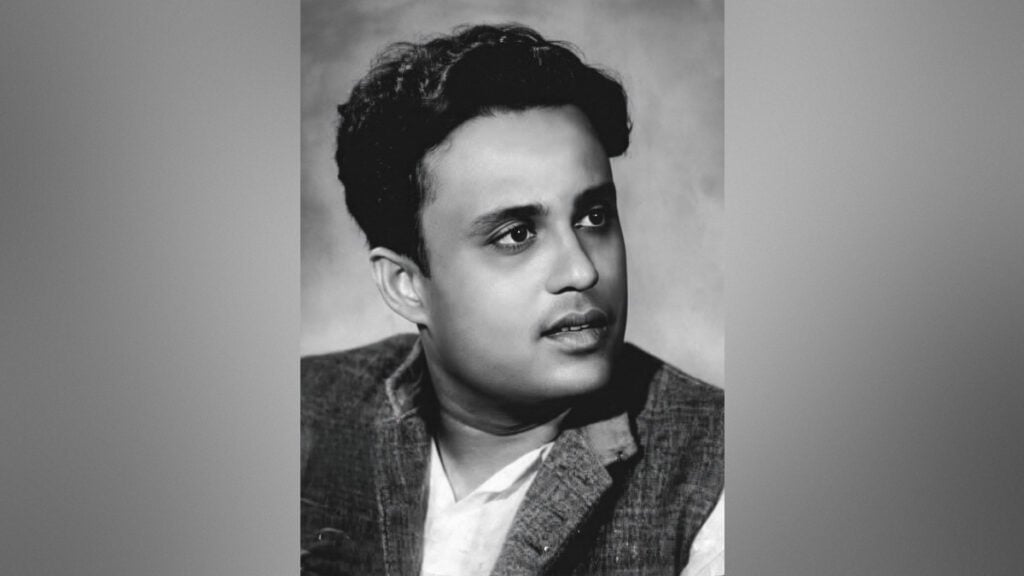
Some voices in Bengali music remain alive long after the era in which they first became popular. Their songs cross generations, carrying emotions and memories that continue to resonate with listeners. Legendary singer, composer and music director Satyachowdhury was one such distinctive voice. His deep, powerful delivery and expressive approach to music earned him a memorable place in the history of Bengali culture.
One of the songs most closely associated with his musical legacy is “Prithibi amare chay, rekho na bendhe amay”. Its evocative words and melody convey a longing for freedom, an attachment to life and a desire to remain connected with the wider world. In Satyachowdhury’s voice, the song acquired a particularly compelling emotional quality, helping it remain part of the collective memory of Bengali music lovers.
Satyachowdhury was born on 17 September 1918 in Kolkata into a distinguished family with a strong interest in music. His formal name was Satyaranjan Chowdhury, while his ancestral roots lay in Rajshahi. Growing up in a musical environment, he developed an early interest in singing and melody. His natural ability, combined with sustained practice and dedication, eventually helped him establish himself in the Bengali music scene.
A defining chapter in his career was his association with the celebrated poet and composer Kazi Nazrul Islam. Satyachowdhury had the opportunity to receive direct musical training from Nazrul, whose influence was significant in the development of Bengali music during that period. The relationship also brought him into close contact with Nazrul’s songs, which he performed with sincerity and emotional conviction.
During the 1940s, Satyachowdhury became particularly recognised for his performances of patriotic songs, Shyama Sangeet and romantic music. His voice could convey a strong sense of patriotism and self-respect in patriotic compositions. In Shyama Sangeet, it expressed devotion and surrender, while his romantic performances revealed a gentler and more intimate side of his artistry. His ability to adapt his vocal expression to the mood and subject of a song became one of his distinguishing qualities.
His connection with Nazrul was also reflected in an important recording episode in 1942. Before Nazrul became seriously ill, three singers recorded songs under his supervision. Satyachowdhury was one of them, alongside Jaganmoy Mitra and Pratibha Ghosh. The association remains a notable part of Satyachowdhury’s musical journey and illustrates his close connection with one of the most influential figures in Bengali music and literature.
His talents extended well beyond singing. Satyachowdhury worked as a composer and music director and was also associated with acting. He later served as an announcer for Akashvani, the broadcasting service widely known as All India Radio. His work across music, performance and broadcasting reflected the breadth of his cultural involvement.
The character of Satyachowdhury’s voice was central to his appeal. It possessed a natural depth and a distinctive strength, but his artistry went beyond vocal power. He had an ability to connect the words of a song with their emotional meaning, allowing listeners to experience the sentiment behind the composition rather than simply hear its melody.
For him, a song could express much more than its tune. Patriotic compositions could evoke attachment to the homeland, devotional songs could communicate spiritual emotion, and romantic pieces could capture tenderness and longing. This sensitivity to the meaning of lyrics helped give his performances an individual identity.
Satyachowdhury died on 5 December 1993, bringing an end to a long and varied career in the cultural sphere. His death, however, did not mark the disappearance of his musical legacy. The songs he performed continued to preserve his memory and introduced later generations to a distinctive chapter in the development of Bengali music.
The enduring association between Satyachowdhury and “Prithibi amare chay, rekho na bendhe amay” is a reminder of the lasting power of music. The song’s central idea of freedom and its emotional connection with life remain accessible to listeners even decades after it was first performed.
Satyachowdhury’s contribution to Bengali culture therefore extends beyond his identity as a celebrated singer. His association with Nazrul, his work across different musical genres, his role as a composer and music director, his involvement in acting and his service as a radio announcer together form the record of a versatile cultural career.
On his birth anniversary, Satyachowdhury is remembered with respect and affection. His voice belongs to an earlier era of Bengali music, yet the emotional quality of his performances continues to give his work a place in the cultural memory of those who cherish the tradition.
His songs remain a lasting reminder of an artiste whose career bridged singing, composition, broadcasting and performance. Through those works, Satyachowdhury’s musical presence continues to endure.