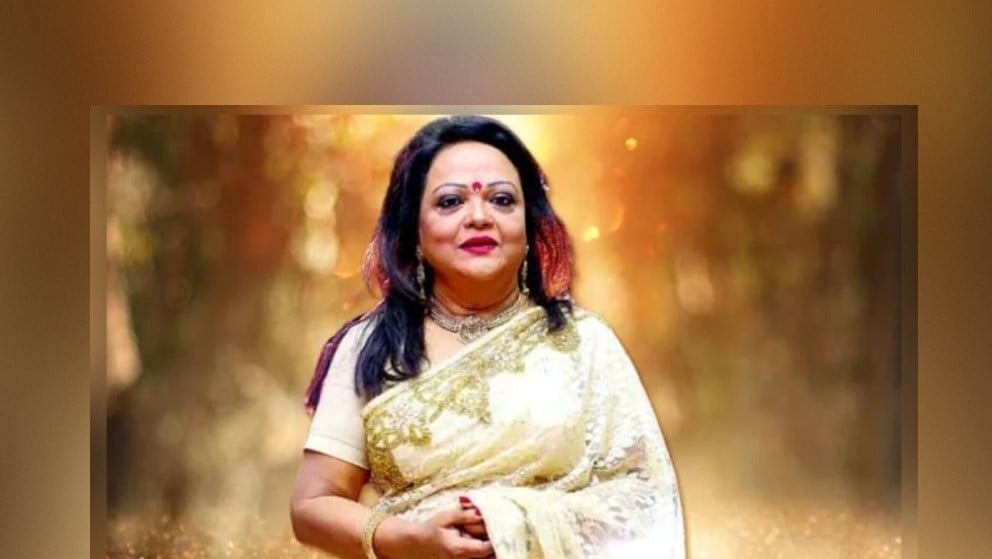
Few voices in Bengali music have achieved the enduring cultural significance of Sabina Yasmin. Over a career spanning more than six decades, the legendary singer has lent her voice to songs of love, loss, patriotism, nature and everyday life, becoming one of the defining voices of Bangladesh’s musical heritage.
Sabina Yasmin celebrates her 72nd birthday today, 4 September. Born in 1954, she grew up in a family deeply connected with music. Her mother, Begum Mouluda Khatun, was a singer, while four of the five sisters in the family—Farida Yasmin, Fauzia Yasmin, Nilufar Yasmin and Sabina Yasmin—were associated with music.
Her musical journey began at a remarkably young age. As a child, Sabina would sit beside her elder sister Farida while she received lessons from Ustad Durgaprasad Roy. She listened carefully and tried to reproduce the melodies she heard. At just six, she won first prize in an All-Pakistan school music competition, an early indication of the talent that would later make her a household name.
By the age of seven, she was already performing on stage. Her formal musical training continued under the renowned music teacher Ustad P C Gomez, from whom she received classical training for around 13 years. As a member of Khelaghar, she also began performing regularly on radio and television during her childhood.
Her association with cinema began while she was still young. She had earlier provided her voice as a child artiste, while her recognised playback career developed in the 1960s. In 1967, she sang ‘Madhu Jochhona Dipali’ for the film Agun Niye Khela, marking an important stage in her journey as a playback singer.
Her breakthrough with a much wider audience came in 1970 through the film Jibon Theke Neya. The song ‘Eki Sonar Aloy Jibon Bhoriye Dile’, composed by Khan Ataur Rahman, became closely associated with her voice and remains one of the memorable songs of Bengali cinema.
From that point, Sabina Yasmin’s career expanded across an extraordinary range of musical forms. She has performed modern Bengali songs, patriotic numbers, folk music, Rabindra Sangeet, Nazrul Sangeet, ghazals and classical music. Her ability to adapt her voice to different musical traditions helped establish her as one of the most versatile singers in Bangladesh.
Several of her songs have become closely associated with the country’s cultural and patriotic consciousness. Among them are ‘Shob K’ta Janala Khule Dao Na’, ‘Majhi Nao Chhariya De’, ‘Shundor Shubonno’, ‘Shadhinota Tumi’, ‘Ekti Bangladesh Tumi Jagroto Jonotar’ and ‘Jonmo Amar Dhonno Holo Ma Go’.
Her contribution to film music has been recognised repeatedly at the national level. Sabina Yasmin has won the National Film Award for Best Female Playback Singer 15 times, a record that reflects the extraordinary scale and longevity of her contribution to Bangladeshi cinema.
Her list of national honours is equally significant. She received the Ekushey Padak in 1984 and the Independence Award in 1996, two of Bangladesh’s highest state recognitions. She also received an honorary doctorate in 1985. Her work has earned recognition beyond Bangladesh as well.
Sabina Yasmin’s musical career has taken her to audiences in several countries, including the United Kingdom, Sweden, Norway, Hong Kong, the United States and Bahrain. She has also performed in India and Pakistan. Her repertoire has extended beyond Bengali, reflecting the breadth of her musical interests and experience.
She has worked with some of the most celebrated figures in South Asian music. Among the distinguished names associated with her career are composer R D Burman and singers such as Kishore Kumar, Manna Dey, Asha Bhosle, Shyamal Mitra and Kumar Sanu. These collaborations placed her within a wider musical tradition that connected Bangladesh with the broader cultural landscape of the Indian subcontinent.
Her artistic career has not been limited to singing. Sabina Yasmin also appeared in the film Ulka, directed by Gazi Mazharul Anwar. In 2010, she served as a judge on the television singing competition Shera Kontho, contributing her experience to the assessment of emerging singers.
Family relationships also played a significant role in her musical journey. Her brother-in-law Khan Ataur Rahman, a prominent filmmaker, actor, lyricist and composer, was among the people who encouraged and supported her artistic development. His contribution to Bangladeshi cinema and music also intersected with some of the most important phases of Sabina Yasmin’s career.
Across more than six decades, she has reportedly recorded around 16,000 songs, a substantial proportion of them for films. The sheer volume of her work is remarkable, but her legacy cannot be measured by numbers alone. Many of the songs she recorded decades ago continue to be heard by audiences today, while her voice remains familiar to successive generations.
Her importance to Bangladeshi music also lies in the diversity of emotions she has conveyed. She has sung about personal relationships and heartbreak, as well as the landscape, history and aspirations of Bangladesh. Her patriotic repertoire, in particular, has given her voice a lasting place in the country’s cultural memory.
The continued popularity of her songs demonstrates how a distinctive voice can outlive changes in musical taste and technology. The platforms through which people listen to music have changed dramatically since Sabina Yasmin began her career, yet many of her recordings remain part of Bangladesh’s shared musical experience.
For generations of listeners, songs such as ‘Eki Sonar Aloy Jibon Bhoriye Dile’ evoke memories that extend well beyond the music itself. Her voice has accompanied different stages of people’s lives, from childhood and adolescence to adulthood, while her patriotic songs have remained part of national and cultural occasions.
At 72, Sabina Yasmin stands as one of the most accomplished voices in the history of Bangladeshi music. Her journey from a young girl singing on stage to a nationally honoured and internationally recognised artiste represents one of the country’s most enduring musical careers.
Her birthday offers an opportunity to look back at a body of work that has crossed generations and musical boundaries. More than six decades after she first entered the world of performance, Sabina Yasmin’s songs continue to occupy a distinctive place in Bengali music, preserving a remarkable chapter of Bangladesh’s cultural history.