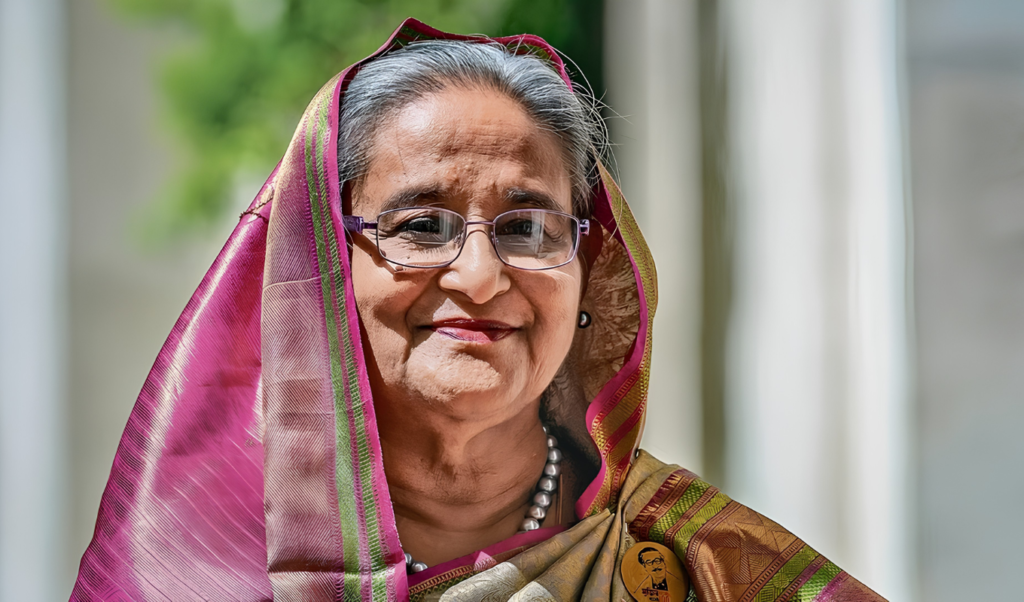
Former Bangladeshi Prime Minister Sheikh Hasina has asserted that she does not require permission from any government to return to Bangladesh, stating that her planned homecoming is driven by a duty to stand alongside the people rather than a desire to reclaim political power. Speaking from an undisclosed location in India during her first telephone interview with the Indian newspaper, Sheikh Hasina expressed a firm intention to return by December, adding that the precise date, time, and entry route would be announced in due course.
Reflecting on her return, Sheikh Hasina described her homecoming as a matter of responsibility towards Bangladesh’s future. Addressing questions regarding potential extradition demands linked to diplomatic exchanges between New Delhi and Dhaka, she questioned how her presence in India or her public statements could harm bilateral relations. She noted that political figures operating from abroad have historically conducted activities without hindrance from host governments, maintaining that truthful dialogue does not damage bilateral ties. In her view, regional relations suffer when democratic norms erode, extremism rises, minorities face insecurity, or state institutions are weaponised for political retaliation. She stressed that a stable, secular, and economically vibrant Bangladesh remains vital for regional stability across South Asia.
| Economic & National Indicators | Sheikh Hasina’s Claimed Figures | Stated Current / Revised Figures |
| National Economy Size | Expanded from ~$70 billion to $450 billion | Reported decline across key sectors |
| Per Capita Income | Rose from $482 to $2,784 | Stagnated due to inflation |
| GDP Growth Rate | 6.80% during Awami League tenure | Dropped to 2.22% |
| Industrial Growth | Positive historical trend | First negative growth in 54 years |
| Unemployment Impact | Stable job generation | Over 20 million newly unemployed |
| Power Generation Capacity | Scaled up to nearly 29,000 MW | Widespread fuel shortages and load-shedding |
| Fertilizer Production | All units operational | 5 out of 6 factories shut due to gas crisis |
| Defence Procurement Plan | Focused on core economic growth | $2.3 billion planned for J-10CE jets |
| Legal Cases Against Hasina | Zero baseline | Over 600 cases termed ‘unfounded’ |
| History of Awami League | Founded in 1947 | Subject to calls for political bans |
Commenting on the state of the domestic economy, Sheikh Hasina contrasted her administration’s economic record with current conditions. She claimed that under her leadership, the national economy grew from approximately $70 billion to $450 billion, pushing per capita income from $482 up to $2,784. According to her, GDP growth has now slowed to 2.22 percent, with industrial output contracting for the first time in over five decades, accompanied by rising poverty and mass joblessness. She highlighted severe disruptions in power and gas supplies, noting that five out of the country’s six fertiliser factories have ceased operations due to fuel shortages, driving up commodity prices. In this context, she questioned the rationale behind reported plans to purchase J-10CE fighter jets from China for $2.3 billion when essential utility services face funding strains.
Addressing the legal actions against her, Sheikh Hasina dismissed the more than 600 criminal cases filed against her as politically motivated fabrications designed to weaponise the judiciary. She recounted surviving the 2004 grenade attack—which claimed 24 lives and injured over 300—to emphasise that personal safety concerns would not deter her return. Regarding proposals to ban the Awami League, she argued that as an institution established in 1947 that led the nation’s independence movement under Sheikh Mujibur Rahman, its ultimate judge remains the Bangladeshi electorate through democratic polls, not executive bans.
Expressing deep concern over security trends, Sheikh Hasina pointed to growing extremism and attacks on cultural landmarks, shrines, and minority communities. She referenced warnings regarding militant networks attempting to establish regional cells, cautioning that dismantling specialized counter-terrorism units or releasing convicted extremists undermines national security. Such instability, she warned, carries wider implications for maritime security, regional trade, and international counter-terrorism cooperation across the Bay of Bengal.
While expressing gratitude to the government and people of India for hosting her with dignity, Sheikh Hasina acknowledged the personal toll of living away from her homeland. She stated that she monitors daily developments in Bangladesh closely, keeping track of economic hardships and public safety concerns, driven by a desire to see the country return to a path of stability and progress.