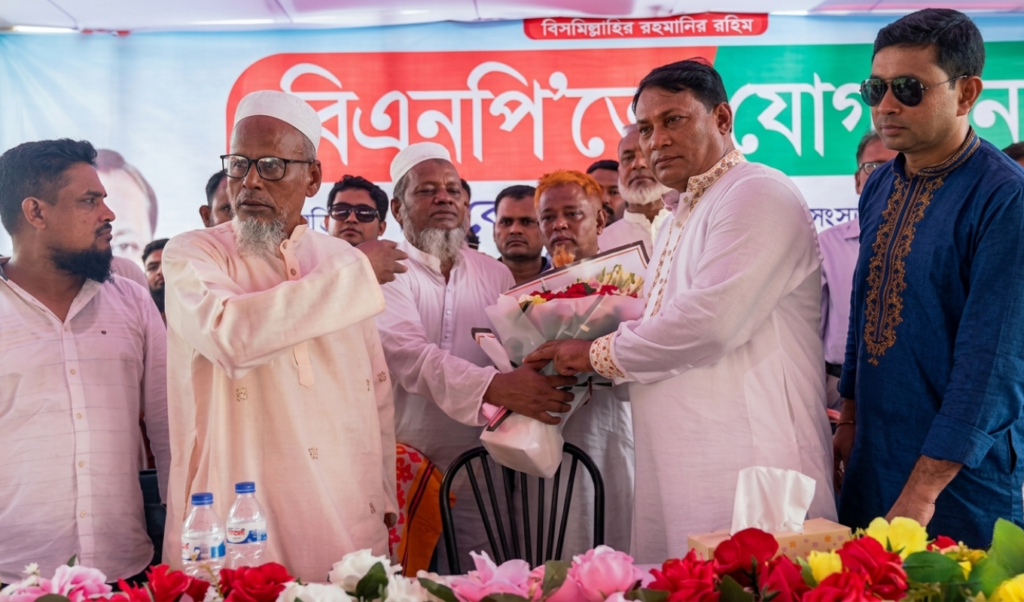
A substantial political shift has occurred in the southwestern district of Gopalganj after approximately 1,200 leaders and activists from the recently banned political party, the Bangladesh Awami League, formally crossed the floor to join the Bangladesh Nationalist Party (BNP). The mass defection ceremony took place on Wednesday afternoon, 3 June, at the Jangal Bazar area within the Nijra union of Gopalganj Sadar sub-district. The event marked a critical realignment of local political forces in a region historically considered a bastion of the political opposition.
The departing cohort was spearheaded by prominent grassroots organisers from the Nijra Madhyapara locality, specifically Chhanoar Hossain Mollah, who also held the position of Treasurer within the Gopalganj Sadar Upazila Awami League, alongside fellow local leader Nur Islam Sheikh. The large delegation officially entered the ranks of the BNP by presenting a ceremonial bouquet of flowers to the incumbent Member of Parliament for the Gopalganj-2 constituency, Dr K. M. Babar, who was elected during the 13th National Parliamentary Elections held in February 2025.
High-Profile Attendance and Political Endorsements
The defection ceremony drew a substantial crowd of local residents, political observers, and senior district officials belonging to the BNP and its various front organisations. The formal welcoming committee comprised the leadership elite of the district, including:
-
Sikdar Shahidul Islam Lenin, President of the Gopalganj Sadar Upazila BNP
-
Fazlul Kabir Dara, General Secretary of the Gopalganj Sadar Upazila BNP
-
S. M. Ziaul Kabir Biplob, Member of the Gopalganj District BNP Executive Committee
-
Sheikh Hasibur Rahman Hasib, President of the Pourashava (Municipal) BNP
-
Sajjad Hossain Hira, Senior Municipal BNP Leader
-
Rajib Biswas, Representative from the Jatiyatabadi Juba Dal (the youth wing)
-
Saiful Islam, Representative from the Jatiyatabadi Chhatra Dal (the student wing)
[Awami League Cohort: Chhanoar H. Mollah & Nur I. Sheikh]
                         │
                         ▼ (Mass Defection Ceremony)
[Formal Induction via Flowers at Jangal Bazar, Nijra]
                         │
                         ▼
[Official Reception by Dr K. M. Babar, MP & BNP Leadership]
Addressing the gathered assembly following the formal induction processes, Dr K. M. Babar emphasized that the current domestic landscape has positioned the BNP as a critical vehicle for translating public expectations into administrative reality. The parliamentarian asserted that the party remains committed to institutional inclusivity, stating:
“In the current political reality, the BNP is playing a crucial role in fulfilling the expectations of the general public. We warmly welcome experienced and popular individuals from various political parties who choose to join the BNP.”
Motivations and Historical Electoral Context
The transition of such a significant volume of political workers is notable given the specific electoral history of the Gopalganj-2 parliamentary constituency, which encompasses the Gopalganj Sadar area and partial sections of the Kashiani sub-district. During the general elections held on 13 February 2025, Dr K. M. Babar secured the parliamentary seat under the BNP ticket, garnering a total of 40,048 votes. He successfully defeated his closest rival, an independent rebel BNP candidate named M. H. Khan Monju, who secured 33,039 votes in a tightly contested regional race.
| Political Alignment Details | Statistical and Regional Facts |
| Total Defecting Personnel | Approximately 1,200 Activists and Workers |
| Primary Inductee Leaders | Chhanoar Hossain Mollah & Nur Islam Sheikh |
| Constituency Jurisdiction | Gopalganj-2 (Sadar and partial Kashiani) |
| Electoral Data (Feb 2025) | Dr K. M. Babar won with 40,048 votes |
| Venue of Defection Event | Jangal Bazar, Nijra Union, Gopalganj Sadar |
The two primary leaders coordinating the defection, Chhanoar Hossain Mollah and Nur Islam Sheikh, provided a joint public statement outlining the operational rationale behind their decision to abandon their lifelong affiliation with the Awami League. They asserted that the decision was driven by an overarching desire to secure structural infrastructure development for their villages, establish robust democratic values, and defend the constitutional rights of the local populace. Both incoming leaders expressed a firm determination to work actively towards the practical implementation of the BNP’s core manifestos, organizational philosophies, and upcoming grassroots campaigns across the Nijra union.