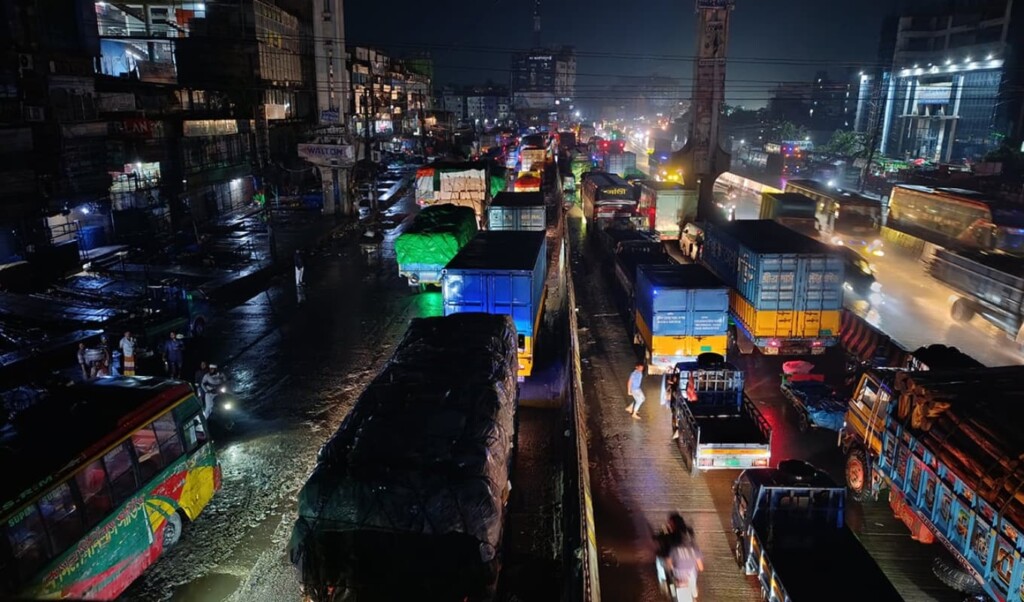
A severe traffic congestion brought a major section of the Dhaka–Chattogram Highway to a standstill after an extended queue of vehicles at a fuel station in Matuail overflowed onto the main carriageway, triggering a disruption that stretched nearly 12 kilometres towards the capital.
The tailback, which developed shortly after midnight on Tuesday (8 April), left the inbound lane—heading towards Dhaka—virtually paralysed for hours as commercial and passenger vehicles struggled to move through the affected stretch between Matuail and Madanpur.
The incident highlights persistent operational challenges along one of Bangladesh’s most vital transport corridors, where roadside fuel stations frequently interact directly with high volumes of freight and passenger traffic.
Traffic disruption overview
| Category | Details |
|---|---|
| Location | Matuail to Madanpur, Dhaka–Chattogram Highway |
| Estimated impact length | ~12 kilometres |
| Time of incident | Around 12:00am, Tuesday (8 April) |
| Affected direction | Inbound (towards Dhaka) lane |
| Primary trigger | Fuel station queue spilling onto highway |
| Vehicles involved | Trucks, buses, covered vans, private cars |
| Contributing factor | Heavy rainfall |
| Managing authority | Highway Police (Shimrail Camp) |
Fuel queue overwhelms station capacity
According to traffic officials, the disruption began when a petrol station in Matuail became overwhelmed by a sudden surge of vehicles seeking refuelling. As the queue exceeded the station’s internal capacity, vehicles gradually began lining up on the adjacent highway, occupying a substantial portion of the Dhaka-bound lane.
Shimrail Highway Police Camp Traffic Inspector Julhas Uddin confirmed that law enforcement personnel were deployed to the site but faced considerable difficulty in restoring normal traffic flow.
He stated that continuous rainfall compounded the situation, reducing visibility and slowing intervention efforts. Despite the presence of officers on the ground, the queue could not be effectively contained before it spilled into the main traffic stream.
Chain reaction across major transport corridor
Eyewitnesses and transport operators reported that heavy vehicles—including long-haul trucks, covered vans, and intercity buses—had begun gathering near the station well before midnight in anticipation of refuelling.
However, once the station reached capacity, vehicles spilled onto the highway in an unregulated formation, sharply reducing usable road space. This immediately slowed traffic movement, eventually causing a complete breakdown in flow.
As congestion intensified, the traffic jam expanded across key junctions and corridors, including Matuail, Signboard, Shimrail, and Kanchpur, before extending as far as Madanpur. Vehicles were reportedly forced to idle for extended periods with minimal forward movement.
Severe impact on commuters and freight
Transport operators described significant delays affecting both passenger and cargo services. Long-distance buses bound for Dhaka were forced to crawl through sections of the highway, while freight vehicles carrying essential goods to the capital experienced operational setbacks.
Passengers travelling overnight expressed frustration at prolonged delays, noting that such congestion is particularly disruptive during late-night hours when traffic is typically expected to flow more freely. Many reported discomfort due to prolonged stationary conditions inside buses.
Freight operators warned that repeated incidents of this nature can have wider economic consequences, particularly given the highway’s role as the country’s primary logistics artery between Dhaka and the port city of Chattogram.
Structural concerns over roadside fuel stations
Local residents and transport stakeholders have repeatedly raised concerns about fuel stations located directly along major highways. They argue that insufficient space management and lack of enforced queuing systems frequently result in vehicles spilling onto main carriageways.
In many cases, there is no clearly designated holding area for waiting vehicles, forcing them to occupy live traffic lanes when station capacity is exceeded. This creates recurring bottlenecks, especially during peak freight movement periods at night.
Calls for coordinated intervention
Affected drivers and passengers have urged authorities to introduce stricter operational protocols for fuel stations situated along national highways. Suggested measures include mandatory internal queuing zones, stricter entry controls, and real-time monitoring of vehicle flow into station premises.
Transport stakeholders have also called for stronger coordination between the Highway Police, local administrative bodies, and fuel station operators to prevent recurrence of similar incidents.
Experts note that even minor disruptions along the Dhaka–Chattogram corridor can rapidly escalate into multi-kilometre gridlock, given the volume of commercial traffic it carries. They emphasise that without structural reforms in roadside fuel management, such congestion events are likely to remain a recurring challenge for one of Bangladesh’s most critical transport routes.