Severe inefficiency, irregularities and wastage have plagued the country’s public healthcare sector. Despite purchasing medical equipment worth hundreds of crores of taka, many machines have remained unused for years. Patients are being deprived of essential treatment while the machines lie idle in storerooms or hospital corners, gathering dust. Although these costly items were purchased with public funds, they are not being utilised for patient care.
At Faridpur Medical College (FMEC), Taslima Begum, a housewife from Sadar upazila, was admitted with severe chest pain. While an ECG was performed initially, neither an echocardiogram, angiogram nor the required CT scan could be done at the hospital. The cardiology department’s cath lab, installed at a cost of Tk 8.88 crore, has been out of service for years. The echo-ETT machine is also not operational.
According to the attending physicians, without these tests it is impossible to confirm whether the patient has arterial blockages. As a result, Taslima’s family was compelled to seek tests at a private diagnostic centre, spending several thousand taka. But since her angiogram could not be performed, she was eventually referred to the National Institute of Cardiovascular Diseases in Dhaka. Taslima said, ‘Poor people have nowhere to receive proper treatment. The hospital has machines, but no one to operate them.’
In such conditions, not only Taslima but countless heart patients are returning home every day without receiving medical care.
A visit to Faridpur Medical College Hospital revealed that due to a shortage of staff, equipment worth nearly Tk 55 crore has been lying unused for years. These include the Tk 8.88 crore cath lab, a Tk 23 crore MRI machine, a Tk 4.82 crore digital X-ray machine, a radiotherapy machine boxed up for seven years, and non-functional echo-ETT and ECG machines. Due to a lack of skilled technicians, cardiac specialists and radiology operators, the machines remain unused. As a result, patients suffering from heart disease, stroke and cancer are being deprived of essential services.
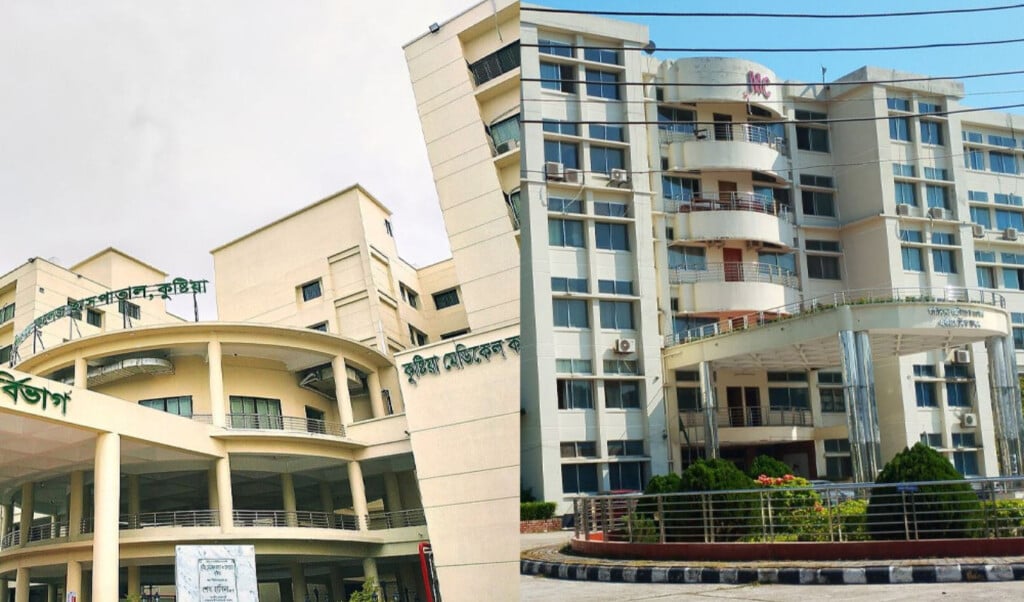
The situation is even worse at Kushtia Medical College Hospital. Construction was completed in December 2023, and the outdoor department was opened earlier in November following political instruction. However, even after two years, no staff has been appointed. Due to student protests, the authorities were forced to launch medicine and paediatrics departments this April despite having no manpower. Although the hospital authorities have softened under pressure, the government remains unmoved. Meanwhile, files requesting manpower continue to circulate at the Secretariat, and medical equipment worth hundreds of crores is deteriorating on different floors of the hospital.
It has been learned that over the past three years, equipment and furniture worth Tk 150 crore were purchased for Kushtia Medical College and Hospital, all of which now lie unused within the building. These include state-of-the-art MRI, CT scan, X-ray and ultrasonography machines, as well as various surgical tools.
Although partial admission activities have begun in two departments, the emergency department is still not operational. The hospital authorities have been unable to provide any timeline regarding when other departments or diagnostic services will be launched. Currently, the medicine and paediatrics departments are admitting a maximum of 45 patients each.
It has also been confirmed that the manpower recruitment file has been stuck at the Ministry of Finance for over six months.
Kushtia Medical College Director Anwarul Kabir told the media, ‘The manpower recruitment order is pending with the Ministry of Finance. They have assured us, but without staff we cannot open all wards and services. Consequently, equipment is being damaged.’
A similar situation exists in the expansion project of the National Institute of Neurosciences & Hospital (NINS). Expensive equipment worth crores has been purchased but remains unused. An ultrasonography machine sent to Valuka Upazila Health Complex in July 2024 was activated in January 2025, only to become non-operational again due to a lack of trained physicians. Meanwhile, malaria and RK-39 test kits worth Tk 1.99 crore remain stored at the Directorate General of Health Services. Digital blood glucometers sent to Trishal and Valuka cannot be used due to the absence of necessary test strips.
The Bangladesh Public Procurement Authority’s ‘Post-Procurement Review’ report highlights the same issues. Reviewing 90 contracts from 2023–24 across the DGHS, Family Planning Directorate and Public Health Engineering Department, the report identified widespread rule violations, delays, lack of competition and unused equipment.
Even more concerning is the lack of competition in tenders. Forty-three percent of DGHS contracts went to single bidders. Five companies alone secured 83 percent of the total contract value. This indicates that a handful of suppliers dominate the procurement market, inflating prices and misusing public funds.
The review also found instances where full payments were made before delivery of goods. Poor documentation has made it difficult for auditors to verify the transactions.
Although the Central Medical Stores Depot (CMSD) follows legal procedures, shortages of staff and the absence of a dedicated procurement cell have slowed operations significantly. Common issues across institutions include reliance on the same contractors, weak contract monitoring, budget inconsistencies and purchases made without proper needs assessment.
Former Secretary of the Implementation Monitoring and Evaluation Division of the Planning Commission, Md Kamal Uddin, told the media, ‘We have forwarded the reports to the concerned ministries. It is their responsibility to take action. But in reality, although irregularities are being identified, no action is being taken.’
Khaborwala/TSN