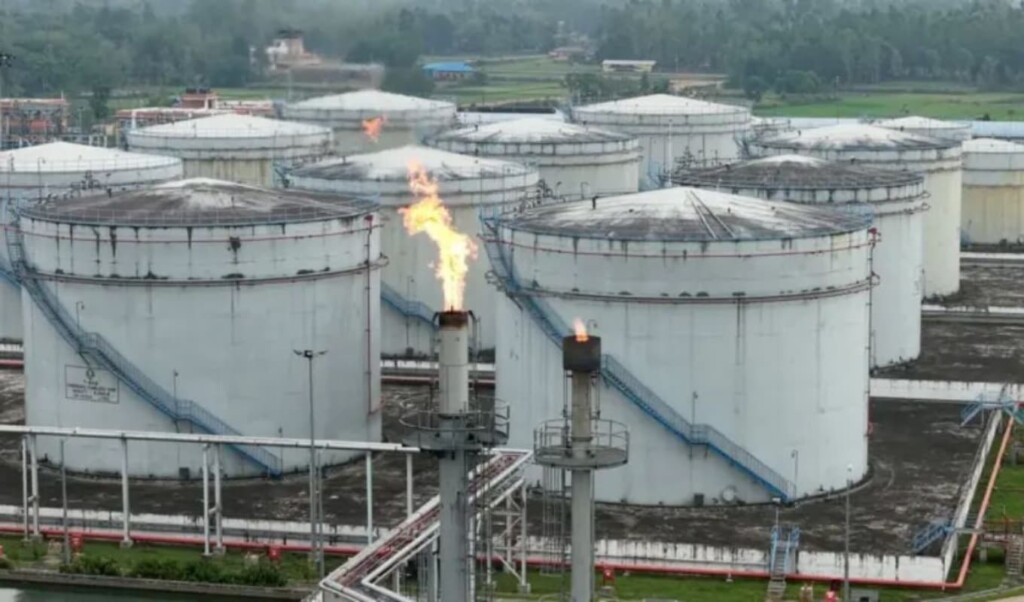
A fresh complexity has emerged in the country’s fuel supply and distribution system, as petrol and octane are reportedly accumulating in storage tanks operated by domestic companies while the state-run Bangladesh Petroleum Corporation (Bangladesh Petroleum Corporation) is not accepting deliveries. The situation has coincided with long queues at filling stations and fuel stockpiling at production facilities.
According to relevant sources, around 75 per cent of the country’s petrol and octane demand is met by five local companies, including four private operators and one state-owned entity. Monthly national demand is estimated at approximately 75,000 tonnes, of which the largest share—around 40 to 45 per cent—is supplied by Super Petrochemical PLC, the country’s principal private supplier.
However, allegations have emerged that the Bangladesh Petroleum Corporation (Bangladesh Petroleum Corporation) issued a letter on 8 April declining to receive fuel from Super Petrochemical PLC. As a result, the company’s storage tanks are reported to be nearing capacity, raising concerns over the continuity of its production operations.
A source within the ministry stated that the Prime Minister, Tarique Rahman, held multiple meetings regarding reports of extended queues of one to two kilometres at petrol stations. He has reportedly instructed authorities to manage the situation and investigate possible irregularities within the fuel sector.
At present, octane storage capacity in the country stands at 53,000 tonnes, while existing stocks are reported to be approximately 55,000 tonnes, indicating a surplus beyond available storage capacity. Compounding the pressure, a vessel carrying 37,000 tonnes of octane arrived on 10 April, further straining the system.
In a letter dated 16 April addressed to the chairman of the Bangladesh Petroleum Corporation, the Chief Executive Officer of Super Petrochemical PLC, Pranab Kumar Saha, expressed concern over the situation. He stated that during a meeting on 5 April, the company was instructed to prepare for the supply of 37,000 tonnes of petrol and octane and 5,000 tonnes of diesel in April. Preparations were made accordingly; however, from 8 April, distribution companies reportedly stopped lifting fuel. He also noted that a previous shipment in February was not collected as promised, forcing a suspension of production in March. Another crude material shipment is scheduled for arrival on 20 April, but continued production may be affected if storage facilities remain full.
Officials from Meghna Petroleum (Meghna Petroleum) stated that there is currently no additional storage capacity for octane, resulting in limited and controlled procurement from private suppliers. Distribution is currently handled by Padma Oil Company (Padma Oil Company), Meghna Petroleum, and Jamuna Oil Company (Jamuna Oil Company).
At present, the three state distribution companies are collectively supplying an average of 12,777 tonnes of diesel, 1,496 tonnes of petrol, and 1,193 tonnes of octane daily. Following the outbreak of conflict in the Middle East on 28 February, fuel rationing was introduced from 8 March. Although rationing was later withdrawn ahead of the Eid period, restrictions on supply levels have remained in place.
Officials believe that constrained supply has contributed to public anxiety and increased hoarding behaviour, leading to extended queues at fuel stations. However, questions have been raised regarding the refusal to accept domestically produced fuel despite existing demand and production capacity.
Key Fuel Indicators
| Indicator | Figure |
|---|---|
| Monthly petrol & octane demand | 75,000 tonnes |
| Supply share from private firms | 40–45% |
| Octane storage capacity | 53,000 tonnes |
| Current octane stock | 55,000 tonnes |
| Incoming octane shipment (10 April) | 37,000 tonnes |
| Daily combined supply (3 distributors) | 15,466 tonnes (approx.) |